
Image: BBC Science
Are the stunning Moon images from NASA's Artemis II mission just beautiful photos? Explore the artistic and scientific value of this historic space journey.
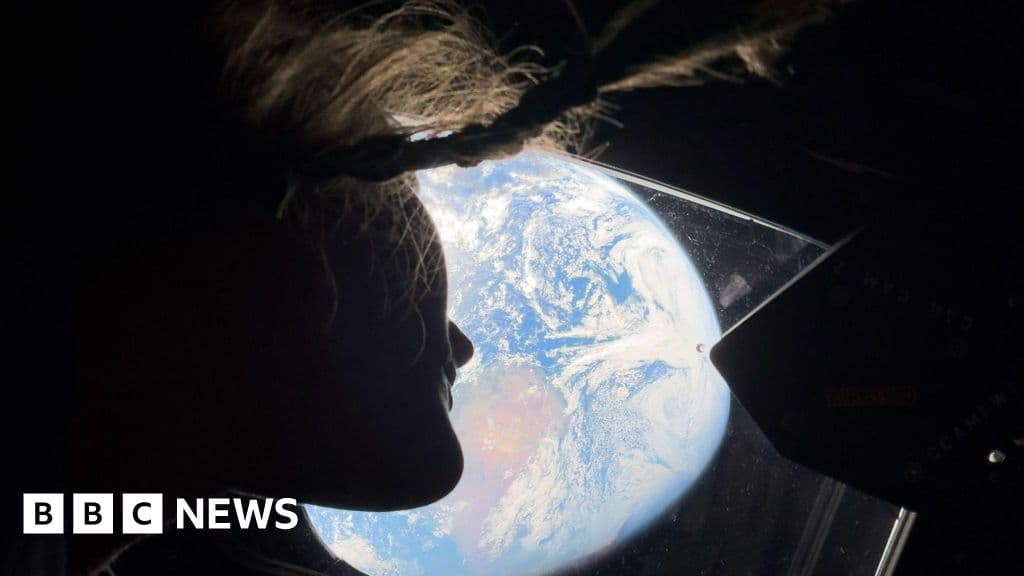
GlipzoNASA is captivating audiences worldwide with breathtaking images captured during the Artemis II mission, showcasing the Moon and Earth from unprecedented perspectives. This historic mission, which includes four astronauts venturing further from Earth than any human has since 1972, has been met with an outpouring of excitement on social media, as millions of users share and engage with these stunning visuals. While the images are undeniably striking, the question arises: do they offer significant scientific insights, or are they merely souvenirs from a space vacation?
The Artemis II mission is a crucial step in NASA's ambitious plan to return humans to the Moon and eventually send them to Mars. To maintain public interest and support, NASA is live-streaming the mission's 10-day journey, with regular video updates from the astronauts. Their enthusiasm is palpable; in fact, the crew members were so engrossed in observing the view that they neglected to clean the spacecraft's windows, prompting NASA to send them instructions on how to do so.
This mission marks a significant milestone as it is the first time digital cameras have been utilized at such great distances in space. The Orion spacecraft is equipped with an impressive array of 32 cameras and imaging devices, 15 of which are mounted on the spacecraft itself, while 17 are handheld by the astronauts. The team is utilizing a combination of Nikon D5 cameras, GoPros, and even smartphones to capture their surroundings. NASA has made these images publicly accessible through its Flickr photostream, detailing the equipment used for each photo.
Among the first images released was a stunning shot titled "Hello, World," taken by Commander Reid Wiseman when the crew was approximately 142,000 miles from Earth and 132,000 miles from the Moon. The photograph features two auroras as Earth eclipses the Sun, with the planet Venus glowing below. While visually appealing, this image does not provide new scientific data, as NASA's Deep Space Climate Observatory has been capturing similar views for years.
On Saturday, NASA unveiled another captivating photo showcasing the Orientale basin, a colossal crater located on the Moon's far side. This image is significant as it marks the first occasion that the entire basin has been viewed by human eyes. Previous lunar missions, including those of the Apollo program, did not have the capability to capture this area fully due to their orbits and lighting conditions.
NASA emphasizes that the human eye is adept at noticing subtle changes in color, texture, and surface characteristics, potentially leading to new discoveries and a deeper understanding of the Moon's features. The agency's commitment to human exploration is clear, as they underscore the value of human observation over robotic exploration.
To gain insight into the scientific merit of these images, I spoke with Chris Lintott, a Professor of Astrophysics at the University of Oxford and co-host of the BBC's The Sky at Night. Lintott expressed skepticism, stating, "The value of the images coming back from Artemis and its crew is artistic, not scientific." He pointed out that since the Apollo missions, robotic explorers have thoroughly mapped the Moon's surface, including its far side.
Recent missions, such as India's Chandrayaan-3, which captured detailed images of the Moon's terrain in 2023, and China's Chang'e-6, which collected the first-ever samples from the far side, have added to the existing body of knowledge. Lintott added, "Unless something very unusual happens, there will be nothing for the Artemis astronauts to discover."
While the artistic value of the images cannot be denied, the scientific output may not be as groundbreaking as some might hope. The images serve to inspire a new generation of explorers and scientists, reigniting public interest in lunar exploration. However, experts in the field suggest that the data gathered by robotic missions may still hold the key to understanding the Moon's mysteries.
The potential for unexpected discoveries during this mission remains, particularly if the crew is fortunate enough to witness a meteor impact on the Moon's surface. However, such events are rare and would require a significant occurrence to be observed.
As the Artemis II mission progresses, all eyes will be on the upcoming lunar flyby scheduled for Monday, during which the crew will come within 4,066 miles of the Moon's surface. This moment will not only provide another opportunity for breathtaking imagery but also a chance for NASA to showcase the capabilities of human exploration in a new era of space travel.
While the artistic appeal of the captured images is evident, the mission serves a dual purpose: to inspire public interest and to pave the way for future scientific endeavors. As NASA continues to push the boundaries of space exploration, the blend of human creativity and technological advancement may unlock new pathways to understanding our solar system.
In conclusion, the images from Artemis II, while visually stunning, raise important questions about the role of human exploration versus robotic missions. As we look toward the future, it will be fascinating to see how these images influence public perception and inspire the next generation of scientists and explorers.

Discover how the brain protein Menin could be the key to halting cognitive decline with new research that uncovers its vital role in aging.
Indian Express
A new 'killer fungus' discovered in the UK targets invasive heath-star moss, offering hope for restoring native habitats. Will it turn the tide against invasives?
BBC Science
A Blue Origin rocket exploded during a test in Florida, prompting investigations. All personnel are safe. What does this mean for the future of space travel?
BBC Business