Glipzo
WorldTechnologyBusinessSportsEntertainmentScienceHealthPolitics
Glipzo
WorldTechnologyBusinessSportsEntertainmentScienceHealthPolitics
  1. Home
  2. /
  3. Science
  4. /
  5. Shocking Study Reveals Closing Eyes Hurts Hearing Ability
Shocking Study Reveals Closing Eyes Hurts Hearing Ability

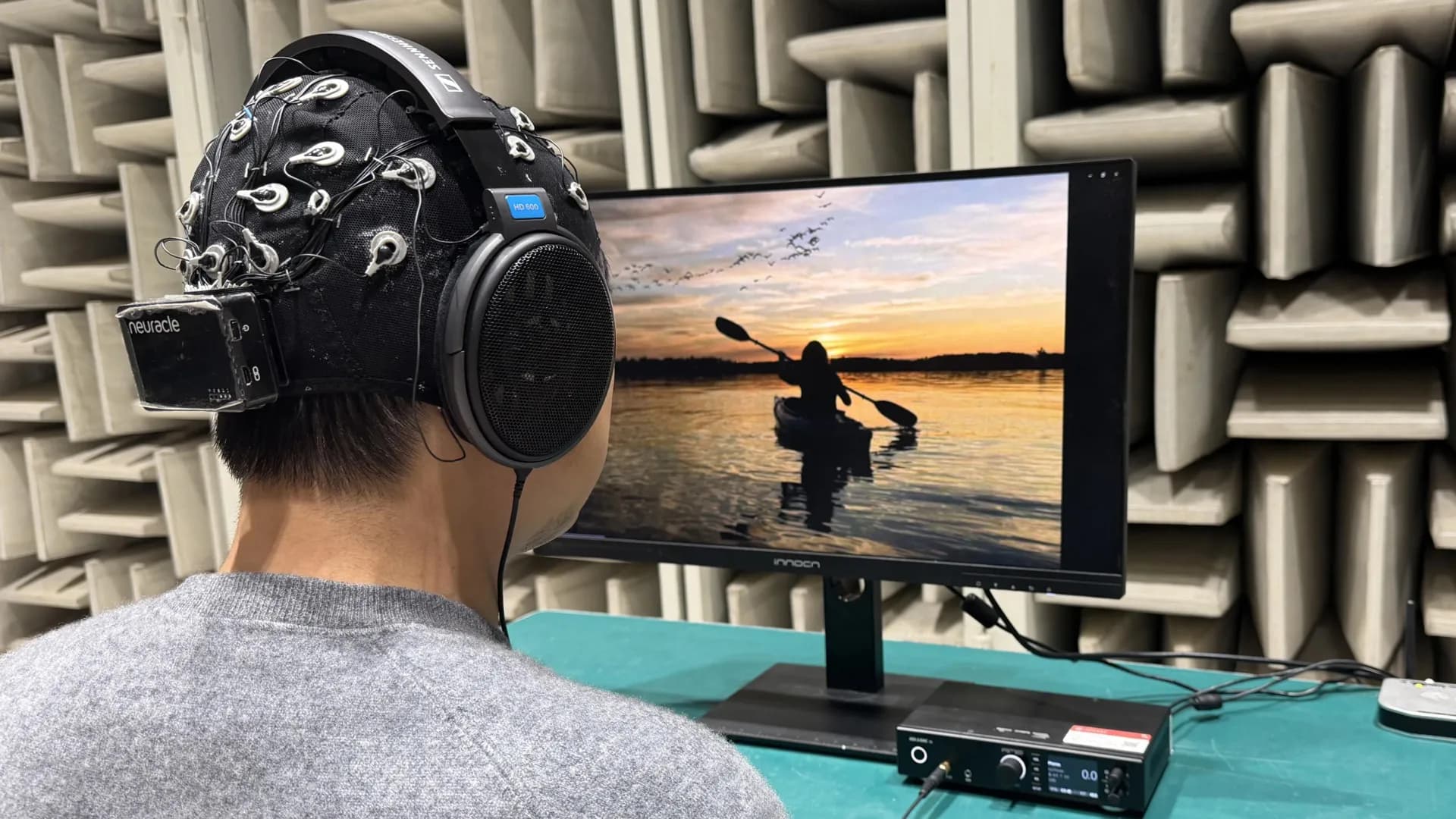
Image: Science Daily

Science
Friday, March 20, 20264 min read

Shocking Study Reveals Closing Eyes Hurts Hearing Ability

A shocking study reveals that closing your eyes may reduce hearing ability in noisy environments. Discover why keeping your eyes open is more effective.

Glipzo News Desk|Source: Science Daily
Share
Glipzo

Key Highlights

  • Closing eyes impairs sound detection, study reveals.
  • Visual input boosts hearing sensitivity significantly.
  • Neural criticality increases noise filtering when eyes are shut.
  • Future research will explore incongruent audio-visual pairings.

In this article

  • The Surprising Truth About Closing Your Eyes and Hearing Many individuals instinctively close their eyes when trying to focus on sounds, believing that it enhances auditory perception by removing visual distractions. However, recent research challenges this common assumption, suggesting that shutting one’s eyes may not always lead to better hearing, especially in noisy environments. A **study published in the Journal of the Acoustical Society of America** (JASA) by researchers from **Shanghai Jiao Tong University** has brought new insights into how visual input can affect our auditory capabilities.
  • Study Overview: Testing Hearing in Noisy Environments The researchers aimed to determine whether closing one’s eyes indeed improves hearing under challenging conditions filled with background noise. Participants were tasked with listening to various sounds through headphones while simultaneously exposed to distracting ambient noise. The goal was to adjust the volume until the sounds were barely audible against the noise.
  • Results: A Counterintuitive Finding Contrary to what many believe, the findings revealed that closing one’s eyes **actually impairs sound detection**. According to study author **Yu Huang**, “We found that, contrary to popular belief, closing one's eyes actually impairs the ability to detect these sounds.” On the other hand, participants who watched a corresponding dynamic video experienced **significantly improved hearing sensitivity**.
  • The Science Behind It: Brain Activity and Filtering To delve deeper into the mechanics of this phenomenon, researchers utilized **electroencephalography (EEG)** to monitor brain activity during the tests. They discovered that closing the eyes shifts the brain into a state known as **neural criticality**. This state increases the brain's tendency to filter incoming information more aggressively, which can lead to the suppression of target sounds that participants were attempting to detect.
  • When Closing Your Eyes May Still Be Beneficial It’s important to note that the detrimental effects of closing one’s eyes appear to be specific to noisy environments. In quieter settings, closing the eyes might still aid in detecting subtle sounds. However, since many everyday situations are characterized by significant background noise, it may be more beneficial to keep your eyes open in these contexts.
  • Future Directions: Exploring Vision and Hearing Interaction The research team is committed to further exploring the complex interplay between sight and sound. One intriguing area of future inquiry involves incongruent pairings of audio and visual stimuli. Huang posed a compelling question: “What happens if you hear a drum but see a bird?”
  • Why This Matters This study not only sheds light on the relationship between vision and hearing but also has practical implications for everyday situations. For individuals working in noisy environments or engaged in activities that require keen auditory attention, this research suggests keeping the eyes open and utilizing relevant visual cues could enhance auditory perception significantly.
  • What to Watch For As research continues in this field, we can anticipate further revelations regarding how our senses interact. Future studies may address how different types of visual stimuli influence our ability to process sound effectively. This knowledge could have broader applications in fields such as **audiology, education, and even technology design**, where enhancing sensory integration could improve communication and learning.

The Surprising Truth About Closing Your Eyes and Hearing Many individuals instinctively close their eyes when trying to focus on sounds, believing that it enhances auditory perception by removing visual distractions. However, recent research challenges this common assumption, suggesting that shutting one’s eyes may not always lead to better hearing, especially in noisy environments. A **study published in the Journal of the Acoustical Society of America** (JASA) by researchers from **Shanghai Jiao Tong University** has brought new insights into how visual input can affect our auditory capabilities.

Study Overview: Testing Hearing in Noisy Environments The researchers aimed to determine whether closing one’s eyes indeed improves hearing under challenging conditions filled with background noise. Participants were tasked with listening to various sounds through headphones while simultaneously exposed to distracting ambient noise. The goal was to adjust the volume until the sounds were barely audible against the noise.

The study employed different visual scenarios to evaluate their impact: - Eyes Closed: Participants attempted to detect sounds with their eyes shut. - Eyes Open with Blank Screen: They then repeated the task while looking at a blank screen. - Still Image: Next, participants viewed a still image relevant to the sound. - Dynamic Video: Finally, they watched a video that matched the sound being played.

Results: A Counterintuitive Finding Contrary to what many believe, the findings revealed that closing one’s eyes **actually impairs sound detection**. According to study author **Yu Huang**, “We found that, contrary to popular belief, closing one's eyes actually impairs the ability to detect these sounds.” On the other hand, participants who watched a corresponding dynamic video experienced **significantly improved hearing sensitivity**.

These results highlight an important distinction: while many believe that closing their eyes helps them focus, it may actually hinder their ability to identify faint sounds in noisy settings. The presence of relevant visual stimuli seems to enhance auditory processing, providing a clearer advantage in sound detection.

The Science Behind It: Brain Activity and Filtering To delve deeper into the mechanics of this phenomenon, researchers utilized **electroencephalography (EEG)** to monitor brain activity during the tests. They discovered that closing the eyes shifts the brain into a state known as **neural criticality**. This state increases the brain's tendency to filter incoming information more aggressively, which can lead to the suppression of target sounds that participants were attempting to detect.

Huang elaborated, “In a noisy soundscape, the brain needs to actively separate the signal from the background. We found that the internal focus promoted by eye closure actually works against you in this context, leading to over-filtering, whereas visual engagement helps anchor the auditory system to the external world.”

When Closing Your Eyes May Still Be Beneficial It’s important to note that the detrimental effects of closing one’s eyes appear to be specific to noisy environments. In quieter settings, closing the eyes might still aid in detecting subtle sounds. However, since many everyday situations are characterized by significant background noise, it may be more beneficial to keep your eyes open in these contexts.

Future Directions: Exploring Vision and Hearing Interaction The research team is committed to further exploring the complex interplay between sight and sound. One intriguing area of future inquiry involves incongruent pairings of audio and visual stimuli. Huang posed a compelling question: “What happens if you hear a drum but see a bird?”

Understanding whether the benefits of visual input stem from simply having one’s eyes open or from the necessity of matching audio and visual information is crucial. This research could ultimately help clarify the distinctions between general attention effects and the specific advantages of multisensory integration.

Why This Matters This study not only sheds light on the relationship between vision and hearing but also has practical implications for everyday situations. For individuals working in noisy environments or engaged in activities that require keen auditory attention, this research suggests keeping the eyes open and utilizing relevant visual cues could enhance auditory perception significantly.

What to Watch For As research continues in this field, we can anticipate further revelations regarding how our senses interact. Future studies may address how different types of visual stimuli influence our ability to process sound effectively. This knowledge could have broader applications in fields such as **audiology, education, and even technology design**, where enhancing sensory integration could improve communication and learning.

In conclusion, the traditional belief that closing one’s eyes enhances hearing is being reevaluated. As we learn more about the intricate connections between our senses, we can better equip ourselves to navigate the often noisy world around us, whether in our daily lives or professional environments.

Did you find this article useful? Share it!

Share

Related Articles

Exclusive Footage: Historic Hatch Opening of Artemis II Orion
Science
Apr 15, 2026

Exclusive Footage: Historic Hatch Opening of Artemis II Orion

Catch the historic moment as the hatch of Artemis II's Orion capsule opens, reuniting astronauts with a cheering recovery crew after their groundbreaking mission.

BBC Science
Critical Consultation for Golden Eagle Reintroduction in England
Science
Apr 14, 2026

Critical Consultation for Golden Eagle Reintroduction in England

Discover the critical consultation for the golden eagle reintroduction in northern England, aiming to restore this majestic species by 2027.

BBC Science
Transforming Coastal Ecosystems with Floating Wetlands
Science
Apr 14, 2026

Transforming Coastal Ecosystems with Floating Wetlands

Discover how floating wetlands aim to restore vital coastal ecosystems in the UK, offering a sustainable solution to environmental degradation.

BBC Science

Categories

  • World
  • Technology
  • Business
  • Sports

More

  • Entertainment
  • Science
  • Health
  • Politics

Explore

  • Web Stories
  • About Us
  • Contact

Legal

  • Privacy Policy
  • Terms of Service

© 2026 Glipzo. All rights reserved.