
Image: Science Daily
Explore the astonishing discovery of L 98-59 d, a sulfur-rich exoplanet defying classification, revealing secrets of our universe.
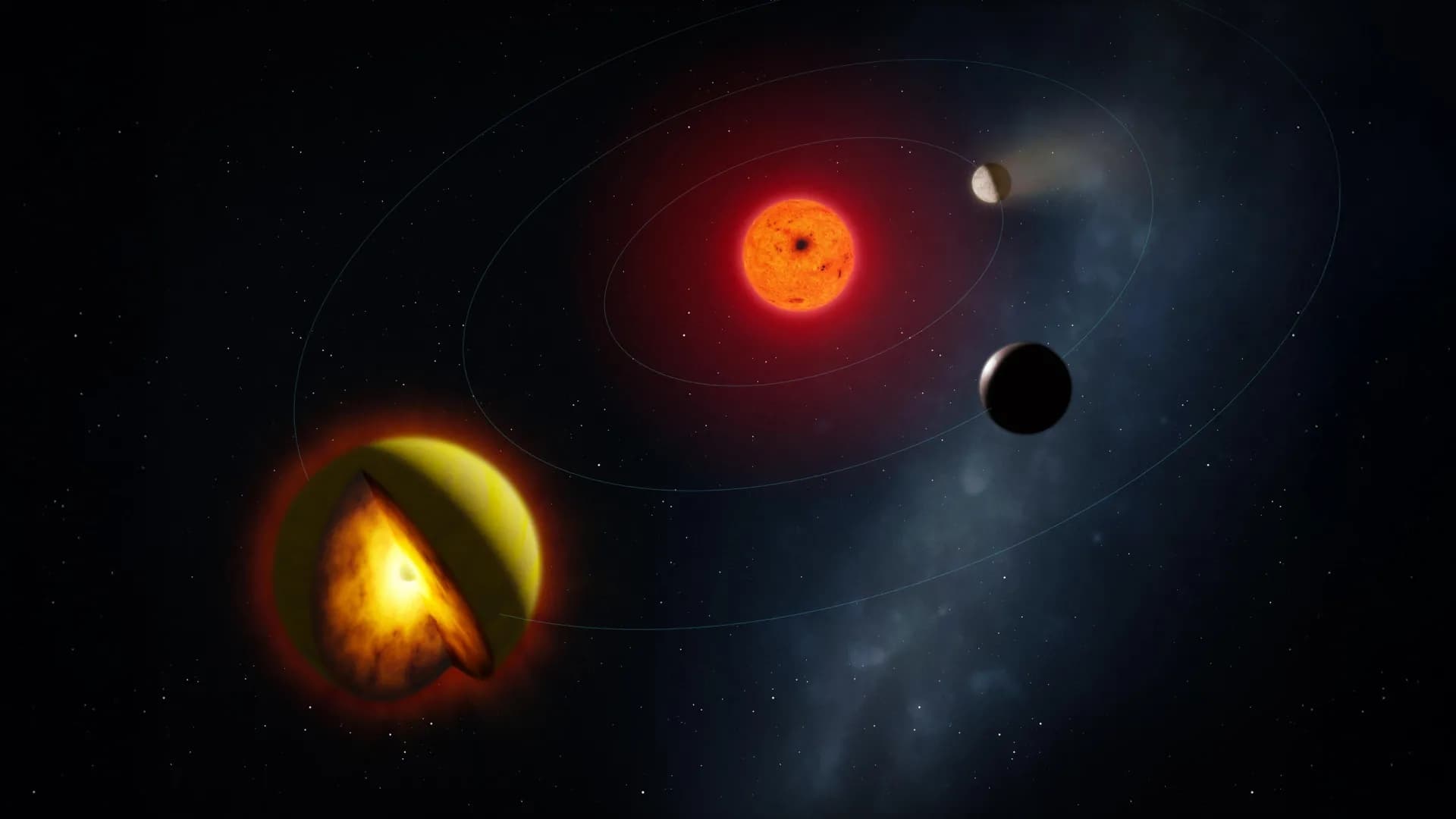
GlipzoL 98-59 d is approximately 1.6 times the size of Earth, yet it has been found to have a surprisingly low density and an atmosphere rich in hydrogen sulfide. This discovery challenges existing classifications of planets, as scientists previously categorized worlds into two primary types: rocky planets with a hydrogen atmosphere or water-rich planets covered in deep oceans and ice.
The research team, which includes experts from the University of Groningen, the University of Leeds, and ETH Zurich, utilized advanced computer simulations to trace the evolution of L 98-59 d from its formation nearly five billion years ago to its current state. By integrating telescope observations with intricate models of planetary interiors and atmospheres, the researchers were able to construct a clearer picture of the planet's formation and ongoing processes.
As a result, the magma ocean not only contributes to the planet’s structure but also supports a thick atmosphere rich in hydrogen. This atmosphere contains sulfur-bearing gases such as hydrogen sulfide (H2S). Ordinarily, radiation from the host star would erode these gases into space through X-ray-driven processes; however, the unique conditions of L 98-59 d allow it to retain its atmospheric components.
Dr. Harrison Nicholls, the lead author of the study, stated: "This discovery suggests that the categories astronomers currently use to describe small planets may be too simplistic. While this molten planet is unlikely to support life, it reflects the extensive diversity of worlds that lie beyond our Solar System. We may then ask: what other types of planets are waiting to be uncovered?"
Simultaneously, the magma ocean serves as a significant reservoir for volatile materials, absorbing and releasing gases over billions of years. This dual mechanism of deep interior storage coupled with ultraviolet-driven chemistry accounts for the distinctive atmospheric properties observed on L 98-59 d.
Scientists emphasize that magma oceans are believed to play a critical role in the development of planetary atmospheres and surface conditions. As research continues, L 98-59 d may provide valuable insights into the processes that govern planetary evolution across the cosmos.
As astronomers look to the future, the discovery of L 98-59 d raises intriguing questions about the variety of planets that populate our universe. The exploration of such unique worlds not only enriches our understanding of planetary systems but also expands the scope of future astronomical studies. What other extraordinary planets might await discovery, and how will they reshape our understanding of the cosmos? The journey of exploration continues, and the universe has much more to reveal.

Discover how the brain protein Menin could be the key to halting cognitive decline with new research that uncovers its vital role in aging.
Indian Express
A new 'killer fungus' discovered in the UK targets invasive heath-star moss, offering hope for restoring native habitats. Will it turn the tide against invasives?
BBC Science
A Blue Origin rocket exploded during a test in Florida, prompting investigations. All personnel are safe. What does this mean for the future of space travel?
BBC Business