
Image: Science Daily
NASA's Hubble captures comet K1 breaking apart, revealing cosmic surprises. Discover the implications for our understanding of the solar system.
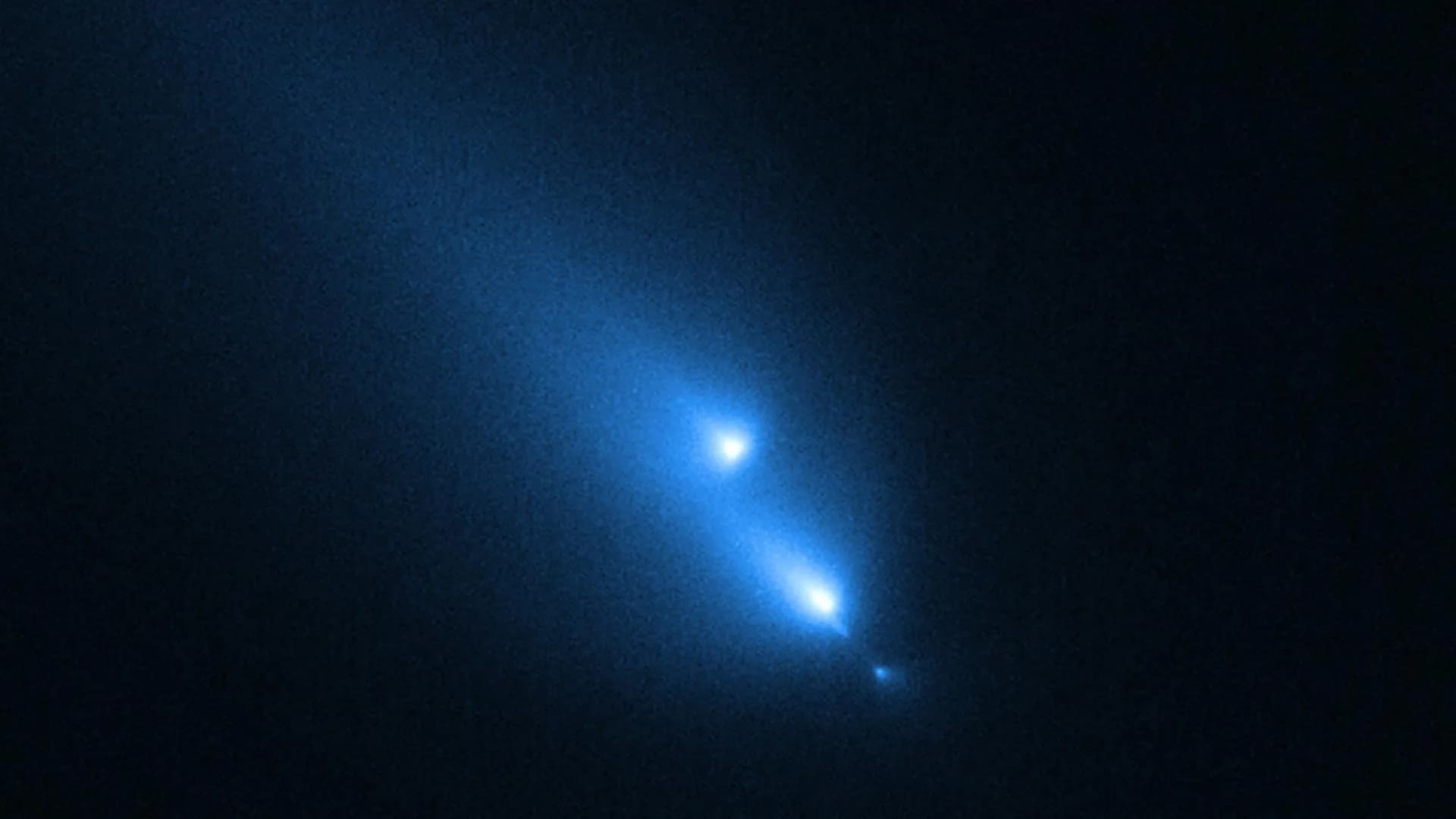
GlipzoIn a stunning turn of events, NASA's Hubble Space Telescope has captured a rare moment in space history by observing comet C/2025 K1 (ATLAS) as it began to disintegrate. This unexpected finding, announced in the scientific journal Icarus, highlights the serendipitous nature of astronomical research and the unique capabilities of Hubble.
On November 8, 2025, Hubble was not initially aimed at comet K1, but rather had to pivot due to unforeseen technical constraints affecting their original target. John Noonan, a research professor at Auburn University, explains the sheer improbability of the incident, stating, "Sometimes the best science happens by accident. We had to find a new target — and right when we observed it, it happened to break apart, which is the slimmest of slim chances."
Noonan's initial review of the data revealed a breathtaking surprise: four separate fragments of the comet, each encased in its own coma of gas and dust. This remarkable discovery underscores the excitement of scientific exploration, where unexpected findings can yield significant insights.
Comets like K1 are remnants from the solar system's formative years, composed of ancient materials that predate the planets. Dennis Bodewits, the principal investigator from Auburn University, emphasized the importance of studying these celestial bodies, noting, "Comets are leftovers of the era of solar system formation, so they're made of 'old stuff' -- the primordial materials that made our solar system."
However, the evolution of these comets raises questions about their composition. Bodewits stated, "When looking at a comet's composition, the question we always have is, 'Is this a primitive property or is this due to evolution?'" Observing K1's breakup provides a unique opportunity to analyze its unaltered materials.
Hubble's observations revealed that comet K1 was in the process of splitting into at least four distinct pieces. While ground-based telescopes could only see these fragments as faint points of light, Hubble's advanced imaging capabilities allowed scientists to discern the individual components clearly.
The breakup occurred approximately one month after K1's perihelion—the point in its orbit when it came closest to the Sun, about one-third of the distance between Earth and the Sun. This phase subjects comets to extreme heat and stress, which can lead to disintegration. K1 was thought to be slightly larger than average, measuring around 5 miles across prior to its breakup.
The research team estimates that the disintegration began roughly eight days before Hubble began capturing images from November 8 to November 10, 2025. These images displayed a smaller fragment splitting further. Hubble's high-resolution capabilities allowed scientists to trace these fragments back to their original state, providing insights into the sequence of events leading to the breakup.
However, an intriguing mystery emerged—why was there a delay in the brightness of the comet following its fragmentation? The team suggests that a comet’s brightness is primarily due to sunlight reflecting off dust particles. When K1 broke apart, it exposed fresh ice rather than dust, which could account for the initial dimness.
The researchers have proposed several theories to explain the observed delay in brightness. Some possibilities include: - Dust Layers: A dry dust layer may have initially shrouded the newly exposed icy surfaces. - Reflectivity Changes: The new ice might not reflect light as effectively until it was processed by solar radiation. - Outgassing Events: Delayed outgassing could lead to a temporary dimness as fresh material was released into space.
These hypotheses highlight the complexities of comet behavior and the challenges faced in understanding these ancient celestial objects. As researchers analyze the data further, they hope to unravel the mysteries surrounding comet K1 and gain insights into the behavior of other comets.
The accidental observation of comet K1's breakup by Hubble opens new avenues for understanding the origins of our solar system. Comets are not mere celestial bodies; they hold the keys to unraveling the mysteries of planetary formation and evolution. Each fragment and its composition can tell us more about the conditions that existed during the early solar system, providing a glimpse into our cosmic past.
The implications of this discovery extend beyond K1. As Hubble continues its mission, scientists will likely seek to observe more comets, hoping to capture similar events. The challenge remains to time these observations accurately, given the unpredictable nature of comet behavior.
As we look to the future, the scientific community is eager to delve deeper into the findings from Hubble's observations, potentially leading to breakthroughs in our understanding of these fascinating celestial objects. With advanced technology and ongoing research, who knows what other surprises the cosmos has in store?
The capture of comet K1 breaking apart is a testament to the wonders of exploration and the importance of remaining open to the unexpected in scientific inquiry.
The accidental observation of comet K1 by Hubble serves as a reminder of the unpredictable nature of space exploration. As scientists continue to analyze the data, the surprising findings may reshape our understanding of comets and, by extension, the history of our solar system.

Discover how the brain protein Menin could be the key to halting cognitive decline with new research that uncovers its vital role in aging.
Indian Express
A new 'killer fungus' discovered in the UK targets invasive heath-star moss, offering hope for restoring native habitats. Will it turn the tide against invasives?
BBC Science
A Blue Origin rocket exploded during a test in Florida, prompting investigations. All personnel are safe. What does this mean for the future of space travel?
BBC Business