
Image: Science Daily
Scientists uncover a colossal granite mass beneath Antarctica, reshaping our understanding of glaciers and climate change. Discover the implications now.
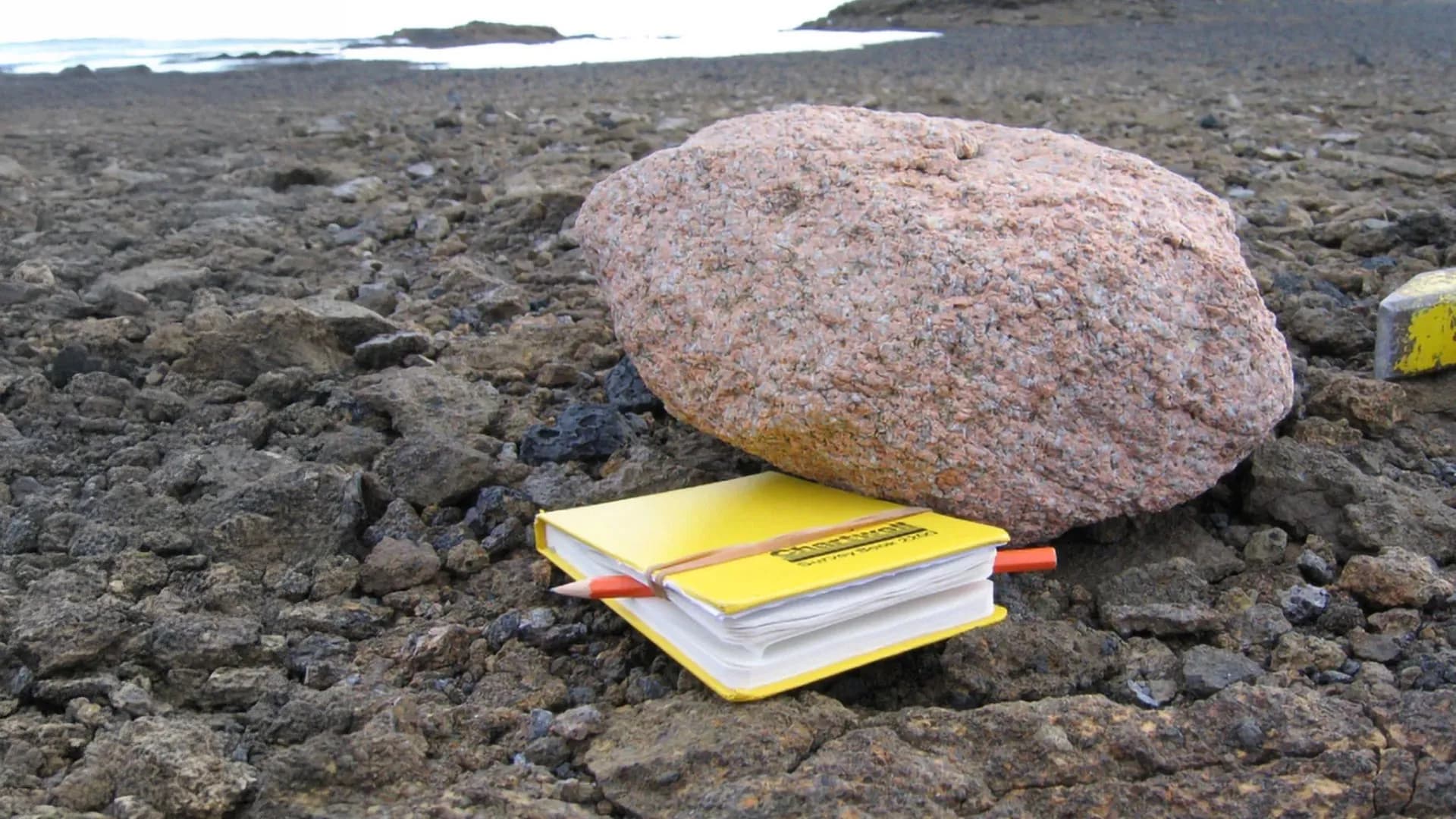
GlipzoA recent discovery in the Hudson Mountains of West Antarctica has taken the scientific community by storm. Researchers have identified a massive buried granite formation beneath the Pine Island Glacier, measuring approximately 100 km wide and 7 km thick—an immense structure nearly half the size of Wales. This revelation stems from the analysis of striking pink granite boulders scattered across the rugged volcanic landscape, which have puzzled scientists for decades.
The bright pink rocks, perched on mountain ridges, raised critical questions about their origins and the geological history of Antarctica. Their unusual placement suggested a complex geological past, prompting scientists to investigate the connection between these surface boulders and the hidden granite mass below.
Led by the British Antarctic Survey (BAS), a team of researchers employed advanced techniques to date the granite. By examining the radioactive decay of elements within tiny mineral crystals, they determined that these rocks formed roughly 175 million years ago, dating back to the Jurassic period.
Despite establishing the age of these boulders, the team required further data to understand their journey to the mountain tops. This led to a series of airborne surveys conducted over the region, which would ultimately reveal the extent of the hidden granite mass.
Utilizing state-of-the-art gravity measurements collected by BAS' Twin Otter aircraft, researchers detected an unusual signal beneath the ice, indicating the presence of a large granite body. This data aligned perfectly with the expected characteristics of such a hidden formation, solving a long-standing mystery about the origin of the pink granite boulders.
The connection between the surface boulders and the deep geological structure provided new insights into the historical behavior of the Pine Island Glacier. It revealed that during previous ice ages, the glacier's movement was significantly different, pulling rocks from its base and transporting them uphill when the ice sheet was substantially thicker.
This groundbreaking discovery has far-reaching implications for understanding the dynamics of the glacier during the last ice age, approximately 20,000 years ago. By analyzing past ice thickness and movement patterns, scientists hope to enhance computer models that predict how Antarctica's ice sheets may respond to ongoing climate change.
Dr. Tom Jordan, the lead author and a geophysicist at BAS, expressed his excitement over the findings: "It's remarkable that pink granite boulders spotted on the surface have led us to a hidden giant beneath the ice. By combining geological dating with gravity surveys, we’ve not only solved a mystery about where these rocks came from but also uncovered new information about how the ice sheet flowed in the past and how it might change in the future."
The research also emphasizes the importance of subglacial geology in present-day conditions. The region surrounding Pine Island Glacier has experienced some of the most rapid ice loss in Antarctica in recent years. The type of rock situated beneath the glacier plays a crucial role in determining how easily the ice moves and how meltwater is transported beneath it.
By deepening our understanding of these geological processes, scientists can refine models estimating future sea level rise, a critical factor for coastal populations worldwide.
Dr. Joanne Johnson, a co-author and geologist at BAS, played an essential role in collecting the boulders during fieldwork in the Hudson Mountains. She noted the significance of these rocks as historical records: "Rocks provide an amazing record of how our planet has changed over time, especially how ice has eroded and altered the landscape of Antarctica. Boulders like these are a treasure-trove of information about what lies deep beneath the ice sheet, far out of reach."
The research team’s efforts to identify the source of these granite boulders have unveiled vital clues about the potential changes in the West Antarctic Ice Sheet, which can significantly impact global sea levels.
This research exemplifies how the fusion of geology and geophysics can unveil hidden features beneath the icy expanse of Antarctica, enhancing our comprehension of the forces that shape our planet. As climate change continues to pose a significant threat to polar regions, ongoing studies will be critical in predicting future scenarios.
Continued exploration and monitoring of the Pine Island Glacier and the surrounding regions will provide invaluable insights into how these ice masses may evolve in response to a warming planet. Scientists will be watching closely for changes in ice dynamics and their implications for global sea levels.
By piecing together the history of Antarctica’s geological past, researchers aim to provide essential data needed to prepare for the future impacts of climate change on coastal communities around the globe.

Discover how the brain protein Menin could be the key to halting cognitive decline with new research that uncovers its vital role in aging.
Indian Express
A new 'killer fungus' discovered in the UK targets invasive heath-star moss, offering hope for restoring native habitats. Will it turn the tide against invasives?
BBC Science
A Blue Origin rocket exploded during a test in Florida, prompting investigations. All personnel are safe. What does this mean for the future of space travel?
BBC Business