
Image: Science Daily
Discover the groundbreaking finding of a hidden 48-dimensional world in quantum light, revolutionizing quantum information and technology. Explore how this discovery matters.
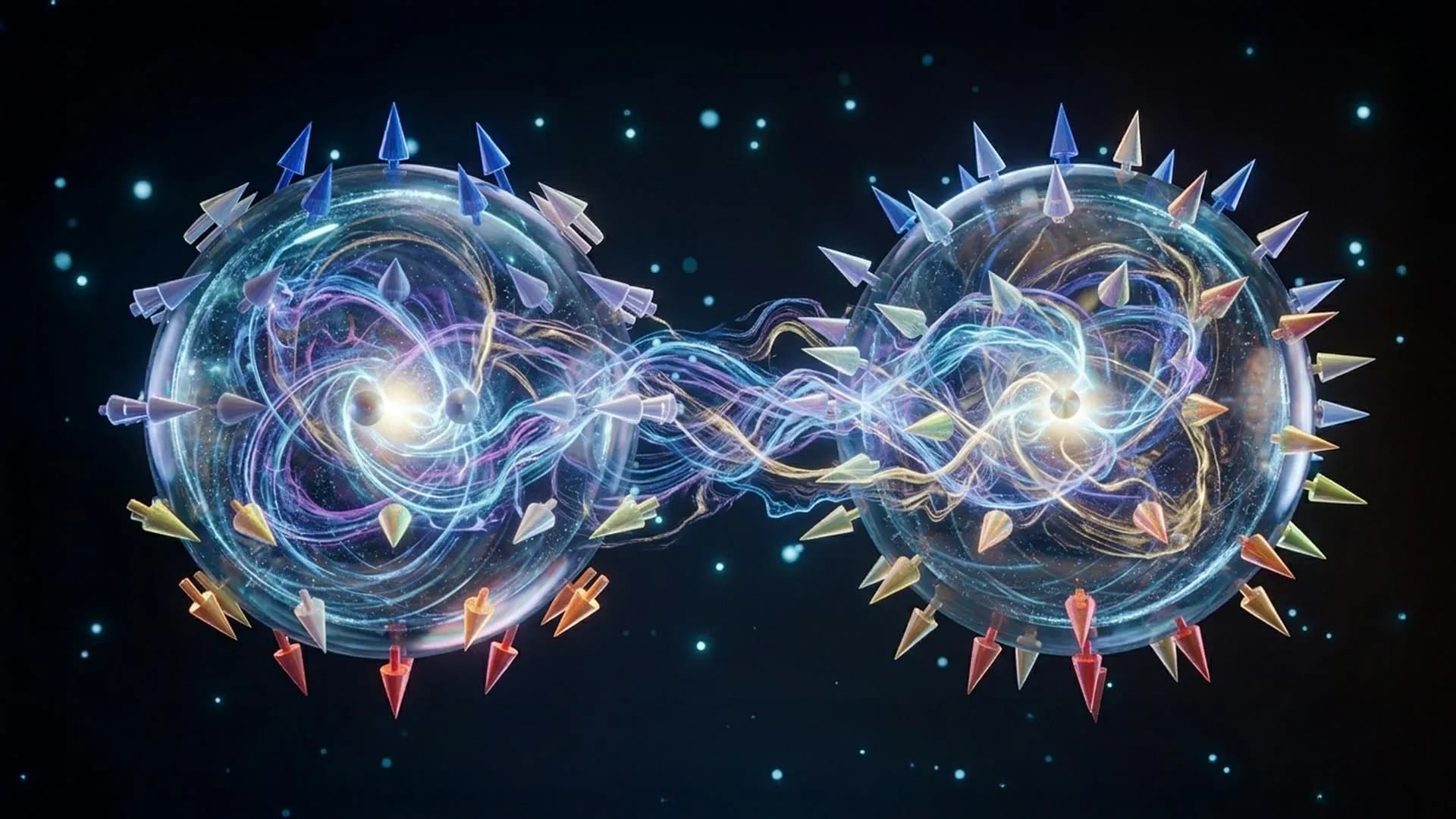
GlipzoA groundbreaking revelation in quantum optics has emerged from the University of the Witwatersrand in South Africa, in collaboration with Huzhou University. Researchers have uncovered a stunning feature in a common technique for producing entangled photons, revealing that this method can house previously unknown topological structures. Their findings, which were published in Nature Communications, indicate that these topological configurations can reach an astonishing 48 dimensions, along with over 17,000 unique topological signatures. This discovery essentially provides a vast new "alphabet" for encoding stable quantum information, enhancing our understanding of quantum systems.
In many quantum optics laboratories, entangled photons are typically generated through a process known as spontaneous parametric downconversion (SPDC). This technique naturally creates entanglement in the spatial characteristics of light. The research team’s findings indicate that within these spatial structures lies a hidden realm of high-dimensional topologies. This complex arrangement could lead to innovative methods for storing and safeguarding information, making quantum systems more resilient against noise and potential errors.
The ability to harness these topological structures could revolutionize how we approach quantum data storage and transmission, making it vital for future advancements in quantum computing and communication technologies.
The research team employed the orbital angular momentum (OAM) of light, a property that allows for a range of dimensional variations, from simple two-dimensional cases to extensive high-dimensional scenarios. This flexibility enables the formation of much richer topological structures than previously acknowledged in standard optics.
Professor Andrew Forbes, from the Wits School of Physics, emphasizes the significance of their findings: > "We report a major advance in this work: we only need one property of light (OAM) to make a topology, whereas previously it was assumed that at least two properties would be needed -- usually OAM and polarization. The consequence is that since OAM is high-dimensional, so too is the topology, and this let us report the highest topologies ever observed."
One of the most remarkable aspects of this discovery is its accessibility. The necessary resources to explore these high-dimensional topologies are readily available in most quantum optics laboratories. Researchers are not required to use specialized equipment or engage a quantum engineer to leverage these findings.
Pedro Ornelas, a member of the research team, stated: > "You get the topology for free, from the entanglement in space. It was always there, it just had to be found."
This accessibility could inspire a wave of new experiments and studies in quantum optics, as researchers can now explore these dimensions without significant investment in new technologies.
Identifying these high-dimensional structures was not straightforward, as explained by lead author Prof. Robert de Mello Koch from Huzhou University. He noted: > "In high dimensions, it is not so obvious where to look for the topology. We used abstract notions from quantum field theory to predict where to look and what to look for -- and found it in the experiment!"
This combination of theoretical guidance and experimental validation highlights the innovative approach taken by the researchers and underscores the importance of interdisciplinary collaboration in advancing scientific knowledge.
While the entanglement of orbital angular momentum has been a subject of exploration, it has often been deemed fragile. However, the team’s findings suggest that by viewing OAM through the lens of topology, this perspective may shift. By harnessing these newly identified structures, scientists have the potential to develop more reliable quantum systems.
This could pave the way for practical applications in various fields, including secure communication systems, advanced computing, and even cryptography. The implications of such advancements extend beyond just theoretical physics; they hold the promise of transforming technology as we know it.
As researchers continue to delve into the complexities of these topological structures, we can expect an exciting period of discovery in the realm of quantum optics. The newfound understanding of high-dimensional topologies opens the door to innovative applications that could fundamentally change our approach to quantum technologies.
What’s next? Watch for ongoing research efforts that may further elucidate the potential applications of these topological discoveries and how they might be integrated into future quantum systems. The intersection of quantum mechanics and topology may very well drive the next wave of technological advancements in our increasingly digital world.
Understanding and leveraging these high-dimensional topological structures could enable more robust and efficient quantum systems, making them crucial for the future of quantum computing and secure communications.

Discover how the brain protein Menin could be the key to halting cognitive decline with new research that uncovers its vital role in aging.
Indian Express
A new 'killer fungus' discovered in the UK targets invasive heath-star moss, offering hope for restoring native habitats. Will it turn the tide against invasives?
BBC Science
A Blue Origin rocket exploded during a test in Florida, prompting investigations. All personnel are safe. What does this mean for the future of space travel?
BBC Business