

Image: Science Daily
Discover how the revolutionary Jerk method predicts volcanic eruptions with unprecedented accuracy, offering crucial warnings for communities at risk.
GlipzoPredicting volcanic eruptions remains a formidable challenge for scientists and emergency management teams worldwide. On October 23, 2023, a pivotal study published in Nature Communications unveiled a new detection technique named "Jerk," developed by researchers from the Institut de Physique du Globe de Paris (IPGP) and the GFZ Helmholtz Centre for Geosciences. This innovative method utilizes a single broadband seismometer to identify extremely subtle ground movements associated with magma intrusions deep within the Earth’s crust.
The Jerk technique stands out because it can detect the earliest signs of volcanic activity in real-time, offering a potentially life-saving warning system for nearby communities. After a decade of rigorous testing at a volcanological observatory on La Réunion Island, the Jerk system successfully predicted 92% of the 24 eruptions that occurred between 2014 and 2023. Remarkably, the warning times varied, with alerts issued anywhere from a mere few minutes to a maximum of eight hours prior to an eruption.
While about 14% of alerts did not culminate in eruptions, they still managed to detect magma movements beneath the surface, showcasing the system's sensitivity. Given its minimal equipment requirements, the Jerk system has the potential to serve as a crucial early warning tool, especially for volcanoes that lack comprehensive monitoring.
Predicting when a volcano will erupt is notoriously complex due to the multitude of warning signs that may precede an event. Common indicators include: - Increased seismic activity - Ground deformation - Changes in volcanic gas emissions and composition
While scientists have a general understanding of these signals, accurately interpreting them to forecast eruptions remains a significant hurdle. The unpredictability of eruptions, including their timing, duration, and intensity, complicates matters further.
False alarms present another considerable challenge. Erroneous warnings can lead to costly evacuations, economic disruptions, and a general public distrust of monitoring systems. Consequently, enhancing the reliability of eruption forecasts is a central objective for researchers in the field of volcanology.
Many traditional methods for predicting eruptions rely on probabilistic analyses, examining statistical correlations within vast datasets. In contrast, the Jerk technique, led by Dr. François Beauducel of the IPGP and Dr. Philippe Jousset from the GFZ Helmholtz Centre, directly targets the physical signals linked to magma movement.
The Jerk method identifies minuscule ground motions that occur when magma rises into the Earth's crust. These motions manifest as very low-frequency transients—impulse-like transitions recorded in horizontal ground motion. The researchers suggest that these signals stem from dynamic rock fracturing processes occurring before an eruption.
The first recognition of these signals emerged over a decade ago during the analysis of extensive datasets from previous eruptions at the Piton de la Fournaise volcano on La Réunion. Remarkably, these signals are incredibly small, measuring just a few nanometers per second cubed (nm/s³). Yet, they can be captured by a single broadband seismometer equipped with specialized data processing capabilities, which correct for variables like Earth tides. When the system detects a signal exceeding a preset threshold, it promptly triggers an alert.
The Jerk system was installed in April 2014 at the Piton de la Fournaise observatory, a facility managed by the Institut de Physique du Globe de Paris. As an automated element of the WebObs monitoring system, it leverages data from a broadband seismological station part of the global Geoscope network, located just 8 km from the volcano's summit.
The first alert generated by the Jerk system came on June 20, 2014, issuing a warning 1 hour and 2 minutes before an eruption. Over the years, this innovative method has been instrumental in enhancing the understanding of volcanic behavior and improving emergency response protocols.
The emergence of the Jerk technique could significantly transform how scientists predict volcanic eruptions, which is critical for public safety and disaster preparedness. By providing earlier warnings, this approach can facilitate timely evacuations and minimize the risks posed to nearby communities.
Furthermore, the simplicity and efficiency of the Jerk method make it particularly applicable to volcanoes that are currently under-monitored. As researchers continue to refine this technique, it holds the promise of becoming a vital asset in volcanic hazard mitigation.
As the research community delves deeper into the implications of the Jerk method, the following developments are anticipated: - Broader Implementation: Expect to see the Jerk technique tested and possibly adopted in other volcanic regions worldwide, enhancing global eruption prediction capabilities. - Continuous Improvement: Ongoing research will likely focus on refining the algorithm and data processing techniques, improving the system's accuracy and reliability further. - Integration with Existing Systems: The potential for integrating the Jerk method with other monitoring systems could provide a comprehensive approach to volcanic risk assessment.
In conclusion, the discovery and implementation of the Jerk technique represent a significant leap forward in volcanology. As scientists unlock the secrets of volcanic activity, communities can look forward to enhanced safety measures and more effective disaster preparedness strategies.

Discover how the brain protein Menin could be the key to halting cognitive decline with new research that uncovers its vital role in aging.
Indian Express
A new 'killer fungus' discovered in the UK targets invasive heath-star moss, offering hope for restoring native habitats. Will it turn the tide against invasives?
BBC Science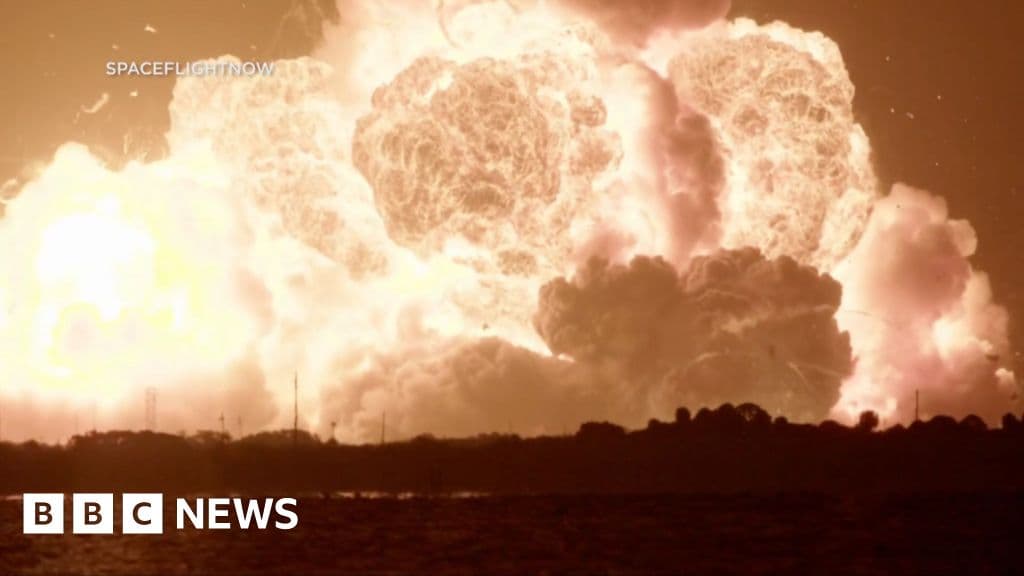
A Blue Origin rocket exploded during a test in Florida, prompting investigations. All personnel are safe. What does this mean for the future of space travel?
BBC Business