
Image: Science Daily
NASA's Webb Telescope reveals a brain-shaped nebula, PMR 1, offering unprecedented insights into stellar evolution and cosmic mysteries.
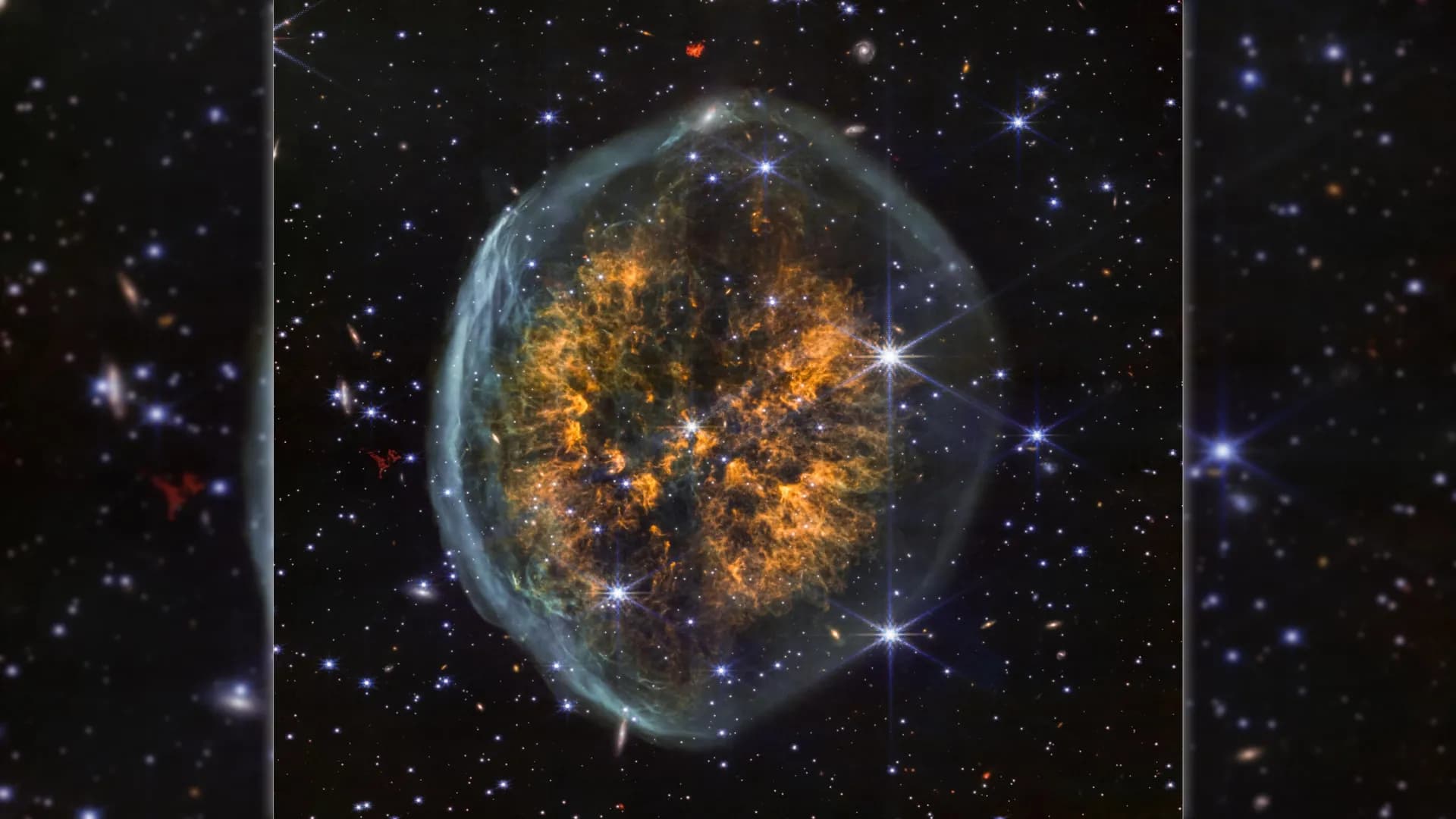
GlipzoRecent observations from NASA's James Webb Space Telescope have shed light on a fascinating celestial object known as Nebula PMR 1. This nebula, which has garnered the nickname "Exposed Cranium", appears strikingly like a brain encased in a transparent skull. This unique visual has piqued the curiosity of astronomers and space enthusiasts alike, as Webb captures unprecedented clarity and detail in its images.
The nebula was first identified over a decade ago by the retired Spitzer Space Telescope, but Webb's advanced technology has enabled scientists to explore its intricacies more thoroughly. Utilizing both near-infrared and mid-infrared light, Webb reveals features that eluded earlier observations, allowing for a comprehensive analysis of this peculiar cosmic formation. The findings not only enhance our understanding of PMR 1 but also highlight the dynamic processes at play in dying stars.
Upon examining Nebula PMR 1, researchers noted distinct layers indicating various developmental stages. The outer shell consists primarily of hydrogen, reflecting the material expelled during the star's earlier life phases. In contrast, the inner region showcases a more intricate assembly of gases and structures, illustrating the ongoing evolution of the nebula.
One of the most intriguing features captured by Webb is a dark lane running vertically through the nebula's center. This lane serves to divide the structure into two sections, reminiscent of the two hemispheres of a brain. Webb's high-resolution images suggest that this dark lane may be linked to a significant outburst from the central star, likely driven by jets of material that are ejected in opposing directions. The evidence of this activity is particularly prominent in the MIRI images, where gas from the inner region appears to be pushed outward, adding to the nebula's complex anatomy.
While much remains to be learned about Nebula PMR 1, scientists agree that it is intricately shaped by a star nearing the conclusion of its fuel-burning phase. During this period, stars progressively shed their outer layers into the cosmos—a process that, while seemingly slow, occurs rapidly on a cosmic scale. Webb's observations provide a crucial snapshot of this phase, illuminating how stars evolve and interact with their surrounding environments.
The future of the central star remains uncertain, as its eventual fate hinges on its mass. If the star is sufficiently massive, it could culminate in a spectacular supernova explosion. Conversely, if it resembles our Sun more closely, it will gradually lose its outer material until only a dense core, known as a white dwarf, remains. This remnant will embark on a slow cooling process over an extensive time frame.
The James Webb Space Telescope stands out as the most sophisticated space observatory ever constructed, designed to explore a wide array of celestial phenomena. From studying objects within our solar system to examining exoplanets and investigating the formation of galaxies across the universe, Webb has become an essential tool for astronomers.
This groundbreaking project is a collaborative effort between NASA, the European Space Agency (ESA), and the Canadian Space Agency (CSA). As Webb continues to provide new insights into the universe's formation and evolution, its findings promise to deepen our understanding of cosmic events and the life cycles of stars.
The exploration of nebulae like PMR 1 is crucial for astronomers as they seek to unravel the mysteries of stellar evolution and the life cycle of stars. By studying these celestial phenomena, scientists gain valuable insights into how elements are formed and dispersed throughout the universe, impacting the creation of new stars and planets.
As the James Webb Space Telescope continues its mission, we can anticipate more remarkable discoveries that will further illuminate our understanding of the cosmos. The ongoing analysis of PMR 1 and similar objects will not only enhance our knowledge of stellar processes but may also offer clues about the origins of our own solar system.
As researchers delve deeper into the data collected by Webb, several key aspects will be critical to monitor: - Further analysis of Nebula PMR 1: Expect more detailed findings that could reveal additional layers and structures within the nebula. - Comparative studies with other nebulae: Observations of similar objects will enhance our understanding of cosmic evolution and stellar life cycles. - Technological advancements: As Webb continues to operate, advancements in observational techniques may unveil even more complex behaviors of actively evolving nebulae.
In summary, the discovery of Nebula PMR 1 by the James Webb Space Telescope not only captivates with its striking visuals but also plays a vital role in advancing our understanding of the universe's intricate processes and the fate of dying stars.

Discover how the brain protein Menin could be the key to halting cognitive decline with new research that uncovers its vital role in aging.
Indian Express
A new 'killer fungus' discovered in the UK targets invasive heath-star moss, offering hope for restoring native habitats. Will it turn the tide against invasives?
BBC Science
A Blue Origin rocket exploded during a test in Florida, prompting investigations. All personnel are safe. What does this mean for the future of space travel?
BBC Business