Glipzo
WorldTechnologyBusinessSportsEntertainmentScienceHealthPolitics
Glipzo
WorldTechnologyBusinessSportsEntertainmentScienceHealthPolitics
  1. Home
  2. /
  3. Science
  4. /
  5. NASA's ESCAPADE Mission: Unlocking Mars' Atmospheric Secrets
NASA's ESCAPADE Mission: Unlocking Mars' Atmospheric Secrets

Image: Science Daily

Science
Sunday, March 15, 20264 min read

NASA's ESCAPADE Mission: Unlocking Mars' Atmospheric Secrets

NASA's ESCAPADE mission aims to uncover how Mars lost its atmosphere and the implications for future human exploration. Discover the groundbreaking insights ahead!

Glipzo News Desk|Source: Science Daily
Share
Glipzo

Key Highlights

  • NASA's ESCAPADE will explore Mars' lost atmosphere.
  • Two spacecraft offer unique insights into Mars' magnetosphere.
  • Data will help protect astronauts from space weather.
  • ESCAPADE promises unprecedented monitoring of Mars' changes.

In this article

  • Introduction: Mars' Transformation Unveiled Mars, once a vibrant planet with flowing water and a thick atmosphere, has transformed into the cold, arid world we see today. Researchers believe a significant factor in this change is the relentless solar wind — a continuous stream of charged particles from the Sun that has gradually stripped away much of Mars' atmosphere over billions of years. As the atmosphere dissipated, the planet cooled, leading to the loss of its surface water and rendering it uninhabitable.
  • The Importance of the ESCAPADE Mission NASA's ESCAPADE mission is more than just an exploration of Mars; it holds potential implications for future human expeditions. Understanding the processes that eroded Mars’ atmosphere could provide insights into protecting astronauts against space weather hazards. As **Joe Westlake**, the heliophysics division director at NASA Headquarters, stated, "The pioneering ESCAPADE duo will not only investigate the Sun's role in transforming Mars into an uninhabitable planet, but also will help inform the development of space weather protocols for solar events directed at Mars during future human missions to the Red Planet."
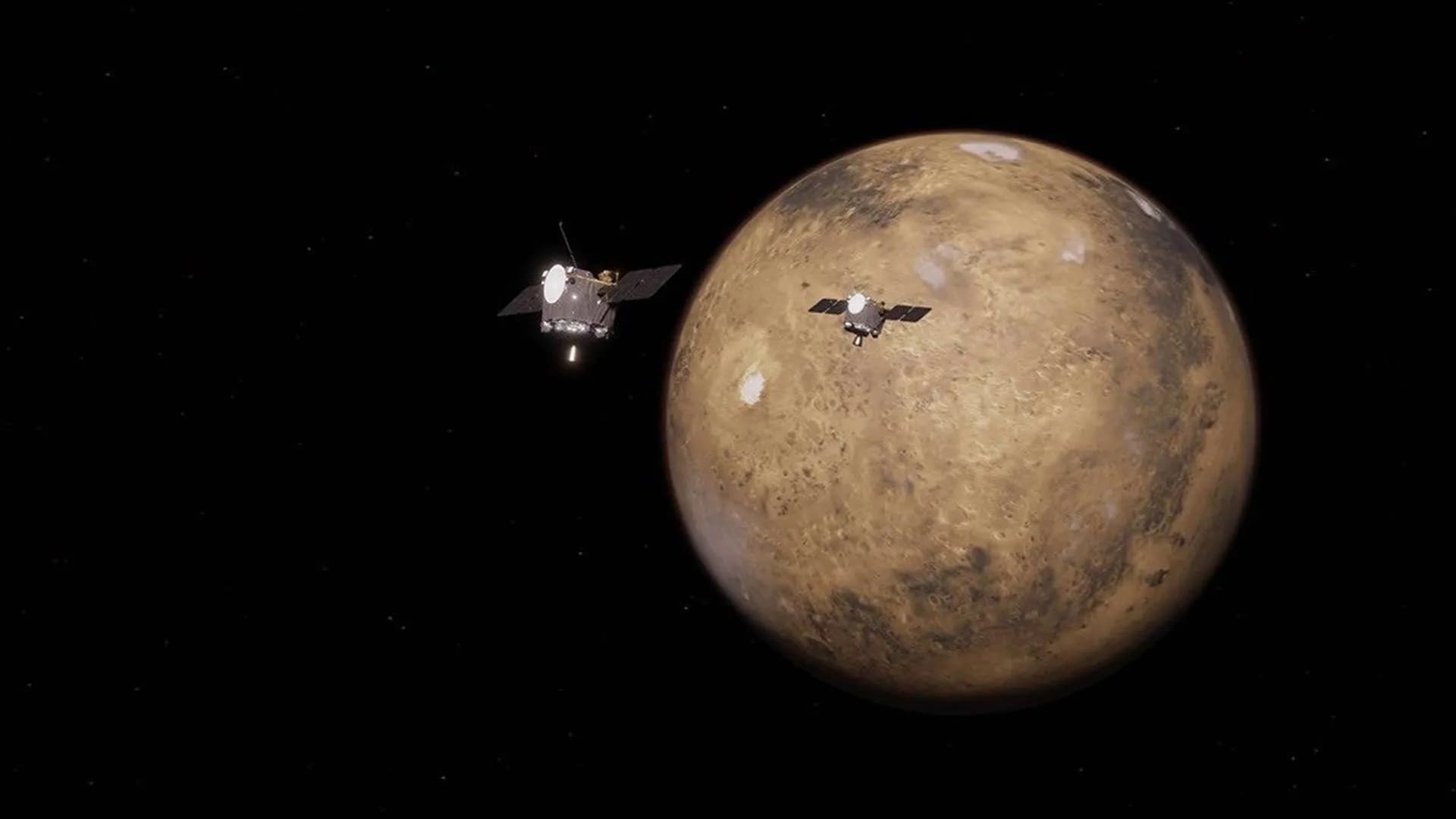
  • Dual Spacecraft, Dual Perspectives What sets the **ESCAPADE mission** apart is its innovative approach using two spacecraft working in tandem. This collaboration allows scientists to observe Mars' magnetic environment from two distinct locations, enhancing the understanding of its atmospheric dynamics. By tracking rapid changes in Mars' magnetosphere — the area influenced by the planet's magnetic forces — the mission aims to identify the mechanisms that facilitate the atmospheric loss.
  • A Game-Changer for Atmospheric Research The dual-spacecraft strategy of ESCAPADE is described as a game changer by its principal investigator, **Rob Lillis** from the University of California, Berkeley. He noted that this mission provides a unique "stereo perspective" of Mars, offering scientists a simultaneous view that previous missions could not achieve with a single spacecraft.
  • Exploring the Magnetosphere After approximately six months, the two spacecraft will shift into separate orbits. One will maintain a close proximity to Mars, while the other will venture farther away. This phase will last for five months, enabling researchers to observe the solar wind's approach to Mars while simultaneously analyzing how the planet reacts within its magnetosphere.
  • Why It Matters Understanding Mars' atmospheric loss is not only crucial for scientific knowledge but also for future human exploration. As humanity's focus shifts toward Mars as a potential destination for colonization, insights from the ESCAPADE mission could inform strategies to safeguard astronauts against the harsh space weather that arises from solar activity.
  • Future Implications and What to Watch For As the ESCAPADE mission continues to unfold, researchers and space enthusiasts alike should monitor its progress closely. The data collected could reshape our understanding of planetary atmospheres beyond Mars, potentially impacting missions to other celestial bodies in our solar system.

Introduction: Mars' Transformation Unveiled Mars, once a vibrant planet with flowing water and a thick atmosphere, has transformed into the cold, arid world we see today. Researchers believe a significant factor in this change is the relentless solar wind — a continuous stream of charged particles from the Sun that has gradually stripped away much of Mars' atmosphere over billions of years. As the atmosphere dissipated, the planet cooled, leading to the loss of its surface water and rendering it uninhabitable.

To explore this cosmic mystery, NASA has launched the ESCAPADE (Escape and Plasma Acceleration and Dynamics Explorers) mission on November 13, 2025. This ambitious project aims to unearth how Mars lost its atmospheric shield and how solar activity continues to shape the planet. As of February 25, 2026, the mission's scientific instruments are fully operational, ready to gather critical data both during transit and once they arrive at Mars.

The Importance of the ESCAPADE Mission NASA's ESCAPADE mission is more than just an exploration of Mars; it holds potential implications for future human expeditions. Understanding the processes that eroded Mars’ atmosphere could provide insights into protecting astronauts against space weather hazards. As **Joe Westlake**, the heliophysics division director at NASA Headquarters, stated, "The pioneering ESCAPADE duo will not only investigate the Sun's role in transforming Mars into an uninhabitable planet, but also will help inform the development of space weather protocols for solar events directed at Mars during future human missions to the Red Planet."

Dual Spacecraft, Dual Perspectives What sets the **ESCAPADE mission** apart is its innovative approach using two spacecraft working in tandem. This collaboration allows scientists to observe Mars' magnetic environment from two distinct locations, enhancing the understanding of its atmospheric dynamics. By tracking rapid changes in Mars' magnetosphere — the area influenced by the planet's magnetic forces — the mission aims to identify the mechanisms that facilitate the atmospheric loss.

Michele Cash, the ESCAPADE program scientist at NASA, emphasized the significance of having two spacecraft, stating, "Having two spacecraft is going to help us understand cause and effect — how the solar wind, when it comes to Mars, interacts with the magnetic field."

A Game-Changer for Atmospheric Research The dual-spacecraft strategy of ESCAPADE is described as a game changer by its principal investigator, **Rob Lillis** from the University of California, Berkeley. He noted that this mission provides a unique "stereo perspective" of Mars, offering scientists a simultaneous view that previous missions could not achieve with a single spacecraft.

Once the spacecraft reach Mars, they will initially follow an identical orbital path, enabling them to observe the same regions of the planet at slightly different times. This allows for unprecedented monitoring of changes in Mars' magnetic environment, with scientists able to detect variations on timescales as short as two minutes.

Lillis explained, "When we have two spacecraft crossing those regions in quick succession, we can monitor how those regions vary on timescales as short as two minutes. This will allow us to make measurements we could never make before."

Exploring the Magnetosphere After approximately six months, the two spacecraft will shift into separate orbits. One will maintain a close proximity to Mars, while the other will venture farther away. This phase will last for five months, enabling researchers to observe the solar wind's approach to Mars while simultaneously analyzing how the planet reacts within its magnetosphere.

Lillis noted that, "Prior spacecraft could either be in the upstream solar wind, or they could be close to the planet measuring its magnetosphere, but ESCAPADE allows us to be in two places at once and to simultaneously measure the cause and the effect."

Why It Matters Understanding Mars' atmospheric loss is not only crucial for scientific knowledge but also for future human exploration. As humanity's focus shifts toward Mars as a potential destination for colonization, insights from the ESCAPADE mission could inform strategies to safeguard astronauts against the harsh space weather that arises from solar activity.

Future Implications and What to Watch For As the ESCAPADE mission continues to unfold, researchers and space enthusiasts alike should monitor its progress closely. The data collected could reshape our understanding of planetary atmospheres beyond Mars, potentially impacting missions to other celestial bodies in our solar system.

In conclusion, the ESCAPADE mission represents a significant leap forward in planetary science. By unraveling the processes that led to Mars' atmospheric decline, scientists can not only learn about the Red Planet's history but also prepare for the future of human exploration in space.

Did you find this article useful? Share it!

Share

Related Articles

Critical Efforts Underway to Save Stranded Whale Timmy
Science
Apr 17, 2026

Critical Efforts Underway to Save Stranded Whale Timmy

A new rescue effort for stranded whale Timmy includes using air cushions. Can this innovative method save him? Learn more about his situation.

BBC World
Shocking Butterfly Comeback After 430 Trees Planted
Science
Apr 17, 2026

Shocking Butterfly Comeback After 430 Trees Planted

Rare white-letter hairstreak butterflies return to Quantock Hills after volunteers plant 430 elm trees, marking a significant conservation success. Find out more!

BBC Science
Major Fundraising Drive to Revive Surrey's Wildlife
Science
Apr 16, 2026

Major Fundraising Drive to Revive Surrey's Wildlife

Surrey Wildlife Trust launches a £40K campaign to revive local wildlife, reconnecting communities with nature. Discover how you can help!

BBC Science

Categories

  • World
  • Technology
  • Business
  • Sports

More

  • Entertainment
  • Science
  • Health
  • Politics

Explore

  • Web Stories
  • About Us
  • Contact

Legal

  • Privacy Policy
  • Terms of Service

© 2026 Glipzo. All rights reserved.