
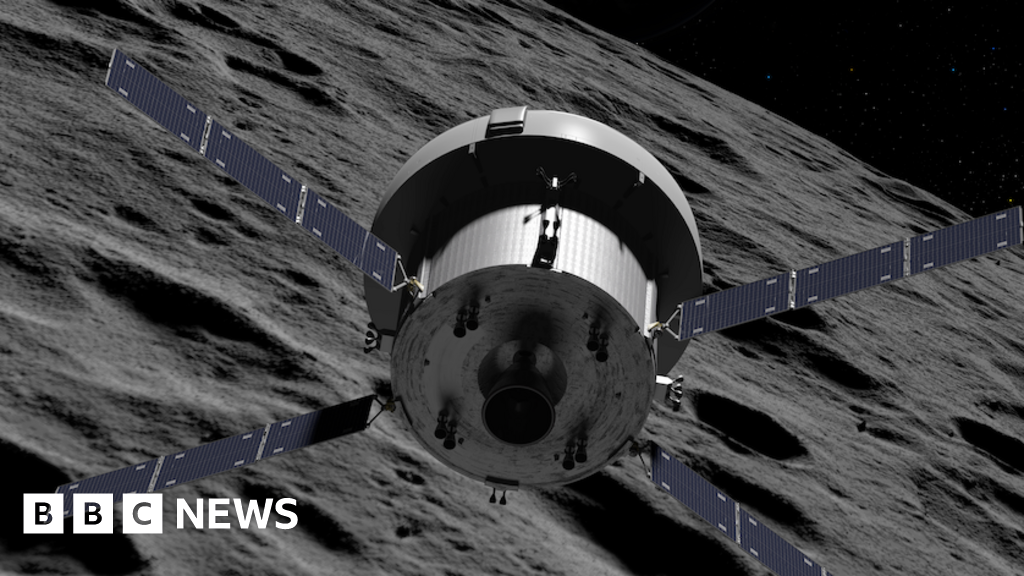
Image: BBC Science
NASA's Artemis II mission breaks distance records and captures stunning lunar views. Discover the astronauts' journey and what's next in space exploration.
GlipzoOn a remarkable journey that is poised to reshape humanity's understanding of lunar exploration, four astronauts from NASA's Artemis II mission have successfully completed a dramatic fly-by of the Moon. This significant event marks a pivotal moment in space travel, as the crew ventured further from Earth than any other human beings in history. The mission reached its climax on Monday, when the Orion spacecraft broke the previous distance record set by the Apollo 13 mission in 1970.
As the crew embarked on their lunar fly-by, they temporarily lost communication with Earth for approximately 40 minutes while positioned behind the Moon. This momentary disconnect was anticipated, but it was still a tense period for mission controllers and families back home. Upon re-establishing contact, astronaut Christina Koch expressed her joy, stating, "It's so great to hear the Earth again."
During their historic fly-by, the Orion spacecraft came within a few thousand miles of the lunar surface, allowing the astronauts to witness a total solar eclipse from a perspective never before seen by humans. As the Moon eclipsed the Sun, the crew experienced a breathtaking view of the cosmos, a reminder of the vastness and beauty of space.
At 13:56 EDT (18:56 BST), the astronauts achieved a new record for human travel, surpassing the previous mark of 248,655 miles (400,000 km). Canadian astronaut Jeremy Hansen remarked on the significance of this achievement, saying, "As we surpass the furthest distance humans have ever traveled from planet Earth, we do so in honoring the extraordinary efforts and feats of our predecessors in human space exploration."
The Artemis II mission, while not intended for lunar landing, took the crew around the far side of the Moon—an area that has remained largely unexplored by humans. Though satellites have captured images of this hidden region, the astronauts became the first to observe its vast craters and lava plains up close. Equipped with a variety of professional equipment, the astronauts documented their experiences through an array of photographs and sketches, adding a personal touch to the scientific mission.
The internal lights of Orion were dimmed during the fly-by to enhance visibility through the windows, allowing the crew to take in the lunar landscape without reflections. This adjustment not only improved their view but also created an intimate atmosphere for observing the Moon's surface.
NASA's science team emphasized that the astronauts' audio descriptions during the fly-by would be as valuable as the visuals. As the crew narrated their observations, they could identify subtle colors, textures, and contrasts that might not be immediately apparent in images alone. Dr. Kelsey Young, the agency's lunar science lead, highlighted the unique advantages of human observation, stating, "Human eyes and brains are highly sensitive to subtle changes in color, texture, and other surface characteristics."
The most nerve-wracking phase of the mission occurred when the Orion spacecraft slipped behind the Moon, severing its radio and laser connections to Earth. For roughly 40 minutes, the astronauts found themselves isolated on the lunar far side. Just before this disconnection, Pilot Victor Glover delivered an uplifting message to those on Earth: "As we prepare to go out of radio communication, we're still going to feel your love from Earth. And to all of you down there on Earth and around Earth, we love you, from the Moon. We will see you on the other side."
As the mission control team, friends, and family waited with bated breath, the countdown to re-establishing contact added an element of suspense to an already historic mission. The anticipation of waiting for communication to resume underscored the emotional connection shared between the astronauts and their loved ones back on Earth.
The Artemis II mission is more than just a record-breaking journey; it symbolizes a significant leap in humanity's quest to explore the Moon and beyond. With plans for future lunar landings and even missions to Mars, the data collected during this fly-by will provide invaluable insights into human space travel and the feasibility of long-term missions.
The images and audio captured will not only serve as a record of the astronauts' experiences but will also contribute to our understanding of the Moon's geology and surface characteristics. As NASA prepares to share this content with the public, excitement builds around what future missions may hold.
As humanity continues to push the boundaries of space exploration, the Artemis II mission serves as a reminder of our collective aspirations and the enduring spirit of discovery.

Discover how the brain protein Menin could be the key to halting cognitive decline with new research that uncovers its vital role in aging.
Indian Express
A new 'killer fungus' discovered in the UK targets invasive heath-star moss, offering hope for restoring native habitats. Will it turn the tide against invasives?
BBC Science
A Blue Origin rocket exploded during a test in Florida, prompting investigations. All personnel are safe. What does this mean for the future of space travel?
BBC Business