
Image: BBC Science
NASA reveals breathtaking images from Artemis II's lunar fly-by, featuring stunning Earthset and solar eclipse views. Explore the significance of this mission!
GlipzoNASA has unveiled breathtaking images taken by astronauts during their historic Artemis II mission, including an awe-inspiring 'Earthset' and a mesmerizing solar eclipse. The images provide a glimpse into the extraordinary views experienced by the crew as they flew past the Moon on their way back to Earth.
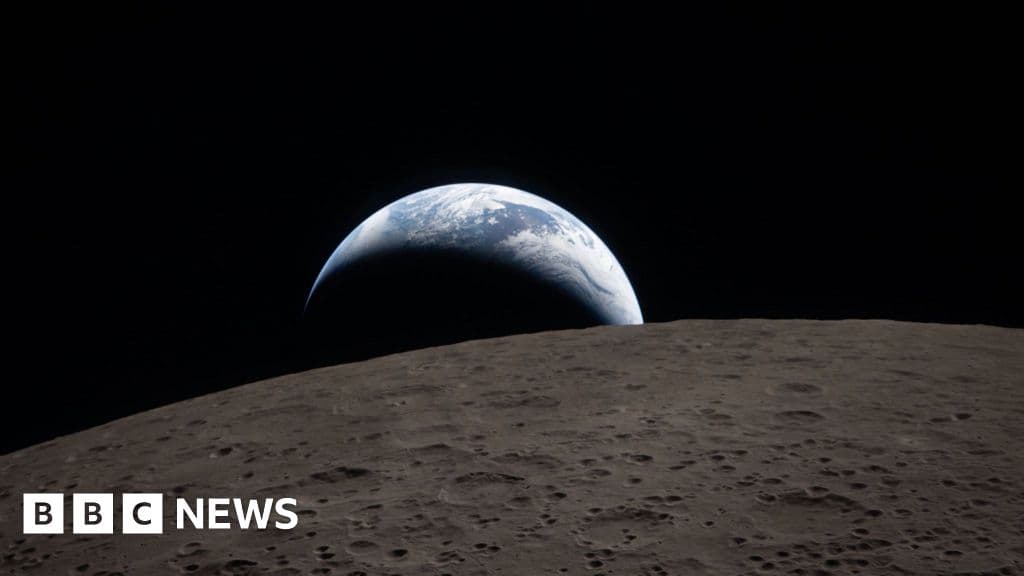
The Artemis II mission has captured the imagination of space enthusiasts worldwide, and now, NASA is sharing the first images taken by its astronauts during their lunar fly-by. The crew had the unique opportunity to witness and photograph an 'Earthset'—a stunning view of Earth as it slowly disappears behind the Moon’s rugged terrain. This image recalls the iconic Earthrise photo taken by Bill Anders during Apollo 8 in 1968, which showcased the delicate beauty of our planet against the vastness of space.
In addition to the 'Earthset', the astronauts were treated to a rare solar eclipse, where the Moon obscured the Sun. These images not only highlight the astronauts' remarkable journey but also mark a significant moment in space exploration history. The photographs were taken during a six-hour fly-by, which included a challenging period of radio silence when the spacecraft was positioned behind the Moon, out of contact with mission control.
NASA has indicated that the Earthset photograph was taken through the window of the Orion spacecraft on Monday at 18:41 Eastern Daylight Time (23:41 BST). The image vividly displays a portion of Earth engulfed in darkness, illustrating nighttime on our planet, while swirling clouds can be seen over the regions of Australia and Oceania. In the foreground, the Ohm crater is highlighted, showcasing its terraced edges and the distinct central peaks formed during the crater's creation.
Victor Glover, one of the crew members, expressed his sheer amazement at witnessing the solar eclipse, describing the experience as “sci-fi” and “unreal.” He was particularly captivated by the view of the Sun's corona, which formed a glowing halo around the Moon. Glover noted, “The Earth is so bright out there and the Moon is just hanging in front of us.” This moment of totality lasted nearly 54 minutes, a stark contrast to the brief solar eclipses experienced from the Earth’s surface.
While satellite images of the Moon’s far side have been captured over the years, the astronauts' firsthand observations during the fly-by are invaluable. The crew recorded audio notes detailing their experiences, which NASA scientists will analyze for insights into lunar geology and the broader implications for future space missions.
The ability to see the Moon and Earth from such a unique vantage point allows scientists to gather new data and perspectives that remote sensing cannot provide. The images serve not only as a record of this monumental event but also as a testament to the ongoing exploration of our solar system that began with the Apollo missions decades ago.
As NASA continues to analyze the data collected during the Artemis II mission, the space agency is set to further its plans for future lunar exploration, including potential manned missions to Mars. The success of Artemis II paves the way for upcoming missions, enhancing our knowledge of lunar geology and improving our understanding of the conditions necessary for human life beyond Earth.
The stunning photographs captured during this mission will likely inspire future generations of astronauts and space enthusiasts alike. As we await further developments from NASA, the legacy of Artemis II is sure to fuel curiosity and foster a deeper appreciation for the wonders of space exploration.
The images released by NASA not only showcase the breathtaking beauty of Earth and its moon but also highlight the technological advancements and the spirit of exploration that drive humanity to look beyond our planet. This mission serves as a reminder of our fragile existence on Earth and the importance of protecting our planet as we venture into the cosmos.
In conclusion, the Artemis II mission marks another significant chapter in the story of human exploration. As we look forward to what lies ahead in space exploration, the images and experiences of the crew remind us of the limitless possibilities that await us beyond our atmosphere.

Discover how the brain protein Menin could be the key to halting cognitive decline with new research that uncovers its vital role in aging.
Indian Express
A new 'killer fungus' discovered in the UK targets invasive heath-star moss, offering hope for restoring native habitats. Will it turn the tide against invasives?
BBC Science
A Blue Origin rocket exploded during a test in Florida, prompting investigations. All personnel are safe. What does this mean for the future of space travel?
BBC Business