
Image: Science Daily
Discover a significant freshwater reservoir beneath the Great Salt Lake, revealing vital insights into hydrology and environmental management.
GlipzoA remarkable new study has revealed a substantial freshwater reservoir lying beneath the Great Salt Lake, thanks to innovative airborne electromagnetic (AEM) surveys. Conducted along the southeastern edge of the lake, specifically near Farmington Bay and Antelope Island, researchers from the University of Utah have brought to light critical insights about this underground water system. This discovery is particularly significant as it marks a pivotal moment in our understanding of the geology and hydrology of one of the largest terminal lakes in the Western Hemisphere.
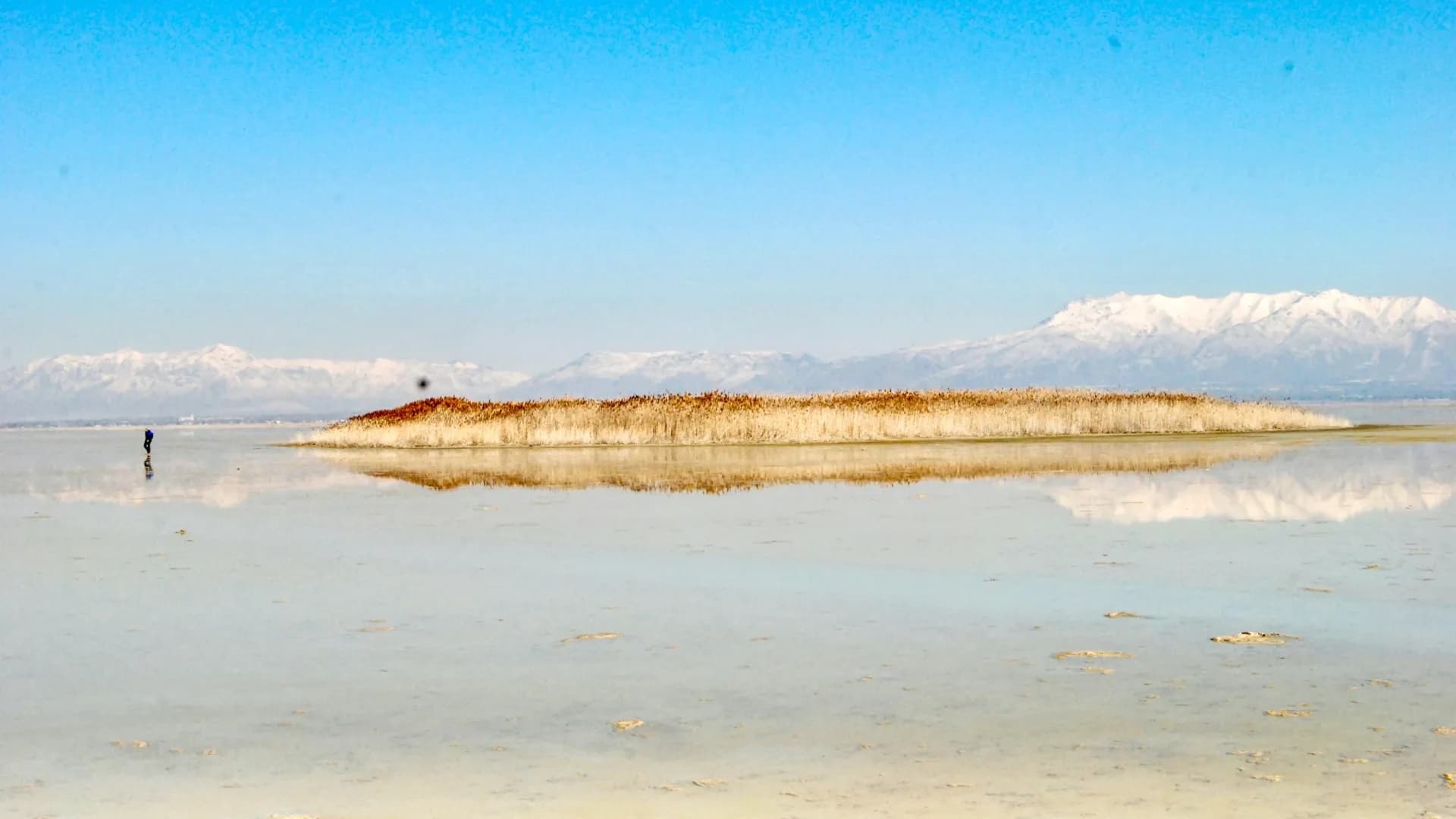
The AEM surveys, performed last year, aimed to investigate the geologic formations beneath the lake. This work gained momentum after scientists noticed freshwater bubbling up under pressure in certain areas of the exposed lakebed, resulting in unusual mounds covered with dense phragmites reeds. These observations prompted a detailed examination of the freshwater's extent and depth, which researchers discovered reaches between 3 to 4 kilometers (approximately 10,000 to 13,000 feet) beneath the lake's salty surface.
Lead author Michael Zhdanov, a distinguished professor of geology and geophysics, emphasized the groundbreaking nature of this study, stating that it is the first instance where AEM technology has successfully identified freshwater beneath the conductive saltwater layer at the Great Salt Lake's surface. The research team meticulously mapped the freshwater's spatial extent and depth, providing a clearer picture of this potential reservoir's volume and characteristics.
Zhdanov explained, "If you know how deep, you know how wide, you know the porous space, you can calculate the potential freshwater volume." This understanding could have significant implications for water resource management and environmental conservation in the region.
The findings were published in the Scientific Reports, a journal affiliated with Nature, as part of a larger initiative led by the University of Utah's Department of Geology & Geophysics. This research, funded by the Utah Department of Natural Resources, seeks to deepen our understanding of the groundwater beneath the Great Salt Lake. The ongoing research project has involved contributions from senior faculty and graduate students, resulting in two additional studies thus far, with more publications anticipated.
Interestingly, the study reveals that rather than freshwater migrating solely towards the edges of the lake, it appears to be moving into the subsurface towards the interior. This observation defies traditional expectations in hydrology, as noted by co-author Bill Johnson, a hydrologist involved in the study. He pointed out, "What we would normally expect as hydrologists is that the brine would occupy the entire volume underneath that lake... But we find it's coming in towards the interior."
This unexpected hydrological behavior raises important questions about the dynamics of the lake's water systems and suggests that further research is needed to understand the implications of these findings on the broader ecosystem.
The impetus for this research was the emergence of circular mounds on the dried lakebed, which have appeared over the last few years. These mounds, measuring between 50 to 100 meters across, are surrounded by tall reeds that can grow up to 15 feet high. As water levels in the Great Salt Lake have continued to drop, approximately 800 square miles of exposed lakebed have become a significant source of dust pollution, negatively impacting nearby communities.
Johnson and his research team are exploring the potential of utilizing this artesian groundwater to mitigate dust issues effectively. Given that the dust often contains harmful metals, understanding the benefits and risks associated with extracting this groundwater is crucial. Johnson elaborated on their approach, stating, "A first-order objective is to understand whether we could use this freshwater to wet dust hotspots and douse them in a meaningful way without perturbing the freshwater system too much."
The implications of this research extend beyond mere scientific curiosity; they touch on critical environmental and public health issues. As communities surrounding the Great Salt Lake grapple with the consequences of increased dust pollution, the potential for using this newly discovered freshwater reservoir to alleviate these issues offers a glimmer of hope.
Moreover, understanding the characteristics of this freshwater aquifer could play a vital role in sustainable water management strategies in the region, particularly as climate change continues to impact water availability and quality.
The discoveries made by the University of Utah researchers open up new avenues for exploration and understanding of the Great Salt Lake's hydrology. As studies continue to unfold, scientists are looking to answer vital questions about the freshwater reservoir's size, movement, and impact on the surrounding ecosystem. The research community is eager to monitor how this underground freshwater system can contribute to addressing environmental challenges, particularly dust pollution.
In conclusion, the revelation of a significant freshwater reservoir beneath the Great Salt Lake is a major scientific breakthrough with far-reaching implications. This research will be essential for guiding future studies and informing policy decisions aimed at preserving the delicate balance of this unique ecosystem.

Discover how the brain protein Menin could be the key to halting cognitive decline with new research that uncovers its vital role in aging.
Indian Express
A new 'killer fungus' discovered in the UK targets invasive heath-star moss, offering hope for restoring native habitats. Will it turn the tide against invasives?
BBC Science
A Blue Origin rocket exploded during a test in Florida, prompting investigations. All personnel are safe. What does this mean for the future of space travel?
BBC Business