
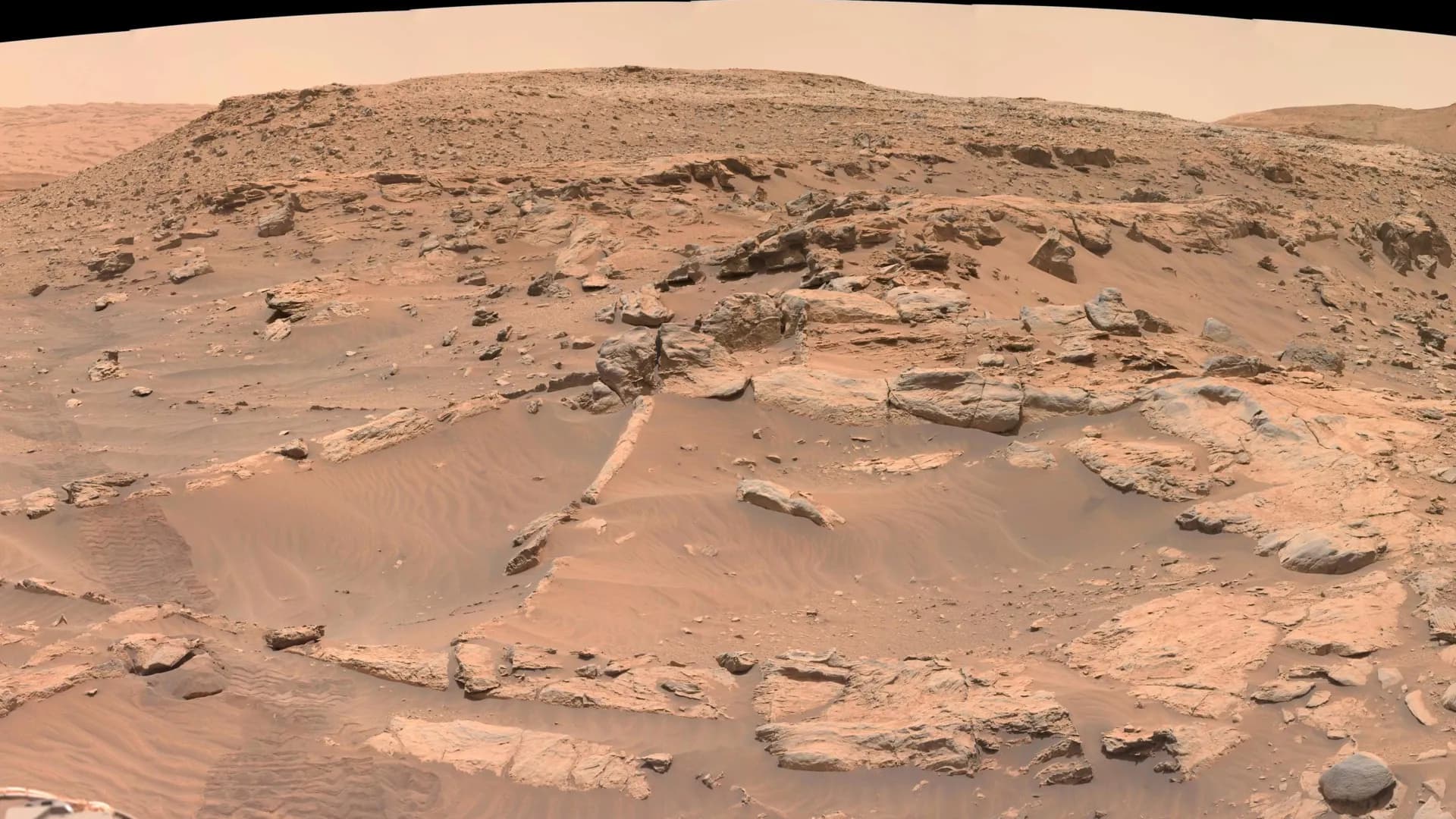
Image: Science Daily
Discover how new research reveals hidden water on Mars that may have supported life far longer than previously believed. Explore the implications for future missions.
GlipzoA recent study by researchers at New York University Abu Dhabi (NYUAD) has unveiled compelling evidence that water once flowed beneath the surface of Mars. This groundbreaking discovery suggests that the Red Planet may have had the potential to support life far longer than previously understood.
Published in the Journal of Geophysical Research - Planets, the study examines ancient sand dunes within the Gale Crater, a region extensively explored by NASA's Curiosity rover. The researchers propose that these dunes, which solidified into rock over billions of years, were influenced by interactions with groundwater lurking beneath Mars' surface.
The research was spearheaded by Dimitra Atri, the Principal Investigator at NYUAD's Space Exploration Laboratory, alongside research assistant Vignesh Krishnamoorthy. To gain insight into the Martian landscape, the team compared data from Curiosity with analogous rock formations found in the deserts of the United Arab Emirates, which formed under similar conditions on Earth.
Their analysis indicates that groundwater from a nearby Martian mountain infiltrated the dunes through minute fractures. As this moisture ascended through the sandy terrain, it left behind key minerals such as gypsum, which are prevalent in terrestrial desert environments. These minerals are particularly valuable for scientists because they can trap and retain traces of organic material, making them prime candidates for future missions aimed at uncovering evidence of ancient life.
Dimitra Atri emphasized the significance of their findings, stating, "Our findings show that Mars didn't simply go from wet to dry. Even after its lakes and rivers disappeared, small amounts of water continued to move underground, creating protected environments that could have supported microscopic life." This perspective highlights the complexity of Mars' climatic history and its potential for harboring life.
The implications of this discovery are profound, as they enhance our understanding of how Mars evolved over billions of years. It underscores the notion that underground habitats could be among the most promising locations for searching for signs of life on the planet.
The NYUAD research was not only supported by the NYUAD Research Institute but was also conducted at the university's Center for Astrophysics and Space Science. This center is dedicated to advancing scientific knowledge of the cosmos while bolstering the United Arab Emirates' growing role in global space exploration. The project also saw collaboration with James Weston from NYUAD's Core Technology Platform and Panče Naumov's research group.
This discovery is critical for several reasons: - Revolutionizing Our Understanding of Mars: The new evidence suggests that Mars may have had a more dynamic and complex history than previously thought. - Implications for Future Missions: The presence of subsurface water could direct future explorations to areas where life may have existed. - Broader Astrobiological Insights: Understanding Martian environments can provide valuable insights into the potential for life on other planets.
As scientists continue to unravel the mysteries of Mars, this study paves the way for future missions that will aim to further investigate the planet's subsurface environments. Upcoming projects may include: - In-depth analysis of Martian soil samples to search for organic compounds. - Rover missions designed to drill deeper into the Martian crust to access ancient water sources. - Collaboration with international space agencies to enhance the scope and scale of Martian exploration.
The potential for discovering life on Mars, even in microbe form, is a tantalizing prospect for scientists and space enthusiasts alike. As technology advances and our understanding deepens, the red planet may soon reveal its secrets, reshaping our perception of life beyond Earth.
In conclusion, the ongoing exploration of Mars continues to captivate the scientific community, and as new technologies emerge, we are likely to uncover even more astonishing revelations about our neighboring planet's past and its capacity to support life.

Discover how the brain protein Menin could be the key to halting cognitive decline with new research that uncovers its vital role in aging.
Indian Express
A new 'killer fungus' discovered in the UK targets invasive heath-star moss, offering hope for restoring native habitats. Will it turn the tide against invasives?
BBC Science
A Blue Origin rocket exploded during a test in Florida, prompting investigations. All personnel are safe. What does this mean for the future of space travel?
BBC Business