
Image: BBC World
Discover the newly identified giant Nagatitan dinosaur from Thailand, shedding light on ancient climate impacts on dinosaur evolution.
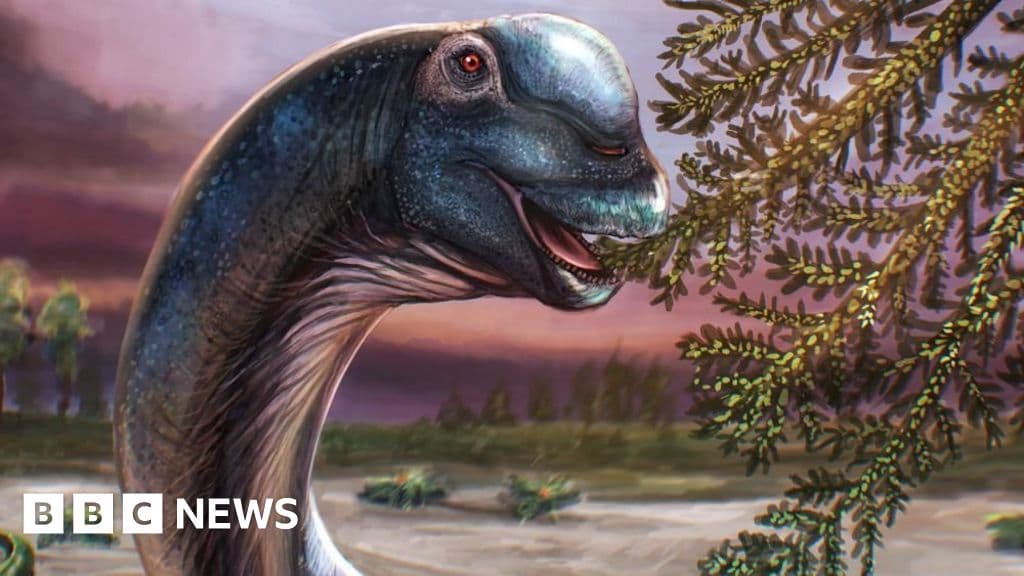
GlipzoIn a groundbreaking revelation, scientists have identified a new species of giant long-necked dinosaur from fossil remains unearthed in Thailand. This colossal creature, named the Nagatitan, is now recognized as the largest dinosaur ever found in Southeast Asia. Weighing an astonishing 27 tonnes—equivalent to about nine adult Asian elephants—and measuring 27 meters (88 feet) in length, the Nagatitan surpasses even the famous Diplodocus in size.
The discovery was made by a collaborative team of researchers from the UK and Thailand, who analyzed fossils that were discovered near a pond in northeastern Thailand nearly a decade ago. Their findings have been published in the scientific journal Scientific Reports and are poised to enhance our understanding of how ancient climatic shifts contributed to the evolution of gigantic dinosaurs.
The full scientific designation of this magnificent dinosaur is Nagatitan chaiyaphumensis. The name itself carries a rich cultural significance: "naga" refers to a mythical serpent in Southeast Asian folklore, while "titan" nods to the gods of Greek mythology, and "chaiyaphumensis" indicates the province in Thailand where the fossils were found. This nomenclature not only honors local heritage but also highlights the creature's monumental stature.
The Nagatitan roamed the Earth approximately 100 to 120 million years ago, a period predating the Tyrannosaurus rex by around 40 million years. This ancient sauropod family member is believed to be about twice the size of the T. rex, underscoring its status as a titan of its time.
Leading the research was Thitiwoot Sethapanichsakul, a Thai doctoral student at University College London (UCL). He remarked that the Nagatitan is referred to as "the last titan" of Thailand because its fossils were found in the youngest dinosaur-bearing rock formation in the country. According to Sethapanichsakul, the geological context suggests that future discoveries of large sauropods in the region are unlikely due to the area's transformation into a shallow sea towards the end of the age of dinosaurs.
"Younger rocks laid down towards the end of the time of the dinosaurs are unlikely to contain dinosaur remains because the region by then had become a shallow sea. So this may be the last or most recent large sauropod we will find in Southeast Asia," he explained. For Sethapanichsakul, the study also symbolizes the fulfillment of a childhood dream to name a dinosaur, showcasing the personal connection many researchers have with their fields.
The Nagatitan marks the 14th dinosaur species to be officially named in Thailand. Dr. Sita Manitkoon, a palaeontologist from Mahasarakham University, emphasized the wealth of dinosaur fossils in the country, suggesting it may be the third richest region in Asia for dinosaur remains. This highlights Thailand as a critical area for paleontological research and discovery.
The discovery also sheds light on the environmental conditions during the Nagatitan's existence. It thrived during a time when atmospheric carbon dioxide levels were on the rise, coinciding with elevated global temperatures. This period raises intriguing questions about how large herbivorous dinosaurs adapted to their environments.
Prof. Paul Upchurch, a co-author of the study from UCL, noted the peculiarities surrounding the sauropods' size during times of high temperatures. He stated that it is somewhat paradoxical that such large creatures could thrive in warming conditions, considering that larger bodies tend to retain heat, making it difficult for them to cool down. This phenomenon suggests that the climate may have had a substantial influence on the vegetation available to these gigantic herbivores.
"It seems a little odd that sauropods were able to cope with higher temperature conditions," he remarked to National Geographic. Upchurch elaborated that high temperatures likely affected the plant life, which was crucial for sustaining the large-bodied sauropods like the Nagatitan.
The discovery of the Nagatitan is not just an isolated event but a pivotal moment in paleontological research that could lead to further discoveries. As scientists continue to investigate Thailand's rich geological formations, there is a strong potential for uncovering more dinosaur species. This highlights the importance of protecting such sites for ongoing research and conservation efforts.
With advancements in technology and methods for analyzing fossils, future paleontologists may soon reveal even more secrets from the age of dinosaurs. Researchers and enthusiasts alike are eagerly anticipating the next chapter in the story of these incredible creatures.
In summary, the Nagatitan chaiyaphumensis not only enriches our understanding of prehistoric life but also emphasizes the dynamic interplay between climate and dinosaur evolution. The legacy of this magnificent titan will undoubtedly inspire further exploration and research in the years to come.

Discover how the brain protein Menin could be the key to halting cognitive decline with new research that uncovers its vital role in aging.
Indian Express
A new 'killer fungus' discovered in the UK targets invasive heath-star moss, offering hope for restoring native habitats. Will it turn the tide against invasives?
BBC Science
A Blue Origin rocket exploded during a test in Florida, prompting investigations. All personnel are safe. What does this mean for the future of space travel?
BBC Business