
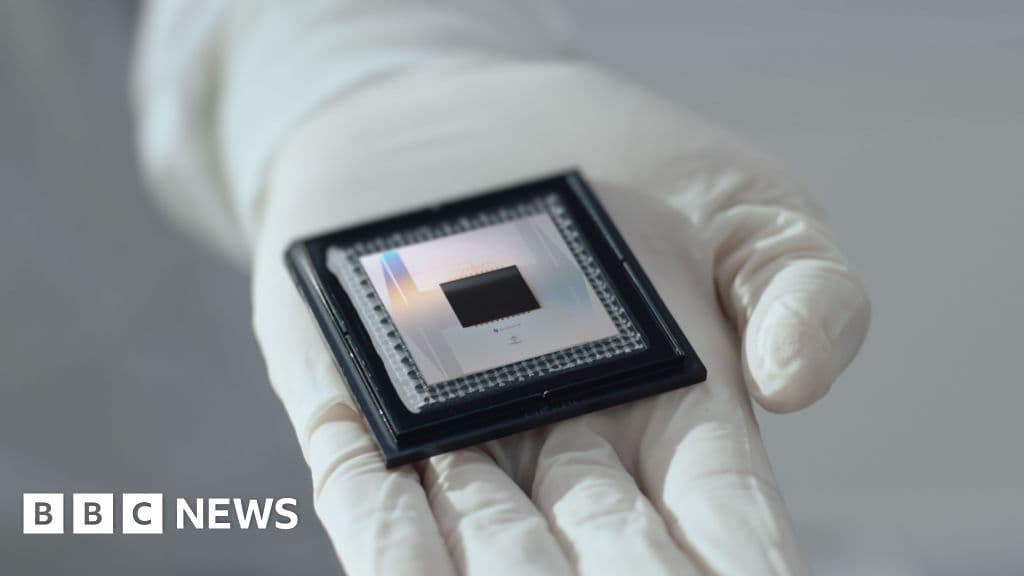
Image: BBC Technology
King's College London gains groundbreaking access to Google's quantum chip, Willow, promising major advancements in science and technology research.
GlipzoIn a groundbreaking achievement, scientists from King's College London have become the first academic team in the UK to gain access to Google's revolutionary quantum computer chip, known as Willow. This milestone was made possible through a collaboration initiated last year between Google and the National Quantum Computing Centre (NQCC) in the UK. The ability to work with Willow represents a significant leap forward in quantum computing, a field that holds the promise of solving complex problems that even the most advanced traditional computers struggle to tackle.
Quantum computers, unlike their classical counterparts, leverage the principles of quantum mechanics—the science that explains the behavior of the smallest particles in nature. According to Google, Willow has the capability to solve a theoretical problem in as little as five minutes, a task that would take the fastest supercomputers approximately 10 septillion years to complete. This staggering difference highlights the potential of quantum technology to revolutionize various fields.
Dr. Eleanor Crane, the lead researcher for King's College on this project, emphasized that the use of Willow could illuminate crucial scientific questions about natural processes. She stated, "It would be useful if society could understand how plants transform sunlight into energy, find materials that transport electricity quickly, or how molecules bind to each other." These inquiries are pivotal for advancements in areas such as renewable energy, materials science, and medicine.
The interactions between fundamental particles are at the heart of these processes. Current computing technologies, including supercomputers, often fall short in efficiently modeling complex systems like photosynthesis or drug interactions. Dr. Crane elaborated on the significance of unlocking these processes: - Developing better solar cells - Creating more efficient energy grid systems - Discovering treatments for previously untreatable diseases
Such advancements could redefine our approach to energy and healthcare, making quantum computing not just a theoretical pursuit but a practical solution for pressing global challenges.
Google's Willow chip incorporates significant breakthroughs that are expected to pave the way for large-scale quantum computing that can deliver real-world benefits. Dr. Crane noted that there have been substantial developments in quantum computing not only in the UK but also across Europe, the United States, and China.
According to Charina Chou, Google's Chief Operating Officer for Quantum, King's College presented a compelling proposal that demonstrated the potential of their research. The NQCC's director, Dr. Michael Cuthbert, asserted that this initiative underscores the UK's commitment to becoming a leader in global quantum research. The UK government has allocated £2 billion in funding for quantum research, indicating the growing importance placed on this transformative technology.
While the advancements in quantum computing are exciting, it is important to note that quantum computers will not replace conventional machines. Each type of computer has its strengths and weaknesses, and quantum technology is still in its infancy. As Sir Peter Knight, Chair of the National Quantum Technology Programme Strategy Advisory Board, mentioned earlier this year, Willow represents a foundational step towards machines that can provide real practical value.
However, Google’s quest in quantum computing faces strong competition from industry giants like IBM, which have established a robust track record in quantum research. Current projects must navigate a landscape filled with technical challenges before quantum devices can evolve into machines capable of widespread practical applications.
Dr. Crane expressed optimism about the future of quantum computing. In a recent interview on the BBC's Today programme, she forecasted that by 2028 or 2030, quantum computers might be able to solve highly complex problems that are currently beyond our reach.
The ability to harness quantum computing technologies like Willow can significantly alter the landscape of scientific research and technology development. As researchers at King's College London begin their work, the implications for industries ranging from energy to healthcare could be profound. - Enhancing energy efficiency through advanced materials. - Accelerating drug discovery with precise molecular modeling. - Transforming renewable energy sources with better solar technology.
As the field continues to evolve, we can expect to see more collaborations and innovations that push the boundaries of what is possible with quantum technology. The next few years will be critical in determining how quickly and effectively these technologies can be integrated into practical applications.
In summary, King's College London’s access to Google's Willow chip is not just a significant milestone for the university but a pivotal moment in the global effort to unlock the potential of quantum computing. As research progresses, stakeholders in academia, industry, and government must work together to ensure that the benefits of quantum technology are realized and made available to society at large.

Discover how the brain protein Menin could be the key to halting cognitive decline with new research that uncovers its vital role in aging.
Indian Express
A new 'killer fungus' discovered in the UK targets invasive heath-star moss, offering hope for restoring native habitats. Will it turn the tide against invasives?
BBC Science
A Blue Origin rocket exploded during a test in Florida, prompting investigations. All personnel are safe. What does this mean for the future of space travel?
BBC Business