
Image: BBC World
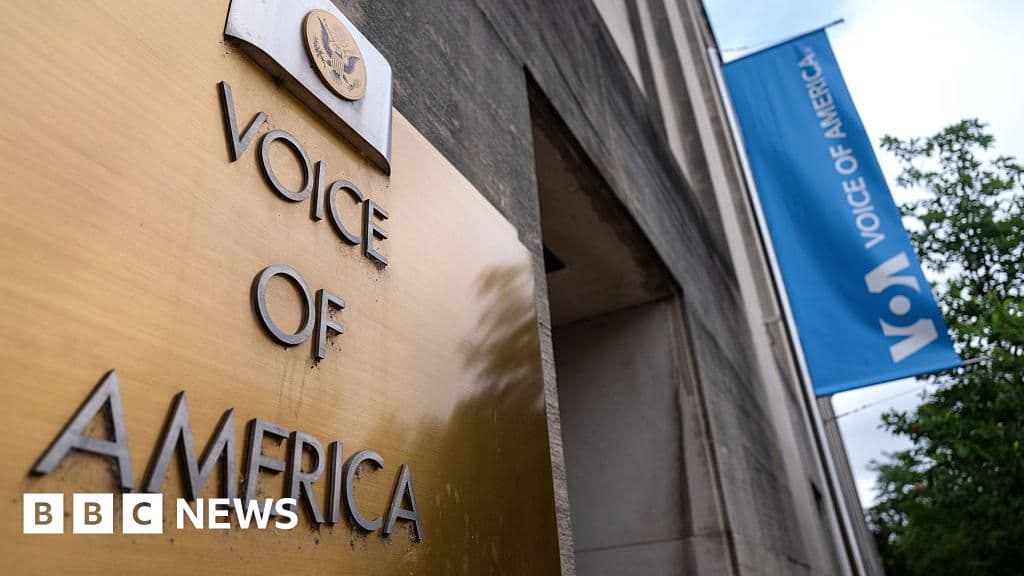
A judge has ruled that Trump's closure of Voice of America was illegal, ordering its reinstatement. What does this mean for press freedom?
GlipzoIn a significant ruling, U.S. District Court Judge Royce Lamberth has declared the closure of the Voice of America (VOA) illegal, ordering that the organization be reinstated within a week. This decision follows an executive order by former President Donald Trump that aimed to shut down the international broadcaster, which has been a cornerstone of American media since its inception during World War II. The Voice of America was established to combat Nazi propaganda, and its mission remains vital in promoting free speech and democracy.
Judge Lamberth's ruling is not just a legal victory; it's a pivotal moment for journalism and free expression. His decision highlights the importance of independent media in a democratic society, especially amid rising concerns about governmental influence over press freedom. The judge emphasized that the administration's actions were “arbitrary and capricious,” indicating a lack of principled reasoning behind the decision to suspend the broadcaster’s operations.
In the wake of Trump's return to office, he quickly targeted the VOA, labeling it as biased and accusing it of promoting left-wing narratives. This led to an executive order that aimed to severely reduce the operations of the VOA and other organizations under the U.S. Agency for Global Media (USAGM), which oversees the VOA, Radio Free Europe, and Radio Free Asia.
The situation escalated when Trump appointed Kari Lake as head of the USAGM. Following her appointment, she dismissed over 85% of the agency's employees, impacting more than 1,000 staff members at the VOA alone. Many of these journalists have remained on paid administrative leave since the closure, contributing to a significant disruption in their ability to provide news and information to their audiences.
Judge Lamberth ruled that Lake’s actions were unconstitutional due to her lack of confirmation by the U.S. Senate, calling into question the legitimacy of her authority to make such sweeping changes. The judge's comments reflect a broader concern about the erosion of institutional checks and balances in U.S. governance.
Among those affected by the closure, Patsy Widakuswara, one of the three journalists who filed a lawsuit against the administration, expressed gratitude for the ruling. She stated, “We hope the American people will continue to support our mission to produce journalism, not propaganda.” This sentiment underscores the critical role of journalists in maintaining a transparent and informed public.
As a result of this ruling, there is now a renewed hope for the future of the VOA as it prepares to resume its services. Before the shutdown, the organization was broadcasting in nearly 50 languages, providing crucial news and information to millions of people worldwide.
The implications of Judge Lamberth's ruling extend beyond just the restoration of the VOA. It raises important questions about the future of independent media in the United States. The closure of the VOA was part of a larger narrative of media polarization in the country, a phenomenon that has seen the U.S. media landscape become increasingly divisive.
Studies show that many American news consumers perceive media as biased, which complicates public trust in news organizations. The reinstatement of the VOA could help counteract some of these perceptions by reinforcing the importance of impartial journalism as a cornerstone of democracy.
Looking ahead, the situation remains fluid. The next steps for the VOA depend on the actions of Sarah Rogers, Lake's nominated successor, who will need to be confirmed by the Senate. There is uncertainty regarding whether she will choose to appeal Judge Lamberth's ruling, which could prolong the situation and add further complications to the restoration of the VOA.
The future of the VOA will also hinge on public support and engagement. As the broadcaster prepares to resume its operations, it will be crucial for journalists to reconnect with their audience, emphasizing their commitment to providing unbiased news coverage. The ruling serves as a reminder of the essential role that independent media plays in a functioning democracy, and it sets a precedent for accountability regarding governmental actions that seek to influence or suppress free speech.
In conclusion, the ruling against the Trump administration's closure of the VOA is a significant victory for press freedom and journalistic integrity. As the situation develops, it will be important to monitor how the USAGM adapts to this legal challenge and how the VOA re-establishes its presence in global media.

Tensions soar as the US and Iran engage in air strikes near the Strait of Hormuz, raising concerns over global oil supply and regional stability.
BBC World
Trump's international interventions face serious stalemates. What will this mean for U.S. foreign policy? Explore the critical challenges ahead.
Indian Express
Tehran denies resignation of President Masoud Pezeshkian amid claims of IRGC influence. What does this mean for Iran's political stability? Click to learn more!
Indian Express