
Image: Science Daily
Discover how Harvard's new chip revolutionizes light control, enabling real-time manipulation of optical chirality for advanced sensing and communication.
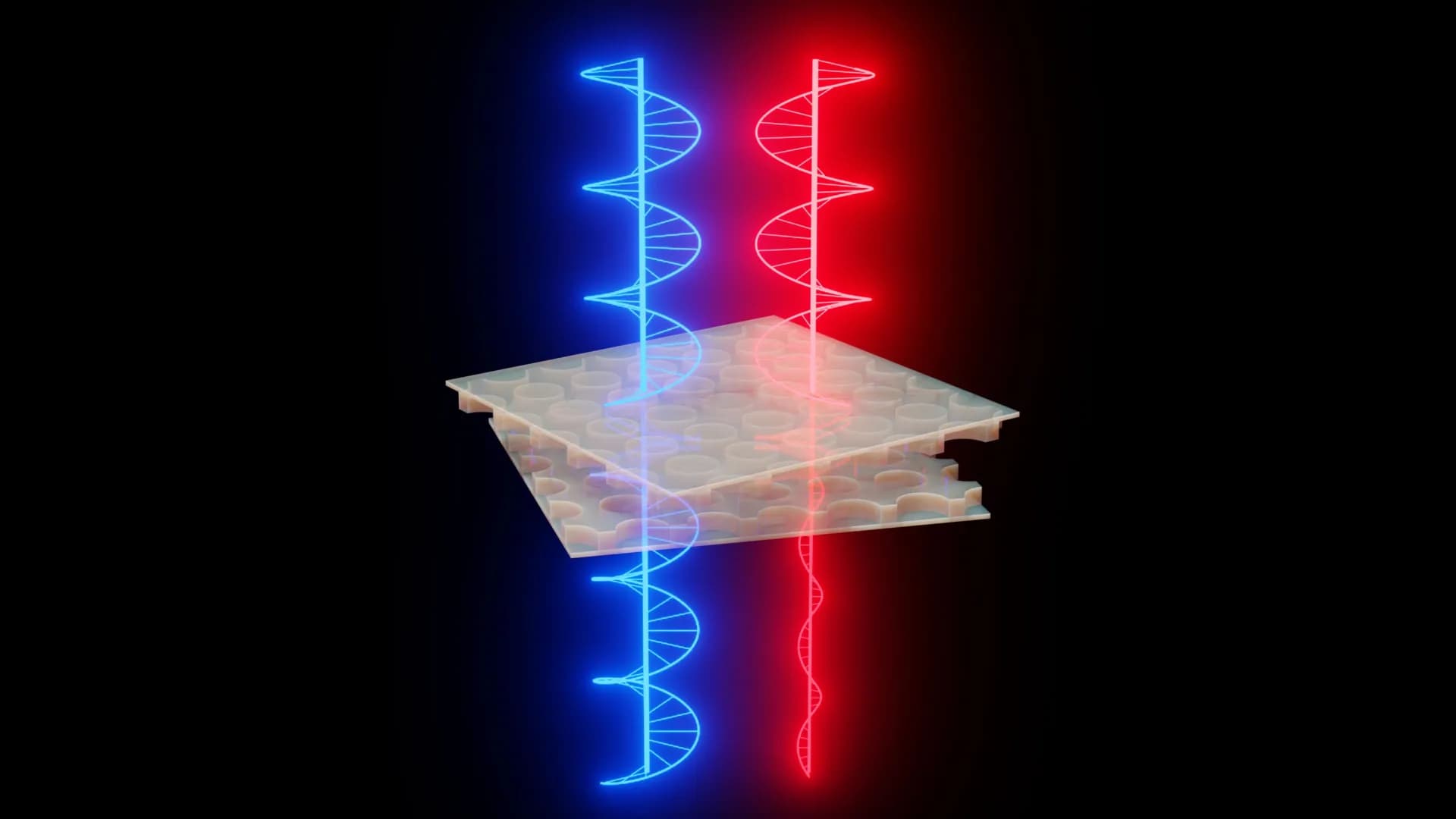
GlipzoResearchers from the Harvard John A. Paulson School of Engineering and Applied Sciences (SEAS) have made a groundbreaking advancement in light manipulation with a new compact device that can actively control the 'handedness' of light in real time. This innovative technology, unveiled in a study published in the journal Optica, leverages a unique design involving twisted bilayer photonic crystals that rotate to influence light's optical chirality.
Optical chirality refers to the property of light that can exhibit left or right-handedness, akin to how human hands are mirror images but cannot be superimposed. This phenomenon is crucial across various scientific disciplines, including pharmaceuticals, chemistry, biology, and physics. The team, under the guidance of Eric Mazur, the Balkanski Professor of Physics and Applied Physics at Harvard, focused on utilizing micro-electromechanical systems (MEMS) to create a versatile photonic device.
Graduate student Fan Du spearheaded the project, which involved designing a reconfigurable twisted bilayer photonic crystal. This device can be adjusted in real time, allowing researchers to control the chirality of light passing through it. Mazur emphasized the significance of this advancement, stating, "Chirality is very important in many fields of science... By integrating twisted photonic crystals with MEMS, we have a powerful platform for modern photonics."
Photonic crystals are intricate nanoscale materials engineered to manipulate how light behaves. These devices, which are small enough to fit on the tip of a pin, are already integral to various technologies, including those used for computing, sensing, and high-speed data transmission. The research team has taken inspiration from twistronics, a field that gained prominence through studies of twisted bilayer graphene, to advance photonic technology.
By layering two silicon nitride structures and rotating them, the researchers can create unique optical properties that are unattainable in a single layer. The twisted bilayer photonic structure introduces a natural asymmetry between left and right circular polarizations, enhancing its effectiveness in controlling light chirality. The implications of this discovery could revolutionize several scientific applications, particularly in terms of chiral light interactions.
Chirality is not merely an abstract concept; it has profound implications in real-world applications. In chemistry, for instance, two molecules that are mirror images of one another can have drastically different effects in biological systems. A notorious case is thalidomide, which was beneficial for treating morning sickness in one form but caused severe birth defects in its mirror-image variant.
To study such chiral molecules, scientists frequently use chiral light. However, traditional tools for detecting light polarization, like wave plates and linear polarizers, are limited in their flexibility and range. The new device from Harvard addresses these issues with its tunable capabilities, offering a significant upgrade over static components.
Unlike traditional photonic devices, the Harvard team's innovation allows for continuous adjustment in response to various types of chiral light without the need for replacing any parts. The design employs a bilayer configuration, where the proximity and rotational alignment of the two photonic crystal layers create a geometrically chiral structure. This capability enables the device to detect the handedness of incoming light with remarkable precision.
The strong interactions between the bilayer's components yield distinct transmission characteristics for left- and right-circularly polarized light when exposed to polarized light at normal incidence (perpendicular to the surface). By manipulating the MEMS system, the researchers demonstrated that the device could achieve near-perfect selectivity in distinguishing light's handedness, a feat not previously attainable.
The implications of this research extend beyond mere academic intrigue; they hold the potential to transform the landscape of optical communication and sensing technologies. The ability to control light's chirality in real time could pave the way for advancements in areas such as quantum photonics, where the manipulation of light is crucial for developing future technologies.
With the growing demand for faster and more efficient data transmission methods, this Harvard device could play a critical role in next-generation communication systems. By enhancing the sensitivity and accuracy of chiral sensing, it could lead to breakthroughs in fields ranging from medical diagnostics to environmental monitoring.
As researchers continue to explore the capabilities of twisted bilayer photonic crystals, the future holds exciting possibilities. The ongoing integration of MEMS technology with photonics is likely to yield even more versatile and powerful devices that can adapt to various scientific and industrial needs.
In conclusion, the development of this real-time light control chip at Harvard not only marks a significant milestone in photonics research but also opens up new avenues for practical applications in numerous fields. As we look forward, keeping an eye on future advancements in this area will be essential, particularly as the demand for innovative technologies grows in our increasingly interconnected world.

Discover how the brain protein Menin could be the key to halting cognitive decline with new research that uncovers its vital role in aging.
Indian Express
A new 'killer fungus' discovered in the UK targets invasive heath-star moss, offering hope for restoring native habitats. Will it turn the tide against invasives?
BBC Science
A Blue Origin rocket exploded during a test in Florida, prompting investigations. All personnel are safe. What does this mean for the future of space travel?
BBC Business