
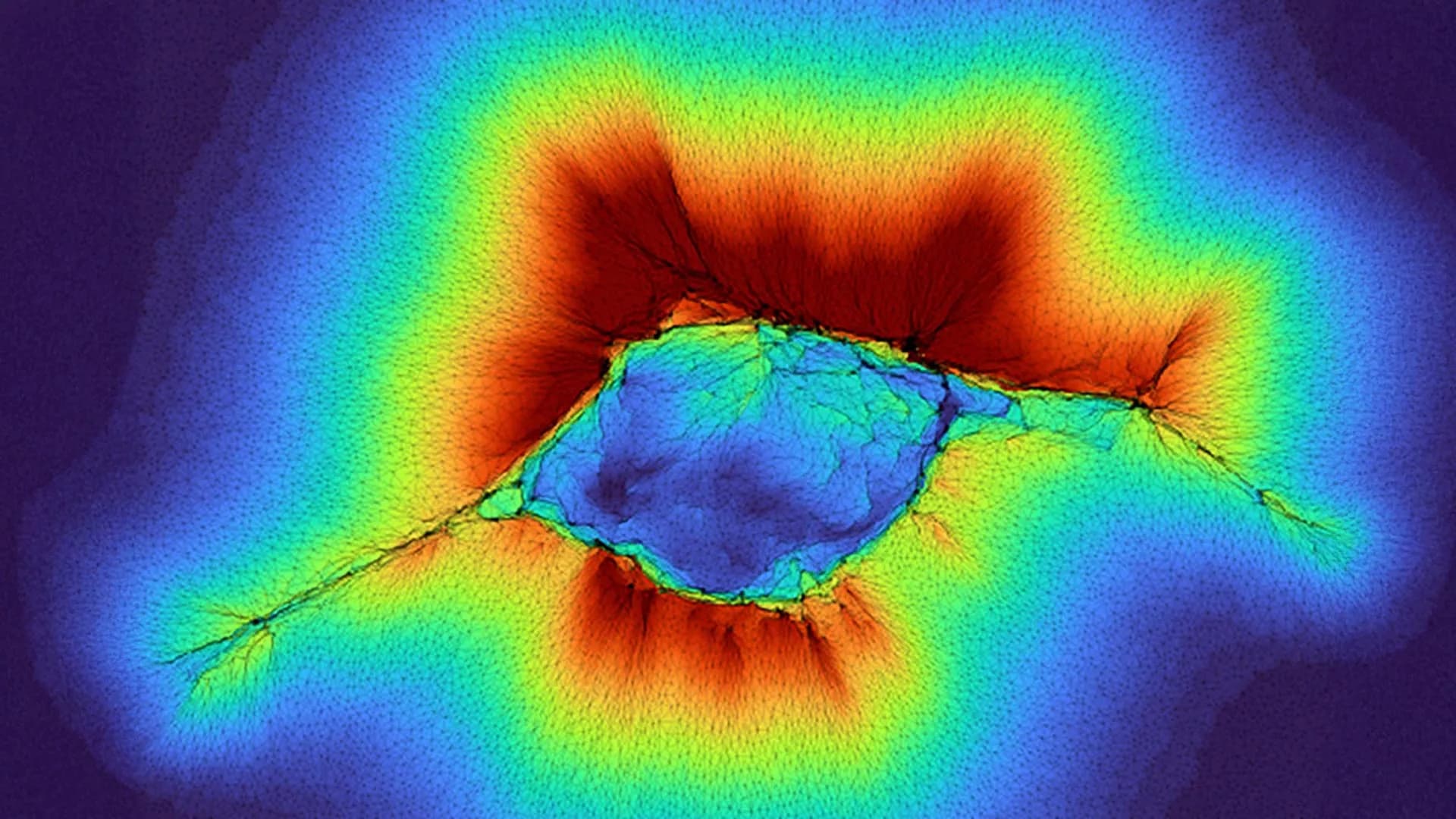
Image: Science Daily
Discover how ordinary cells can sense their environment up to 10x further than expected, shedding light on cancer spread and potential new treatments.
GlipzoIn a surprising revelation, researchers at Washington University in St. Louis have uncovered that ordinary cells possess an extraordinary ability to sense their environment from a distance far greater than previously believed. Published in the journal PNAS, this study reveals that cells can detect environmental cues up to 100 microns away, a significant leap from the earlier understanding that they could only sense their immediate surroundings. This groundbreaking discovery could provide crucial insights into how cancer cells navigate through the body, potentially leading to new strategies for halting their spread.
The analogy of the fairy tale princess who could feel a pea beneath numerous mattresses serves as a fitting metaphor for this phenomenon in cellular biology. Cells, particularly in clusters, exhibit an impressive capability to gather information from layers beyond their direct contact, much like the sensitive princess.
At the helm of this research is Amit Pathak, a professor of mechanical engineering and materials science at the McKelvey School of Engineering. Pathak has been investigating how cells interact with their physical environment, leading to the concept of depth mechano-sensing. This term refers to the ability of cells to detect features of their surroundings beyond their immediate attachment point.
Previously, studies indicated that abnormal cells, specifically those with a pronounced high front-rear polarity, exhibited an enhanced capacity for environmental sensing. Remarkably, these cells can perceive physical cues up to 10 microns beyond their attachment surface. This ability hinges on the way cells manipulate and reshape the extracellular matrix (ECM) around them, allowing them to sense varying stiffness levels, which can indicate the presence of tumors or other tissues.
The recent findings highlight the power of collective cell behavior. When epithelial cells, which are crucial components of various tissues, work in unison, they can generate sufficient force to sense their environment up to 100 microns away. According to Pathak, this collaborative effort enables cells to better probe their surroundings, significantly enhancing their sensory capabilities.
The research suggests that this process occurs in two key stages as cells cluster and initiate migration. Information gathered during these stages informs the cells' movements, guiding them in their journey through tissues.
The implications of these findings are particularly significant in the context of cancer. The enhanced sensing abilities observed in cancer cells could explain their adeptness at escaping tumors and infiltrating adjacent tissues undetected. This skill enables cancer cells to navigate more efficiently, even in softer environments, which could contribute to metastasis—a leading cause of cancer-related deaths.
Researchers aim to delve deeper into how this sensory range is regulated within cells. By identifying the specific regulators that control how far cells can sense their environment, scientists hope to uncover potential therapeutic targets. Disrupting a cancer cell's ability to sense its path could limit its movement and spread, opening new avenues for cancer treatment.
The significance of this research extends beyond just understanding cell behavior. It brings to light the intricate ways in which cells interact with their surroundings, which could lead to innovative strategies to combat cancer spread. As researchers continue to explore the mechanisms behind depth mechano-sensing, future studies will likely focus on:
As the scientific community builds on this foundational knowledge, the hope is that it will contribute to more effective cancer therapies and improved patient outcomes.
Understanding how cells sense their environment and interact with surrounding tissues is critical in the fight against cancer. With cancer metastasis being a complex and challenging aspect of the disease, breakthroughs like this one provide hope for developing new interventions that could restrain the spread of cancer cells in the body. The ongoing research into depth mechano-sensing not only reveals the remarkable capabilities of cells but also underscores the potential for innovative cancer treatments that could significantly impact survival rates and quality of life for patients.
With ongoing funding from the National Institutes of Health (NIH) and the National Science Foundation, this research stands at the forefront of cell biology and cancer therapy exploration. As scientists continue to unravel the intricacies of cell behavior, the future looks promising for advancements that could reshape how we approach cancer treatment.

Discover how the brain protein Menin could be the key to halting cognitive decline with new research that uncovers its vital role in aging.
Indian Express
A new 'killer fungus' discovered in the UK targets invasive heath-star moss, offering hope for restoring native habitats. Will it turn the tide against invasives?
BBC Science
A Blue Origin rocket exploded during a test in Florida, prompting investigations. All personnel are safe. What does this mean for the future of space travel?
BBC Business