
Image: BBC World
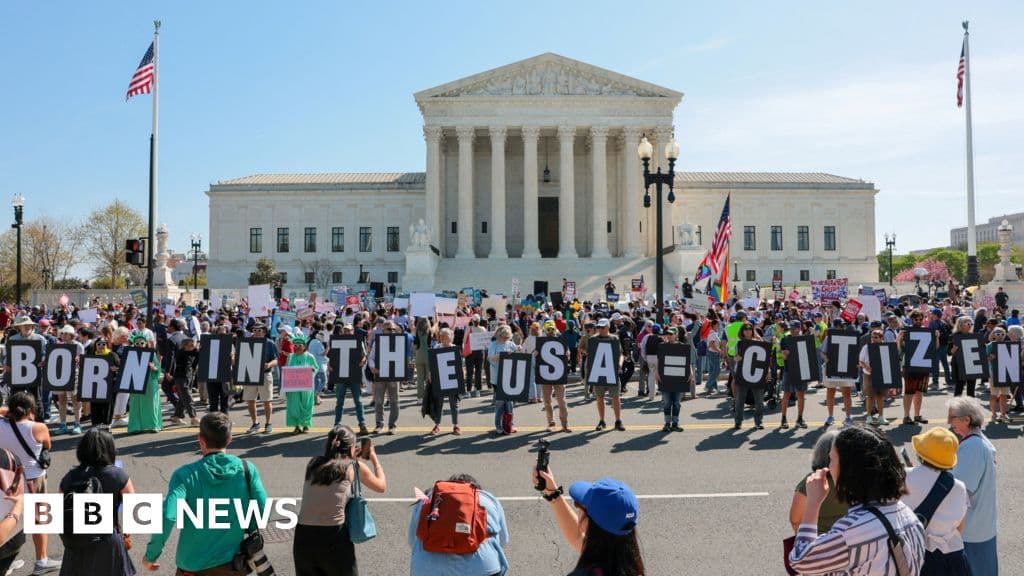
The Supreme Court shows skepticism toward Trump's birthright citizenship order, questioning its legal basis and implications for immigration policy.
GlipzoIn a pivotal moment for immigration policy, the US Supreme Court has expressed significant skepticism regarding President Donald Trump's executive order aimed at limiting birthright citizenship. This move could potentially dismantle a significant aspect of the administration's immigration strategy, with implications resonating across the nation. The arguments were presented on Wednesday, and the court's reactions suggested that the majority of justices are not convinced by the administration's rationale for changing the long-standing practice of granting citizenship to children born to undocumented immigrants and temporary visitors.
The Trump administration has contended that curbing birthright citizenship is essential for controlling illegal immigration. However, critics argue that such a change would overturn over a century of legal precedent and undermine a fundamental principle of US immigration law. The stakes were heightened further as President Trump attended the oral arguments, a rare occurrence for a sitting president, highlighting the case's significance.
If the court rules against Trump, it would mark a second consecutive defeat for the president at the Supreme Court, following a recent ruling that invalidated his global tariffs. A victory, conversely, would enable Trump to advance his promise of overhauling American immigration policies.
During the more than two-hour session, US Solicitor General John Sauer sought to persuade the justices that the 14th Amendment, which enshrines birthright citizenship, had been misinterpreted. He argued that the amendment, initially designed to grant citizenship to formerly enslaved individuals, should not extend to the children of undocumented immigrants.
Chief Justice John Roberts, who often serves as a key swing vote, raised concerns about the implications of limiting citizenship. He questioned how the administration could justify excluding such a broad group of individuals from citizenship rights. “I'm not quite sure how you can get to that big group,” Roberts stated, indicating his hesitation regarding the administration's stance.
A critical point of contention was the interpretation of a specific clause in the 14th Amendment, which grants citizenship to all individuals born or naturalized in the US who are “subject to the jurisdiction thereof.” Sauer posited that this clause should apply only to children of foreign diplomats and a few select groups, claiming that parents who are in the country illegally owe allegiance to their home countries, hence not falling under US jurisdiction.
Several justices, including Justice Elena Kagan, noted that the administration's attempt to redefine birthright citizenship could disrupt a legal tradition rooted in English common law. Kagan remarked, “What the 14th Amendment did was accept that tradition and not attempt to put any limitations on it. That was the clear rationale.” This perspective highlights the importance of maintaining established legal principles in the face of new interpretations.
Justices also referenced the landmark 1898 Supreme Court case, United States v. Wong Kim Ark, which reinforced birthright citizenship for children born to immigrants residing in the US. Cecillia Wang, an attorney for the ACLU, argued that this precedent strongly supports overturning Trump’s executive order. Justice Brett Kavanaugh acknowledged the potential impact of Wong Kim Ark on their deliberation, stating, “If we agree with you how to read Wong Kim Ark, then you win.” This exchange underscores the delicate balance the justices must navigate between legal interpretation and the potential ramifications of their ruling.
As the Supreme Court deliberates, the specifics of their ruling could take various forms. Legal experts suggest that the justices may opt for a narrower interpretation, focusing on a 1952 law that codified birthright citizenship rather than engaging in a broader constitutional debate. This approach would allow the court to sidestep significant constitutional questions, as noted by immigration law expert Stephen Yale-Loehr, who remarked, “The court does not like to rule on constitutional issues if it doesn’t have to.”
The anticipated decision is set to be released in June, marking the first substantial immigration ruling by the court since Trump began his second term. The outcome could have far-reaching consequences, not only for the Trump administration's immigration agenda but also for the broader legal landscape surrounding citizenship in the United States.
The debate over birthright citizenship is more than just a legal issue; it encapsulates the ongoing national conversation about immigration, identity, and what it means to be an American. As the Supreme Court prepares to make its ruling, the implications for millions of families and the future of US immigration policy remain at the forefront of public interest.
Looking ahead, observers will be closely monitoring the Supreme Court's decision, as it could redefine citizenship rights and set significant precedents for future immigration cases. How the justices choose to interpret the law will resonate beyond this singular case, impacting the lives of countless individuals and shaping the narrative of American identity for years to come.

Tensions soar as the US and Iran engage in air strikes near the Strait of Hormuz, raising concerns over global oil supply and regional stability.
BBC World
Trump's international interventions face serious stalemates. What will this mean for U.S. foreign policy? Explore the critical challenges ahead.
Indian Express
Tehran denies resignation of President Masoud Pezeshkian amid claims of IRGC influence. What does this mean for Iran's political stability? Click to learn more!
Indian Express