
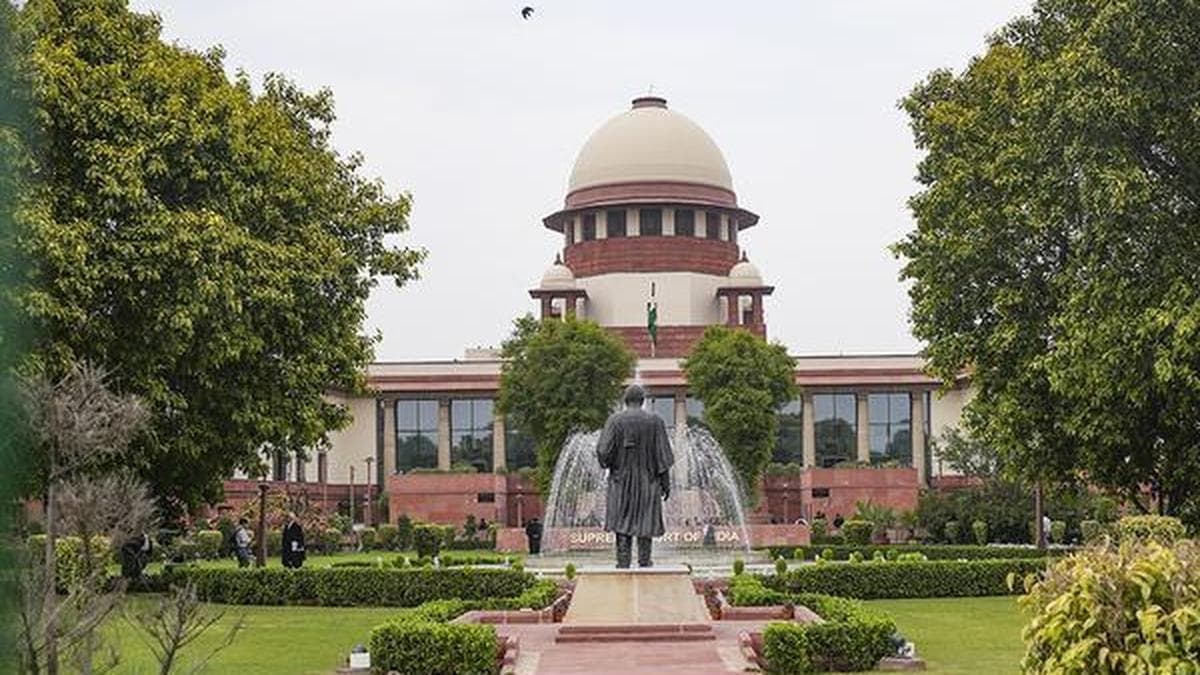
Image: The Hindu
The Supreme Court of India is reluctant to change the five-year law course structure, emphasizing the need for broader stakeholder consultation and reform.
GlipzoOn March 16, 2026, the Supreme Court of India made headlines by showing hesitance to alter the current five-year structure of integrated law programs across the nation. The court emphasized that such significant policy shifts should not fall into the realm of judicial intervention, even while acknowledging the pressing need for reforms to enhance the quality of legal education in India.
The remarks came from a Bench led by Chief Justice Surya Kant and Justice Joymalya Bagchi, who pointed out that while the enhancement of legal education is undoubtedly crucial, changing the duration of professional programs like law requires comprehensive dialogue involving various stakeholders.
> "On the issue of legal education, the judiciary is just one stakeholder. There are many others who also have a say in it," stated the Bench, stressing the importance of including academicians, jurists, and policy researchers in such discussions. This remark underscores the complex nature of legal education reform, which cannot be dictated solely by judicial authority.
The Supreme Court's comments came during the consideration of a Public Interest Litigation (PIL) filed by advocate Ashwini Upadhyay. The petition seeks the formation of a Legal Education Commission composed of distinguished jurists and legal scholars. This commission would be tasked with reviewing the existing regulatory framework governing legal education in India, including the syllabi and the duration of law programs.
Advocate Upadhyay highlighted the disparity in program durations, noting that most professional courses in India, such as CA and B.Tech, are structured for four years, unlike the five-year law programs. He argued that this extended duration could potentially deter talented students from pursuing a career in law, a field that is crucial for upholding justice and social order.
> "This is a PIL seeking the constitution of a Legal Education Commission of eminent jurists to frame the syllabus. Most professional courses are four years, whereas law is five years. It is failing to attract the best talent," Upadhyay asserted.
Chief Justice Surya Kant provided historical context to the five-year law program, clarifying that it predates the establishment of the National Law School system in India. He noted that the first five-year law course was initiated by Maharshi Dayanand University in 1982 or 1983, well before the National Law School came into existence, which has since been viewed as a model for legal education in the country.
Despite acknowledging the historical significance of the five-year program, the Chief Justice pointed out that it might not be within the judiciary's purview to dictate the length of professional courses. He raised a pertinent question to advocate Upadhyay regarding why universities that oppose the five-year structure do not independently pursue changes:
> "Then why can't they reduce the term? Why is a court order needed?"
In response, Upadhyay emphasized the necessity for a coordinated approach, stating that any changes in the duration of law programs would require the endorsement of the Bar Council of India (BCI), the body responsible for regulating legal education in India.
The PIL reflects a growing concern within the legal community regarding the effectiveness of current legal education programs. It points out that the National Education Policy (NEP) 2020 advocates for four-year undergraduate courses across various disciplines, yet the BCI has not acted to review the syllabus, curriculum, or duration of Bachelor of Laws (LLB) and Master of Laws (LLM) degrees.
The petition contends that the five-year structure is not only disproportionate to the course material but also imposes a significant financial burden on students. This extended timeline delays graduates' entry into the workforce, further exacerbating the challenges faced by aspiring legal professionals.
The Supreme Court has scheduled further hearings for April 2026 to continue discussions on this pressing issue. As the legal community awaits the court's next move, several factors will be pivotal in shaping the future of legal education in India:
The conversation around legal education in India is far from over, and as it evolves, the implications for students, educators, and the legal profession as a whole are significant. The outcome of this case could set a precedent for how legal education is structured in the future, impacting countless aspiring lawyers across the nation.
---

Tensions soar as the US and Iran engage in air strikes near the Strait of Hormuz, raising concerns over global oil supply and regional stability.
BBC World
Trump's international interventions face serious stalemates. What will this mean for U.S. foreign policy? Explore the critical challenges ahead.
Indian Express
Tehran denies resignation of President Masoud Pezeshkian amid claims of IRGC influence. What does this mean for Iran's political stability? Click to learn more!
Indian Express