
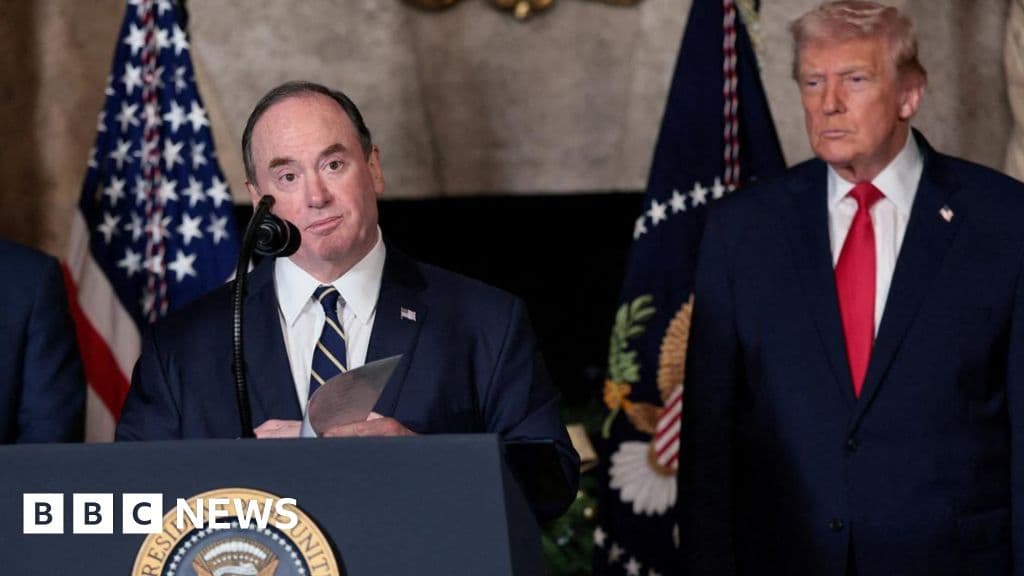
Image: BBC World
US Navy Secretary John Phelan exits his position immediately amid rising tensions in the Middle East. Discover what this means for military strategy.
GlipzoIn a surprising turn of events on Wednesday, the Pentagon announced that US Navy Secretary John Phelan has left his position, effective immediately. This unexpected announcement has raised eyebrows within military circles and beyond, as it comes amid escalating tensions in the Middle East, particularly relating to the US-Israel conflict with Iran. Pentagon spokesman Sean Parnell confirmed Phelan's exit via a social media post, stating that Navy Undersecretary Hung Cao will step in as acting secretary during this transitional period.
Phelan's resignation marks the latest in a series of high-profile departures from the Trump administration, particularly within the Department of Defense. His exit is particularly significant given the current geopolitical climate, where the US blockade of the Strait of Hormuz is under scrutiny. Notably, Phelan did not provide specific reasons for his abrupt departure, leaving many to speculate on the underlying motives.
Phelan’s resignation aligns with a broader trend of military leadership changes since Defense Secretary Pete Hegseth took office. In recent weeks, Hegseth has requested the resignations of multiple senior military officials, including Army Chief of Staff Randy George, and has removed others such as Gen David Hodne and Maj Gen William Green. This wave of dismissals suggests a possible push for new strategies and leadership approaches within the military ranks, especially as the US navigates complex international conflicts.
On behalf of the Department of Defense, Parnell expressed gratitude for Phelan's service, stating, "We are grateful to Secretary Phelan for his service to the Department and the United States Navy. We wish him well in his future endeavors." Such statements, however, often mask the tumultuous circumstances surrounding such departures.
With Phelan stepping down, Hung Cao will now assume the role of acting secretary. Appointed as undersecretary in October 2025, Cao brings 25 years of Navy experience to the table. Notably, he previously ran for a Senate seat in Virginia in 2024, where he garnered support from Trump. His campaign was marked by controversial remarks regarding military diversity initiatives, and he expressed a desire for a more aggressive recruitment strategy, asserting that the Navy needs “alpha males and alpha females.”
Cao’s appointment raises questions about future Navy policies and directions, particularly as the military grapples with recruitment challenges in an evolving societal landscape. Observers will be closely watching whether Cao’s leadership style aligns with the aggressive military posture favored by some factions within the GOP.
The timing of Phelan's exit is crucial, given that it coincides with the US's ongoing military strategy in the region. The US blockade of Iranian ports continues to be a focal point of tension, especially in light of recent clashes in the Strait of Hormuz, a critical route for global oil supply. In a statement, White House Press Secretary Karoline Leavitt indicated that President Trump remains satisfied with the current blockade strategy, emphasizing that Iran's position appears weakened.
Iran has responded to US and Israeli military actions by asserting its control over the Strait of Hormuz, claiming to have seized two vessels in the area. Mohammad Bagher Ghalibaf, Iran's chief negotiator, has stated that reopening the Strait of Hormuz is impossible given the ongoing violations of the ceasefire by the US and Israel. This situation underscores the fragile nature of peace in the region and raises concerns about the potential for further escalations.
Phelan's departure highlights a critical moment in US military leadership, especially as tensions with Iran and ongoing conflicts in the region escalate. As the newly appointed acting secretary, Hung Cao will influence key decisions related to Navy operations, recruitment, and policy formulation.
Key takeaways from this leadership change include: - Increased scrutiny on military policy and recruitment strategies under Cao's leadership. - A potential shift towards a more aggressive military posture, reflecting the sentiments of Trump's MAGA base. - Ongoing international tensions in the Middle East will likely influence military strategies and personnel decisions.
As the new acting secretary, Cao will need to navigate these complex dynamics while addressing the internal challenges within the Navy, including recruitment and retention. Observers will be keen to see how this leadership transition impacts US military strategy in the coming months.
The departure of Phelan and the ascension of Cao signal a pivotal moment for the US Navy amidst ongoing geopolitical tensions. The military community will be looking for signs of how Cao will approach recruitment, diversity initiatives, and operational strategies. Furthermore, as the US continues to assert its presence in the Strait of Hormuz, the Navy's role will be critical in maintaining international shipping routes and national security.
Moving forward, stakeholders will be closely monitoring the implications of this leadership change on military policy and readiness. The evolving situation in the Middle East, coupled with internal changes within the Navy, could have lasting impacts on US military strategy and international relations.

Tensions soar as the US and Iran engage in air strikes near the Strait of Hormuz, raising concerns over global oil supply and regional stability.
BBC World
Trump's international interventions face serious stalemates. What will this mean for U.S. foreign policy? Explore the critical challenges ahead.
Indian Express
Tehran denies resignation of President Masoud Pezeshkian amid claims of IRGC influence. What does this mean for Iran's political stability? Click to learn more!
Indian Express