
Image: Indian Express
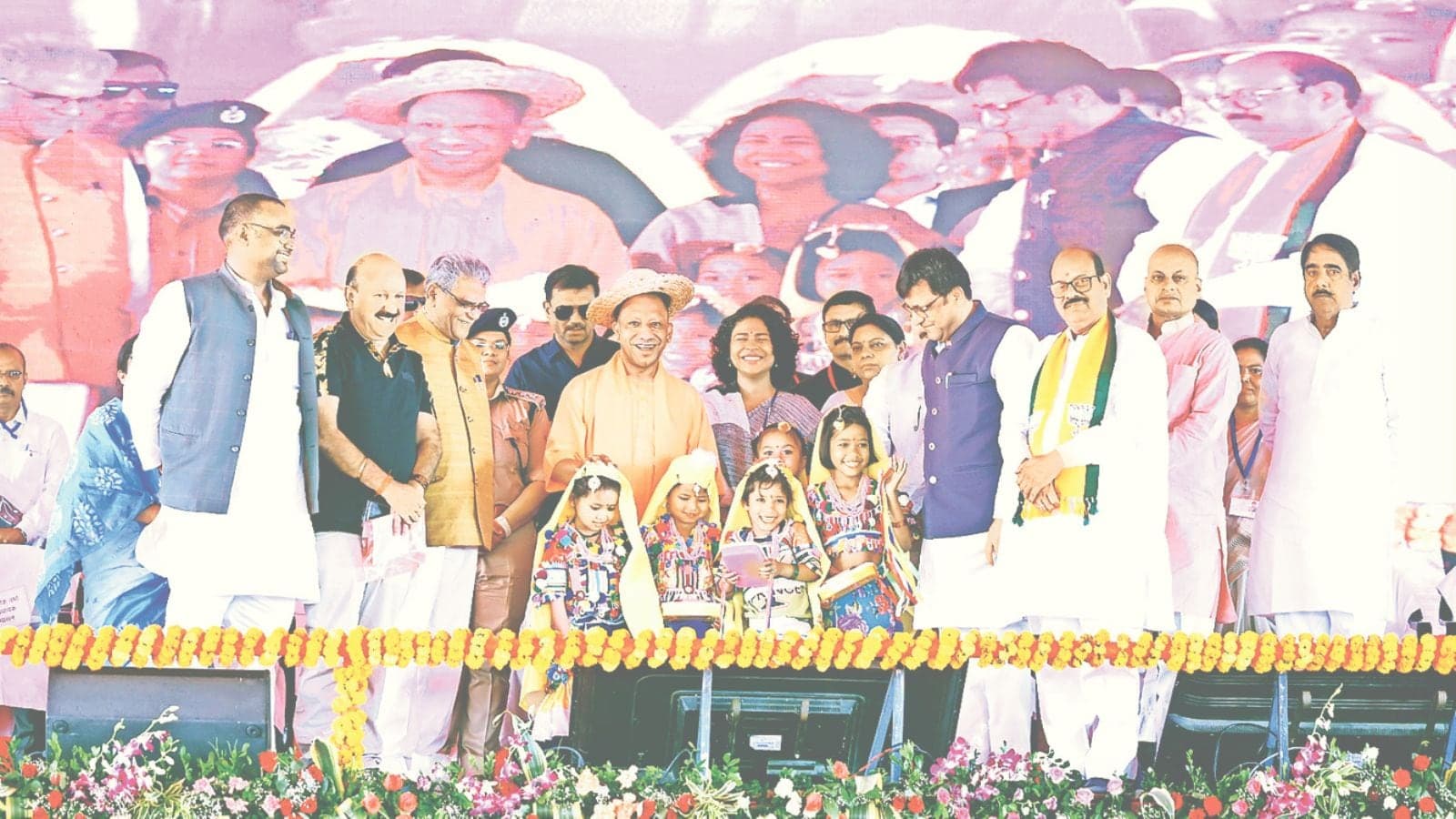
Uttar Pradesh CM Yogi Adityanath grants land rights to 331 Hindu families displaced from Bangladesh, aiming to reshape their identity and future.
GlipzoUttar Pradesh Chief Minister Yogi Adityanath took a significant step on Saturday by distributing land ownership certificates to 331 Hindu families who were displaced from Bangladesh. This event took place in Lakhimpur Kheri, where Adityanath emphasized that these families were forced to leave their homeland, as Bangladesh had rejected them and seized their ancestral properties.
During the distribution ceremony, held in Lakhimpur Kheri, the Chief Minister made a bold announcement to rename the village of Miyapur to Ravindra Nagar, in honor of the esteemed Nobel laureate Rabindranath Tagore. He stated that the previous name was a means to obscure the identities of the displaced families.
> “Their identity will now be linked to Gurudev Tagore,” Adityanath proclaimed, highlighting the need to celebrate Indian heritage rather than “symbols of subjugation.”
The Chief Minister criticized the Congress Party for failing to provide these individuals with land ownership rights despite their past electoral support. He argued that the village's original name was misleading, as no Miya lived there, thus further alienating the community from their roots.
In a broader initiative, Yogi Adityanath announced plans to extend land ownership to 1,031 displaced Hindu and Sikh families across several regions, including Lakhimpur Kheri, Gola Gokarnnath, Dhaurahra, and Mohammadi. He mentioned that approximately 65,000 families displaced from Bangladesh currently reside in Pilibhit, Lakhimpur Kheri, Rampur, and Bijnor districts, reinforcing the government's commitment to granting them ownership rights.
> “Persecuted minorities in Bangladesh look toward India with hope and trust,” he stated, asserting that various communities, including Hindus, Sikhs, Buddhists, Jains, Parsis, and Christians, have suffered under the politics of appeasement.
Adityanath did not shy away from criticizing political adversaries during his speech. He accused the Congress Party, Samajwadi Party, and Trinamool Congress (TMC) of exacerbating the plight of Hindus and other minorities through their policies. He referenced the Citizenship Amendment Act (CAA), which faced opposition from these parties, arguing that such resistance undermines social unity in India.
> “These parties glorify figures like Muhammad Ali Jinnah, while we celebrate the unifying legacy of Sardar Vallabhbhai Patel,” he remarked, indicating that such divisions weaken the fabric of Indian society.
The CM recalled the historical context of religious extremism, which he claimed had devastated the lives of Hindus and Sikhs during the partition in 1947 and the subsequent establishment of Bangladesh in 1971. He emphasized that atrocities continued against Hindus long after the formation of Bangladesh, yet the opposition parties chose to remain silent.
In addition to the land ownership initiatives, Adityanath announced the withdrawal of criminal cases against the Tharu tribal community, which had migrated to Lakhimpur Kheri from the eastern regions of Uttar Pradesh. During the same event, he distributed land rights certificates to over 4,000 families of the Tharu community, promising that no one would be allowed to oppress them.
> “Our government will withdraw all cases registered against the struggling Tharu community by the SP government,” he assured, reinforcing the administration's commitment to protecting the rights of marginalized communities.
Yogi Adityanath's actions reflect a broader strategy aimed at integrating displaced communities into the socio-economic fabric of Uttar Pradesh. By granting land ownership rights, the government seeks to provide stability and a sense of belonging to those who have faced adversity.
As this initiative progresses, it will be crucial to monitor how the government addresses the needs of these communities in the long term. Will the provisions for land ownership translate into economic empowerment and improved living conditions?
The coming months will reveal whether this move can foster social cohesion and whether it signals a shift in how displaced minorities are treated in India.
This initiative highlights the ongoing challenges faced by displaced minorities in India and the government's role in shaping their future. By addressing historical injustices and providing land rights, the administration aims to build trust among these communities and create a more inclusive society. However, the political implications of such moves will also be significant as they could influence upcoming electoral dynamics in the region.

Tensions soar as the US and Iran engage in air strikes near the Strait of Hormuz, raising concerns over global oil supply and regional stability.
BBC World
Trump's international interventions face serious stalemates. What will this mean for U.S. foreign policy? Explore the critical challenges ahead.
Indian Express
Tehran denies resignation of President Masoud Pezeshkian amid claims of IRGC influence. What does this mean for Iran's political stability? Click to learn more!
Indian Express