
Image: BBC Business
A major fire at Australia's Corio oil refinery raises concerns over petrol supplies amid a global fuel crisis. What does this mean for consumers?
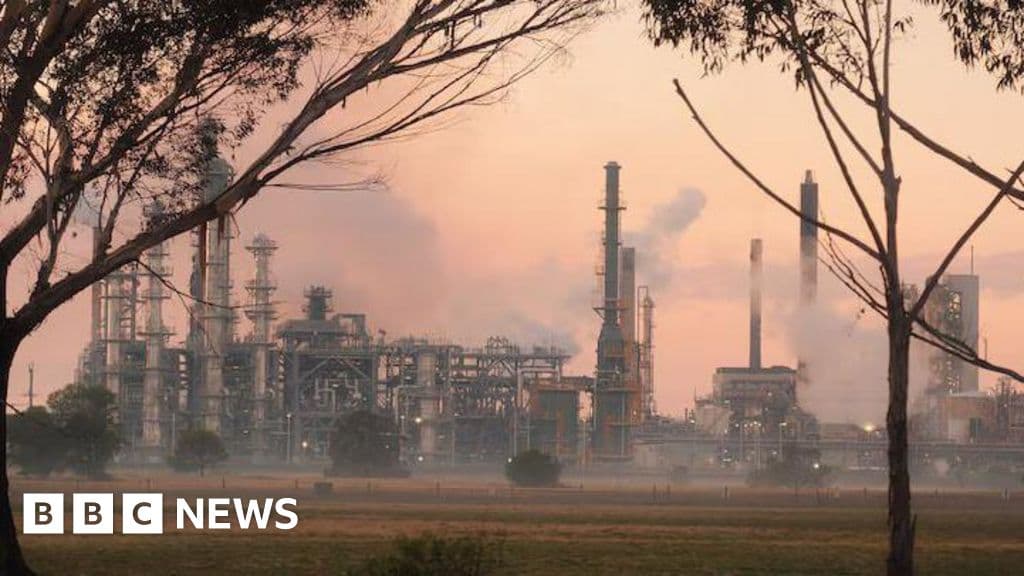
GlipzoA significant fire incident has occurred at Viva's Corio oil refinery in Geelong, located southwest of Melbourne, late Wednesday night, raising alarms over the future of Australia's petrol supplies. With flames and explosions reported just before midnight, emergency responders swiftly mobilized to tackle the situation. This refinery is crucial, producing 50% of Victoria's fuel and 10% of the nation's total output.
Fortunately, there have been no injuries reported from the incident; however, the fire continues to burn, leading authorities to issue warnings regarding the air quality in the vicinity. Energy Minister Chris Bowen expressed concerns about the timing of the fire amidst an ongoing global fuel crisis exacerbated by geopolitical tensions, particularly the situation in Iran.
While the refinery remains partially operational, with reduced levels of jet fuel and diesel production continuing for safety reasons, the government has alerted citizens to potential disruptions in petrol supply. Bowen remarked, "This is not a positive development, but obviously there's a long way to go in terms of working out just what the impact is." He emphasized the need for a thorough assessment of the situation with the involved companies.
The incident unfolds against the backdrop of rising fuel prices in Australia, where the cost of diesel has reportedly doubled in recent weeks. Fuel stations are experiencing shortages, and panic buying has ensued, with airlines also scaling back services due to skyrocketing jet fuel costs. Bowen's comments highlight the urgency of the situation as the nation grapples with fuel supply challenges.
According to Fire Rescue Victoria, the fire originated from an equipment failure, and an investigation is set to follow. The refinery typically processes about 120,000 barrels of oil daily and employs over 1,100 workers. Scott Wyatt, CEO of Viva Energy, stated that the immediate priority is ensuring the site’s safety rather than production. He clarified that while two petrol production units were affected, others remained intact, though the potential for petrol supply impact is significant.
"We’ll only start increasing production again once we’re confident we can do that safely," Wyatt noted, underscoring the careful approach needed in the wake of the fire.
Experts have weighed in on the implications of the fire for Australia’s fuel availability. The country heavily relies on imported refined fuels, primarily sourced from Singapore, South Korea, and Malaysia. This diversified supply chain offers a certain level of resilience against short-term domestic disruptions. Professor Yuan Chen from the University of Sydney remarked, "This diversified supply chain provides a degree of resilience against short-term domestic disruptions."
However, Hussein Dia from Swinburne University of Technology warned that while immediate fuel shortages are unlikely, the fire has reduced the buffer needed to absorb shocks in supply.
The incident has also had a direct impact on the local community. Ronnie Hayden, state secretary of the Victorian branch of the Australian Workers' Union, reported that between 50 to 100 employees were present at the refinery during the fire but were successfully evacuated. Geelong Mayor Stretch Kontelj described the event as “unprecedented”, indicating that the fire could persist for several hours, complicating firefighting efforts.
"I've spoken to management there this morning and needless to say, this has been a huge shock and has rocked them," Kontelj shared with the ABC. He noted the intensity of the fire made it challenging for firefighters to intervene effectively, stating, "The fire is still burning and will have to just burn out."
As authorities and industry leaders assess the ongoing situation, the focus will be on how quickly the refinery can return to full operational capacity and what measures will be taken to mitigate the effects on fuel supplies. Fuel prices may continue to fluctuate as the market reacts to the incident, and consumers may need to prepare for potential shortages.
The fire at the Corio refinery highlights the critical nature of domestic fuel production and the implications of supply chain disruptions. Stakeholders will be closely monitoring developments, and further updates will be essential for both the industry and the public.
In summary, the situation remains fluid. The government’s response, coupled with assessments from industry experts, will shape the narrative in the days ahead. Keeping an eye on fuel availability and price trends will be crucial as Australia navigates through this challenging period.
Commercial LPG prices have risen again, with increases of ₹42 in Delhi and ₹53.50 in Kolkata impacting businesses and consumers alike. Find out more.
Indian Express
Discover how a tragic coal mine explosion in Shanxi, China, reveals ongoing safety concerns in the industry amidst a push for green energy.
BBC Business
Montek Singh Ahluwalia highlights key economic challenges for India, emphasizing the need for a strategic approach to balance payments and investment.
Indian Express