
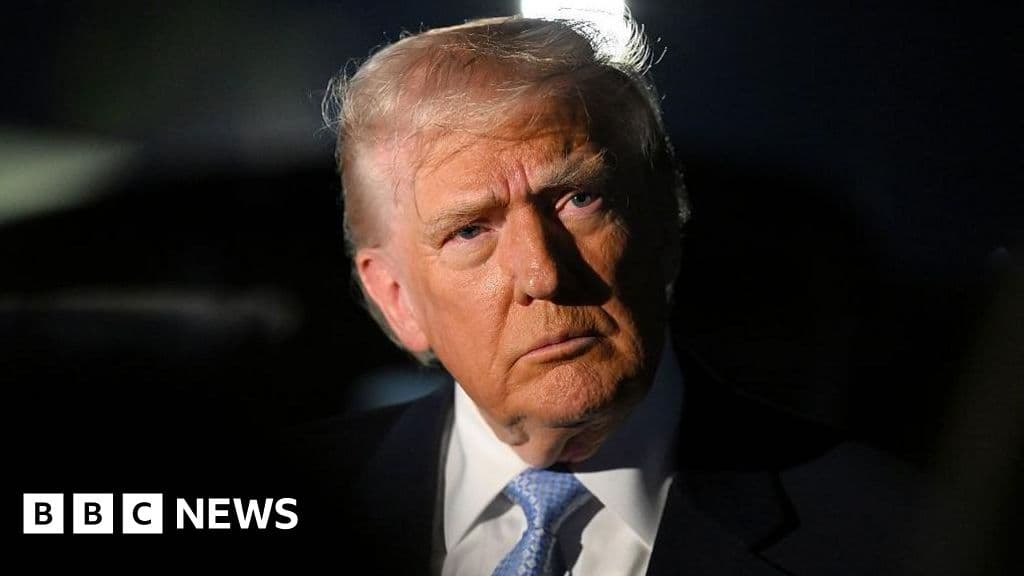
Image: BBC World
Explore the ongoing crisis in the Strait of Hormuz and the skepticism from NATO allies towards Trump's approach. What’s next for global security?
GlipzoIn a surprising twist, President Donald Trump has reignited tensions with NATO allies by suggesting that failure to secure the Strait of Hormuz would be detrimental to the alliance’s future. This remark, made in the context of escalating tensions with Iran, raises significant concerns about the implications of U.S. foreign policy and NATO's role in global security. General Sir Nick Carter, the former chief of the Defence Staff, responded critically, stating, "NATO was created as a… defensive alliance. It was not an alliance that was designed for one of the allies to go on a war of choice and then oblige everybody else to follow."
Trump's remarks come on the heels of a history of his criticisms of NATO members, often questioning their contributions to collective defense. With tensions rising in the Gulf region, his new stance underscores the complexities of international alliances and the expectations placed upon them. The irony is palpable, especially considering Trump’s recent claims over Greenland, an area that further complicates NATO dynamics.
The reaction from European allies has been notably blunt. In Germany, a government spokesperson stated that any conflict with Iran is not a matter for NATO. Defence Minister Boris Pistorius reflected skepticism regarding the capabilities of European naval forces, questioning, "What does Trump expect from a handful of European frigates that the powerful US navy cannot do? This is not our war. We have not started it."
This skepticism highlights a growing divide between the U.S. and its European partners. With the Strait of Hormuz being a critical maritime route for global oil shipments, the stakes are undeniably high. Yet, the lack of consensus about NATO's involvement in a potential conflict with Iran raises urgent questions about the alliance's effectiveness and relevance in contemporary geopolitics.
Despite the dismissive responses from NATO allies, the situation in the Gulf is dire. Iran's actions, notably its control over the Strait of Hormuz, have put Western governments in a precarious position. The current blockade of the strait, allowing only a few vessels to pass, has prompted calls for urgent diplomatic and military solutions before the economic ramifications escalate further.
At a recent press conference, UK Prime Minister Sir Keir Starmer acknowledged ongoing discussions with the U.S., European nations, and Gulf partners to devise a workable strategy. However, he cautioned that decisions are yet to be made. The Prime Minister mentioned the deployment of autonomous mine-hunting systems in the region, which adds a new dimension to naval operations.
The Royal Navy's current posture reflects a significant shift. With the HMS Middleton, a crucial mine countermeasures vessel, undergoing maintenance back in Portsmouth, there are no British mine-clearing ships actively deployed in the Gulf for the first time in decades. Instead, the Royal Navy is exploring the use of advanced seaborne drones designed to neutralize mines while keeping personnel safe.
This shift raises concerns about preparedness. Historically, minesweeping was a fundamental task for navies, but with changing priorities, many nations have reduced their capabilities. Tom Sharpe, a former commander in the Royal Navy, emphasized the risks associated with untested technologies in combat situations, stating, "We're probably going to find out in the next few weeks whether or not it works."
General Carter also highlighted that the last significant de-mining operation by Western forces occurred in 1991 during the Gulf War, when Iraq laid mines to thwart an amphibious landing. It took 51 days to clear those mines, illustrating the complexities and time demands of such operations. Unfortunately, the U.S. Navy has also been moving away from its specialized Avenger-class minesweepers, opting for Independence-class littoral combat ships that incorporate unmanned systems instead.
Beyond minesweeping, Iran's Revolutionary Guard poses additional threats with its arsenal of armed fast boats, naval drones, and shore-launched missiles. Recent imagery released by Iran's Fars News Agency indicates a well-prepared military strategy, with numerous boats and drones stored in underground facilities, underscoring the potential for significant disruptions to shipping in the region.
As the situation continues to unfold, the urgency for a cohesive strategy cannot be overstated. The potential for conflict in the Gulf, exacerbated by Trump's provocative statements and the complex dynamics within NATO, poses risks not only to regional stability but also to the global economy. The intertwining of military readiness, diplomatic negotiations, and the economic implications of a disrupted Strait of Hormuz will shape the coming weeks.
Going forward, observers should keep a close eye on: - The ongoing diplomatic talks among NATO allies and Gulf states. - Developments in military technology and readiness in response to the crisis. - Iran’s movements and the potential for further escalation or conflict.
In conclusion, the conversation surrounding NATO's role in addressing the Iranian crisis is far from over, and how the alliance navigates these challenges will significantly influence its future effectiveness and cohesion. The stakes are high, and the world is watching closely.

Tensions soar as the US and Iran engage in air strikes near the Strait of Hormuz, raising concerns over global oil supply and regional stability.
BBC World
Trump's international interventions face serious stalemates. What will this mean for U.S. foreign policy? Explore the critical challenges ahead.
Indian Express
Tehran denies resignation of President Masoud Pezeshkian amid claims of IRGC influence. What does this mean for Iran's political stability? Click to learn more!
Indian Express