
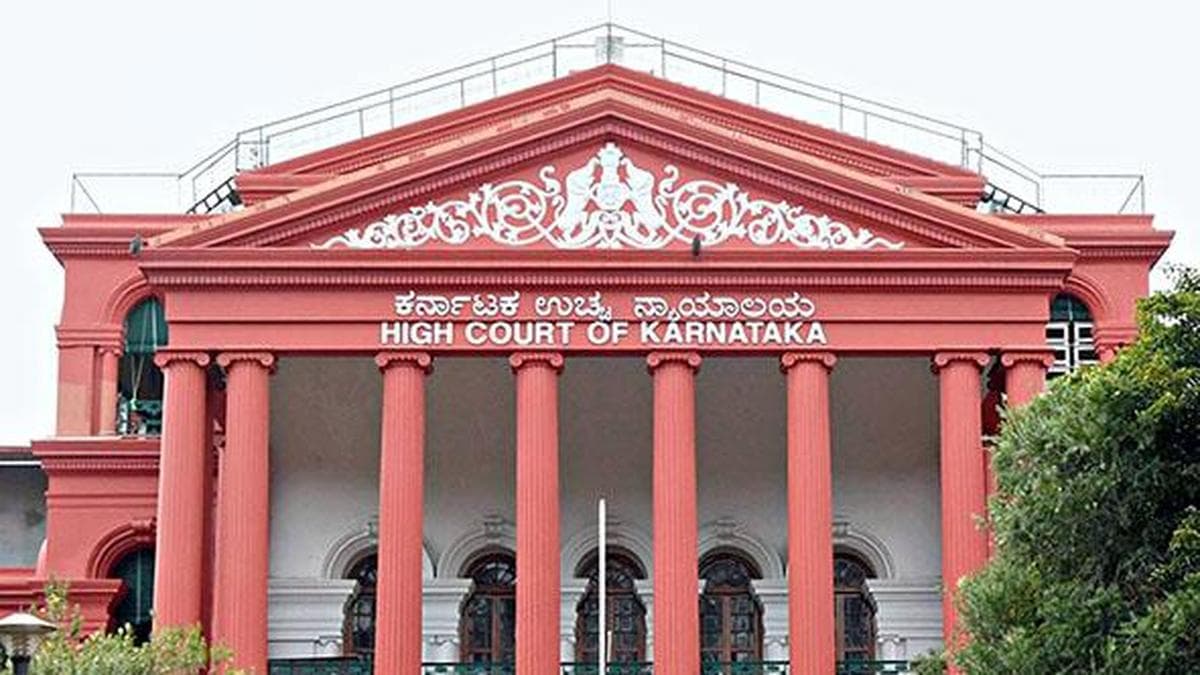
Image: The Hindu
Karnataka High Court rules CMO must not handle employee transfers, emphasizing efficiency and independence in state governance. Learn more.
GlipzoIn a pivotal ruling on March 20, 2026, the Karnataka High Court declared that the Chief Minister’s Office (CMO) should refrain from directly addressing requests related to employee transfers and postings. This decision underscores the necessity for the Chief Minister to focus on essential state functions rather than getting involved in the administrative details of personnel management within government bodies and public sector undertakings.
The ruling was issued by a Division Bench consisting of Justice D.K. Singh and Justice T.M. Nadaf while resolving an appeal brought forth by Chethan S., an assistant engineer employed by the Bangalore Electricity Supply Company Ltd. (BESCOM). Chethan had contested a prior decision made by a single judge on September 9, 2024, which dismissed his petition regarding BESCOM's refusal to post him to a specific sub-division, despite receiving approval from the Chief Minister on June 24.
The judges emphasized that the government’s personnel management should be left to the respective administrative departments. They stated, “The highest authority of the State has better and more important work to perform than interfering with the transfers and postings of the employees.” This perspective aims to streamline government operations and reduce the potential for conflicts arising from political influence in administrative affairs.
The court's ruling highlighted the existing transfer guidelines that necessitate the Chief Minister’s approval only in particular cases, such as premature and delayed transfers. The judges firmly concluded that no direct requests for transfer and posting should be permitted from the CMO, reinforcing the idea that such matters should be resolved at the departmental level.
In a related development, the Chief Secretary of Karnataka, Shalini Rajneesh, submitted an affidavit on March 3, 2026, clarifying that notes received from the CMO are merely recommendatory and do not constitute transfer orders or approvals. She stressed that it is up to the concerned departments to evaluate such recommendations in accordance with the Cadre and Recruitment Rules and the General Transfer Guidelines established by the Department of Personnel and Administrative Reforms (DPAR).
The Chief Secretary’s clarification is particularly significant as it aims to dispel any misconceptions regarding the nature of communications from the CMO. This statement addresses the concerns raised by the single judge about the potential for confusion and mismanagement within the transfer process.
The single judge's remarks previously noted that the High Court had observed numerous instances where the CMO had intervened in the transfers of Group B and C employees, which often contradicted the decisions made by the relevant authorities in the departments. This interference raises questions about whether the Chief Minister is aware of the implications of the approvals being issued by the CMO.
The single judge stated, “This generates a doubt as to whether the CM is aware of the kind of orders/approvals obtained from his office.” Such interventions can lead to dissatisfaction among employees and result in unnecessary litigation, as highlighted by the judge.
The Karnataka High Court’s ruling marks a significant shift in the relationship between the CMO and the state's administrative processes. By limiting the role of the Chief Minister in personnel transfers, the court aims to foster a more efficient and transparent governance structure. This decision could potentially lead to: - Reduced Litigation: With clearer boundaries regarding the role of the CMO, the likelihood of disputes and lawsuits over transfer decisions may diminish. - Enhanced Administrative Efficiency: Allowing departments to handle transfers independently can streamline processes and improve employee satisfaction. - Increased Accountability: Departments will be more accountable for their decisions, leading to better management of personnel resources.
This landmark decision by the Karnataka High Court is not just a legal ruling; it is a pivotal moment for governance in Karnataka, promoting administrative integrity and efficiency while minimizing political interference in employee management.

Tensions soar as the US and Iran engage in air strikes near the Strait of Hormuz, raising concerns over global oil supply and regional stability.
BBC World
Trump's international interventions face serious stalemates. What will this mean for U.S. foreign policy? Explore the critical challenges ahead.
Indian Express
Tehran denies resignation of President Masoud Pezeshkian amid claims of IRGC influence. What does this mean for Iran's political stability? Click to learn more!
Indian Express