
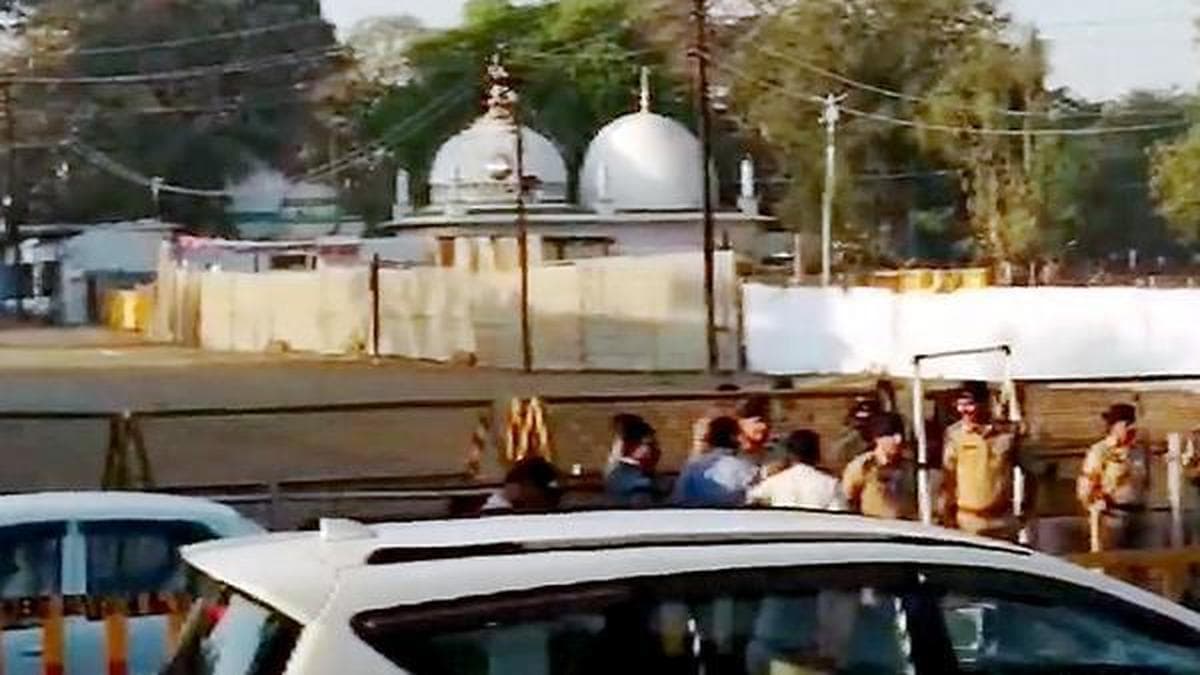
Image: The Hindu
A fresh legal plea claims a Jain temple exists beneath the disputed Bhojshala-Kamal Maula Mosque, sparking controversy and community debate. What’s next?
GlipzoThe Bhojshala-Kamal Maula Mosque site continues to be a focal point of contention in India as fresh legal arguments arise concerning its historical significance. On March 20, 2026, a Division Bench consisting of Justices Vijay Kumar Shukla and Rajesh Kumar Gupta convened in Indore to discuss a petition put forth by Salek Chand Jain, a Delhi-based activist. Jain argues that beneath the current mosque structure exists a historical Jain temple and an educational institution known as a gurukul.
In his petition, Jain is advocating for the Jain community's right to worship at the site, similar to the permissions already granted to both Hindus and Muslims. The court has provided a two-week window for government authorities to submit their objections regarding the maintainability of this public interest litigation (PIL). The next hearing is scheduled for April 2.
During the proceedings, the court acknowledged objections raised by the respondents about the petition's viability as a PIL. The justices granted the government time to respond, emphasizing the importance of addressing these concerns before the next scheduled hearing. This recent plea emerges in the backdrop of ongoing disputes between representatives of both the Hindu and Muslim communities, with the High Court indicating plans to visit the disputed site ahead of the upcoming hearing.
The Archaeological Survey of India (ASI) conducted a detailed survey of the site, prompted by the High Court's directives. Preliminary findings from this massive 2,200-page report indicate that the current mosque structure appears to be built atop the ruins of ancient temples, utilizing remnants from these historic structures. Additionally, the ASI discovered numerous inscriptions in Sanskrit and Prakrit, further supporting the notion of a temple's existence at the site.
Jain's petition claims that the Bhojshala site has historically served as a center for Jain education and worship. One of the focal points of his argument centers around an idol found at the location, which the Hindu community identifies as Vagdevi, the Goddess of Knowledge, specifically Saraswati. Jain asserts that this idol is actually that of Ambika, a revered figure within Jainism, which was installed in the site by King Bhoj of Dhar in 1034 AD.
This idol was reportedly recovered by British authorities in 1875 and is currently housed in a museum in London. Dr. Deepak Nahar, a local activist in Dhar, supports Jain's assertion regarding the idol, but disputes the existence of a Jain temple at the site.
> “The idol is described as that of Jain yakshini Ambika only in the British museum and it is very different from a Saraswati idol,” Dr. Nahar stated, highlighting the differences in historical interpretations.
The ongoing legal battle reflects a broader struggle over the site's historical and cultural narrative. The Hindu petitioners have expressed satisfaction with the ASI's findings, asserting that the structure should be recognized as a Hindu temple. Conversely, the Muslim community has raised concerns, alleging that the ASI neglected their previous objections during the survey process.
Notably, the Bhojshala site is classified as an ASI-protected monument dating back to the 11th century. A 2003 agreement stipulates that Hindus can conduct prayers at the complex every Tuesday, while Muslims are permitted to offer prayers every Friday. This arrangement underscores the site’s significance to multiple religious communities, further complicating the ongoing dispute.
The legal proceedings surrounding the Bhojshala-Kamal Maula Mosque site are significant not only for the communities directly involved but also for the broader discourse on religious heritage and rights in India. The outcome of this case could set a precedent for how such disputes are handled in the future, particularly in a country with a rich tapestry of religious history.
As the next court date approaches, all eyes will be on the arguments presented and the implications they hold for community relations in the region. Will the court's decision favor one community over another, or will it seek a path toward coexistence?
As we anticipate the April 2 hearing, several key aspects will be crucial to monitor: - Government Response: How the government authorities articulate their objections will provide insight into the legal framework surrounding the site. - Community Reactions: The response from both Hindu and Muslim communities may shape the discourse on heritage rights and coexistence. - Court’s Direction: The court's decision will be pivotal in determining the future of religious practices at the site and may influence similar disputes across India.
The ongoing saga at the Bhojshala-Kamal Maula Mosque site serves as a reminder of the complexities inherent in managing historical narratives and religious sentiments in a diverse nation like India.

Tensions soar as the US and Iran engage in air strikes near the Strait of Hormuz, raising concerns over global oil supply and regional stability.
BBC World
Trump's international interventions face serious stalemates. What will this mean for U.S. foreign policy? Explore the critical challenges ahead.
Indian Express
Tehran denies resignation of President Masoud Pezeshkian amid claims of IRGC influence. What does this mean for Iran's political stability? Click to learn more!
Indian Express