
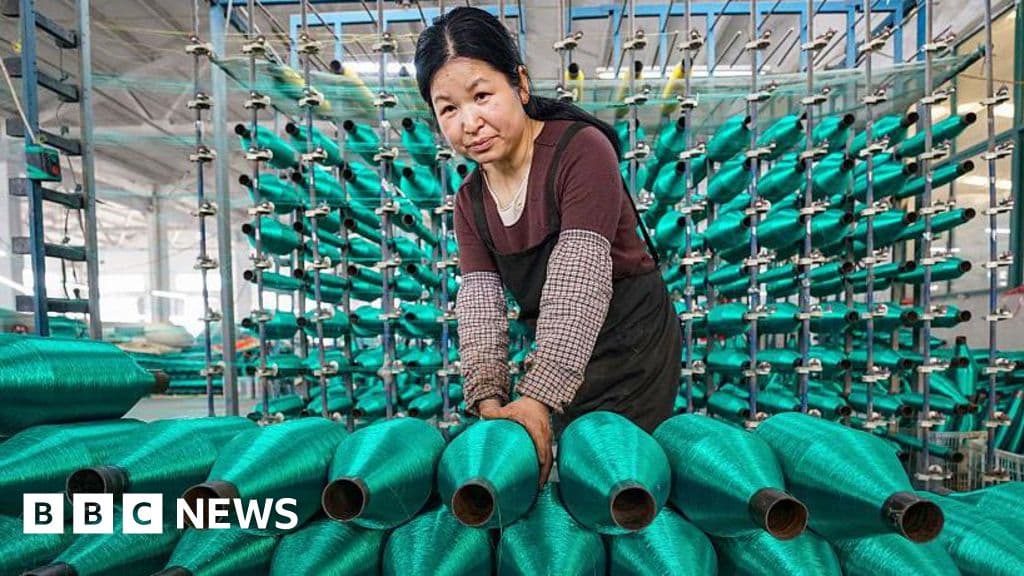
Image: BBC Business
China's economy surprises with 5% growth despite global tensions. Learn how the Iran war impacts trade and what lies ahead for this economic giant.
GlipzoIn a surprising turn of events, China's economy has demonstrated resilience by growing 5% in the first quarter of 2023, surpassing economists' predictions of 4.8%. This growth comes in the midst of a global crisis fueled by the ongoing US-Israel conflict with Iran, which began on February 28 and has disrupted global energy supplies. The data, released by China's National Bureau of Statistics, marks the first update since the government revised its annual economic growth target to a range of 4.5%-5%, the lowest since 1991.
Despite the geopolitical turbulence, particularly affecting Asian markets, China's rebound from a previous quarter's growth of 4.5% can be attributed largely to a robust manufacturing sector. However, the ongoing property investment slump continues to weigh down the economy. Kyle Chan, an analyst at the Brookings Institution, highlighted that while car exports showed promise, the true impact of the Iran conflict on China's economy remains to be fully realized.
As the war in the Middle East continues, the ramifications for China's economy are significant. Chan cautioned that the next quarter's GDP figures might reflect a slowdown due to the trade disruptions caused by the conflict. The Chinese government recently unveiled its economic objectives under the Five-Year Plan, emphasizing investments in innovation and high-tech industries while aiming to stimulate domestic spending.
China's economic landscape is further complicated by external factors such as: - Energy crunch due to the Iran conflict - US tariff policies, which currently impose a 10% tariff on most Chinese goods - A potential restoration of tariffs to previous levels by the beginning of July, as noted by US Treasury Secretary Scott Bessent.
The anticipated meeting between US President Donald Trump and Chinese President Xi Jinping in May could also influence future trade dynamics.
Recent trade data revealed a stark contrast in growth rates, with China's exports slowing significantly to 2.5% in March compared to the same month last year. This decline marks the lowest growth rate in six months and follows a substantial increase in combined exports for January and February, which had seen a jump of over 20%. The slowdown is primarily attributed to the rising costs of goods and reduced consumer spending due to inflation linked to the conflict.
The General Administration of Customs reported that while exports faced challenges, imports surged by nearly 28% in March. This surge indicates rising global costs, likely influenced by the tensions surrounding the Strait of Hormuz, a vital shipping route. As a result, China's monthly trade surplus fell to just over $50 billion, the lowest in more than a year.
Although China is less dependent on oil from the Gulf compared to other Asian economies like Japan and South Korea, rising petrol prices are starting to impact domestic markets. Some Chinese airlines have even begun to reduce flight schedules due to skyrocketing jet fuel costs. As the war progresses, the potential for reduced consumer spending could pose a significant risk to China’s export growth.
Economics lecturer Yixiao Zhou from the Australian National University pointed out that the sustainability of export growth is tied to the economic health of China's trading partners. "Export growth ultimately depends on your trading partners' economies," Zhou stated, emphasizing the importance of global economic conditions on China's export capabilities.
The current state of China's economy amidst the backdrop of geopolitical tensions provides critical insights into the potential for future growth. As the world's second-largest economy navigates through these challenges, its performance could have ripple effects on global markets, influencing trade relationships and economic stability worldwide.
China's efforts to pivot towards high-tech industries and stimulate domestic consumption are crucial strategies aimed at mitigating the adverse effects of international disruptions. Observers are keenly watching how these plans unfold in light of ongoing conflicts and the evolving landscape of global trade.
As China continues to grapple with the effects of the Iran war and domestic economic challenges, stakeholders should monitor several key developments: - Upcoming GDP figures for the next quarter, which could reveal the lasting impact of trade disruptions. - The outcomes of the Trump-Xi meeting in May, which may shape future trade policies and tariffs. - Trends in consumer spending and their implications for exports, especially in light of rising global inflation.
In summary, while China's economy has shown unexpected growth, the challenges posed by international conflicts and domestic issues must not be underestimated. The coming months will be crucial in determining how well China can adapt to ongoing global shifts and maintain its economic momentum.

Commercial LPG prices have risen again, with increases of ₹42 in Delhi and ₹53.50 in Kolkata impacting businesses and consumers alike. Find out more.
Indian Express
Discover how a tragic coal mine explosion in Shanxi, China, reveals ongoing safety concerns in the industry amidst a push for green energy.
BBC Business
Montek Singh Ahluwalia highlights key economic challenges for India, emphasizing the need for a strategic approach to balance payments and investment.
Indian Express