
Image: BBC World
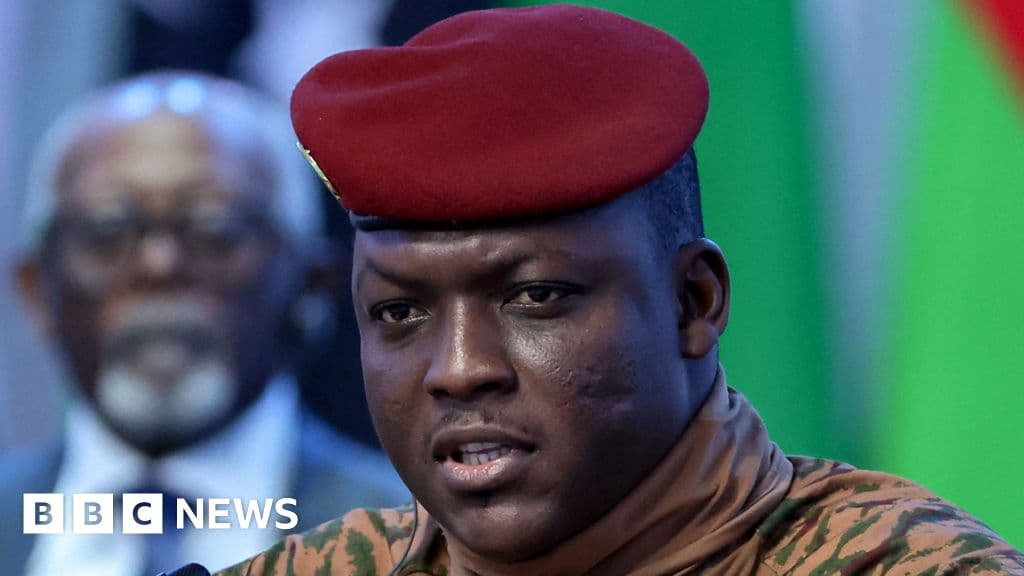
Burkina Faso's military leader Ibrahim Traoré declares democracy a failure, urging citizens to forget it while extending military rule for five more years.
GlipzoIn a recent interview broadcast on state television, Captain Ibrahim Traoré, the military ruler of Burkina Faso, made a shocking statement that could reshape the country's political landscape. He declared that the people must "forget" about democracy, suggesting that it is a system that leads to violence and instability. This assertion comes just months before a promised return to democratic governance, which has now been extended for an additional five years by the military junta.
Taking the reins of power in a 2021 coup, Traoré initially aimed to reinstate democratic processes by July 2024. However, with this deadline approaching, the junta announced a significant policy shift, deciding to prolong their rule. In this context, Traoré argued that the concepts of democracy and political parties are not suitable for Burkina Faso, stating, "People need to forget about the issue of democracy. Democracy is not for us."
He pointed to Libya as a cautionary tale, describing how the imposition of democracy there led to chaos after the fall of Colonel Muammar Gaddafi. Gaddafi's regime, although autocratic, provided certain social services, such as subsidized housing and free education. After his death, Libya descended into turmoil, failing to establish a stable government amidst ongoing violence.
Traoré's recent interview raised eyebrows not only because of its stark rejection of democratic ideals but also due to the junta's recent actions. In January, the military government announced a ban on all political parties, arguing that these entities foster division and instability. Traoré characterized politicians in Burkina Faso as deceitful individuals who embody moral vices, further discrediting the political class.
He claimed, "The truth is, politics in Africa – or at least what we've experienced in Burkina - is that a real politician is someone who embodies every vice: a liar, a sycophant, a smooth-talker." Instead of reverting to a traditional democratic framework, Traoré emphasized a need for a new system that prioritizes sovereignty, patriotism, and revolutionary mobilization. He hinted at a model that would incorporate traditional leaders and grassroots organizations to replace conventional political structures.
In his vision for Burkina Faso, Traoré underscores the importance of economic and military self-sufficiency. He advocates for a work ethic that goes beyond the traditional six- or eight-hour workday, suggesting that such a mindset will not allow Burkina Faso to compete with wealthier nations. This approach aligns with his broader aim to revolutionize how the country operates, distancing it from Western influences.
Despite his controversial stance, Traoré has garnered support from various segments of the population, especially among those disillusioned with traditional political systems. His criticism of Western intervention in Africa resonates with many who view foreign influence as detrimental to African sovereignty.
However, Traoré's leadership has not been without significant challenges. A recent report by Human Rights Watch revealed that over 1,800 civilians have lost their lives in Burkina Faso since Traoré took power. The report attributes approximately two-thirds of these deaths to military operations and allied militias, with the remainder linked to Islamist militants. This statistic paints a grim picture of the ongoing violence that has plagued the region for over a decade.
The junta's departure from collaboration with Western nations, particularly France, in combating Islamist extremism has sparked concerns. Instead, Burkina Faso, along with its neighbors Mali and Niger, has turned to Russia for military support, although this shift has not curbed the violence.
As Burkina Faso navigates this tumultuous period, the international community watches closely. The junta's rejection of democracy raises critical questions about the future of governance in the country. Will Traoré's radical vision for a new political system take root, or will it lead to further instability and violence?
The situation remains fluid, and the potential for conflict or reform hangs in the balance. Observers are keen to see if the junta will maintain its grip on power or if popular dissent will rise against an increasingly authoritarian regime. As the next five years unfold, the world will be watching how the military leadership of Burkina Faso navigates its challenges, particularly in relation to human rights, political freedoms, and the ongoing fight against extremism.
In conclusion, Burkina Faso stands at a pivotal crossroads. The military's dismissal of democratic ideals and its radical reimagining of governance will have lasting implications for both the country and the broader West African region. The question remains: can a nation built on revolutionary principles thrive without the foundations of democracy?

Tensions soar as the US and Iran engage in air strikes near the Strait of Hormuz, raising concerns over global oil supply and regional stability.
BBC World
Trump's international interventions face serious stalemates. What will this mean for U.S. foreign policy? Explore the critical challenges ahead.
Indian Express
Tehran denies resignation of President Masoud Pezeshkian amid claims of IRGC influence. What does this mean for Iran's political stability? Click to learn more!
Indian Express