
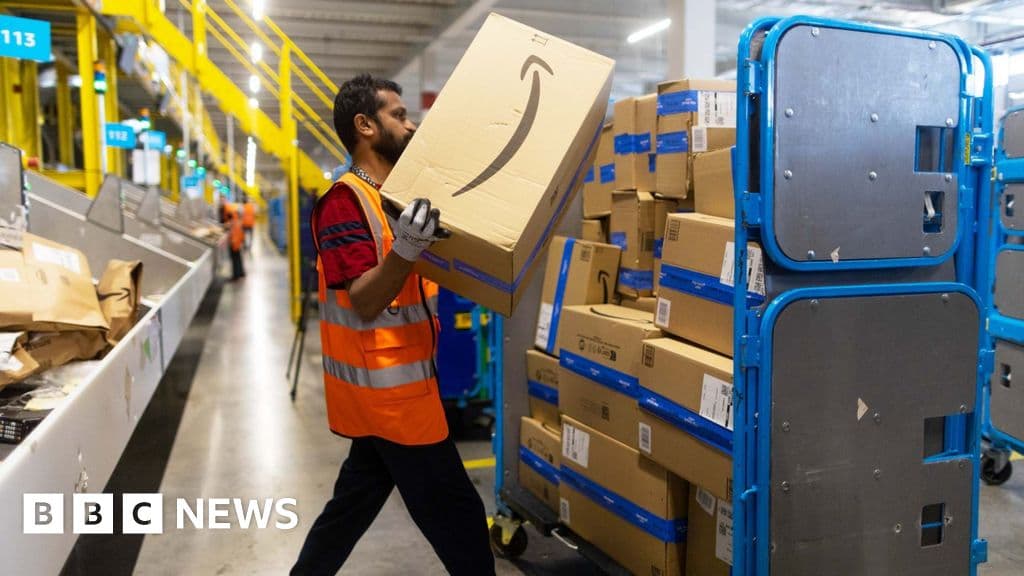
Image: BBC Business
Discover why Amazon leads e-commerce with 40.5% market share and few rivals. Learn about its strategies, technology, and what lies ahead.
GlipzoIn the vast landscape of online shopping, few names resonate as powerfully as Amazon. From vitamins to repair tape and even a jar of mango chutney, countless households rely on Amazon for their shopping needs. Beyond just being a marketplace, Amazon has woven itself into the fabric of everyday life through its ownership of Whole Foods, streaming services, and the AWS (Amazon Web Services) cloud platform. Earlier this year, Amazon surpassed Walmart to become the world's largest company in terms of annual sales, raising questions about its lack of serious competition in the Western e-commerce market.
But why does Amazon stand so tall among its competitors? Is there a lack of competition that leaves consumers at a disadvantage? Despite Amazon's dominance, there are players in the field, including major retailers like Walmart and Target, which have expanded their online capabilities and launched competitive subscription services akin to Amazon Prime. In the UK, Tesco leads in online groceries while Zalando dominates clothing sales in Germany. Additionally, affordable product platforms like Temu and Shein have emerged as significant contenders.
Yet, even with these competitors, Amazon remains the goliath of e-commerce, holding 40.5% of all online retail sales in the U.S. and around 30% in the UK. eBay, often seen as a competitor, has a different business model focused on auctions and collectibles, and its recent $55.5 billion takeover bid by GameStop aims to bolster its market presence. However, eBay's current market share is just 3%, illustrating the vast chasm between it and Amazon.
Experts attribute Amazon's unparalleled market status to several key factors, one being its first-mover advantage. As one of the first companies to scale online retail, Amazon recognized early on how to leverage the internet to revolutionize shopping, achieving rapid market capture.
Another critical aspect is Amazon's unique approach to business sustainability. For years, shareholders permitted the company to operate at a loss, allowing for aggressive reinvestment into growth. Unlike traditional firms that must maintain dividends and shareholder satisfaction, Amazon has never paid a dividend, enabling it to focus on long-term strategies.
David Yoffie, a professor emeritus at Harvard Business School, notes that this strategy has constrained competition, allowing Amazon to thrive where others might falter. Its ability to utilize profits from AWS, its most profitable division, to subsidize its retail operations creates a significant barrier for potential competitors.
Positioning itself as more than just a retail company, Amazon has embraced a technology-first mindset. This approach has enabled the company to leverage algorithms, automation, and data analysis, driving operational efficiency and enhancing the customer experience. The company's culture encourages bold experimentation, venturing into new domains such as cloud computing, consumer electronics, and even healthcare. This willingness to pivot quickly when faced with failure has allowed Amazon to remain agile and responsive to market trends.
Moreover, Amazon's transformation from an online retailer to an online platform in 2000 was a pivotal move. By allowing third-party sellers to list their products, Amazon not only diversified its offerings but also significantly increased its revenue potential without corresponding inventory costs. This model has led to an expansive product range, making it increasingly difficult for competitors to keep pace.
The implications of Amazon's dominance are far-reaching. The company’s market control raises questions about consumer choice and competition. While some argue that Amazon's size leads to better prices and convenience for consumers, others worry that a lack of competition stifles innovation and could ultimately harm consumers in the long run.
As Amazon continues to expand its influence across various sectors, it’s crucial to monitor how this affects not only e-commerce but also related industries. Consumers may benefit from Amazon's efficiencies, but they may also be missing out on the diversity and innovation that comes from a competitive marketplace.
Looking forward, several key developments are worth watching. As competition heats up from both traditional retailers and emerging e-commerce platforms, the question remains: Can anyone effectively challenge Amazon's supremacy?
In summary, Amazon’s ability to dominate the e-commerce landscape is a result of strategic decisions, technological advancements, and a business model that prioritizes growth over immediate profits. As the industry continues to evolve, it will be fascinating to see if competitors can find a way to carve out their own niches—or if Amazon will remain unchallenged in the foreseeable future.

Commercial LPG prices have risen again, with increases of ₹42 in Delhi and ₹53.50 in Kolkata impacting businesses and consumers alike. Find out more.
Indian Express
Discover how a tragic coal mine explosion in Shanxi, China, reveals ongoing safety concerns in the industry amidst a push for green energy.
BBC Business
Montek Singh Ahluwalia highlights key economic challenges for India, emphasizing the need for a strategic approach to balance payments and investment.
Indian Express