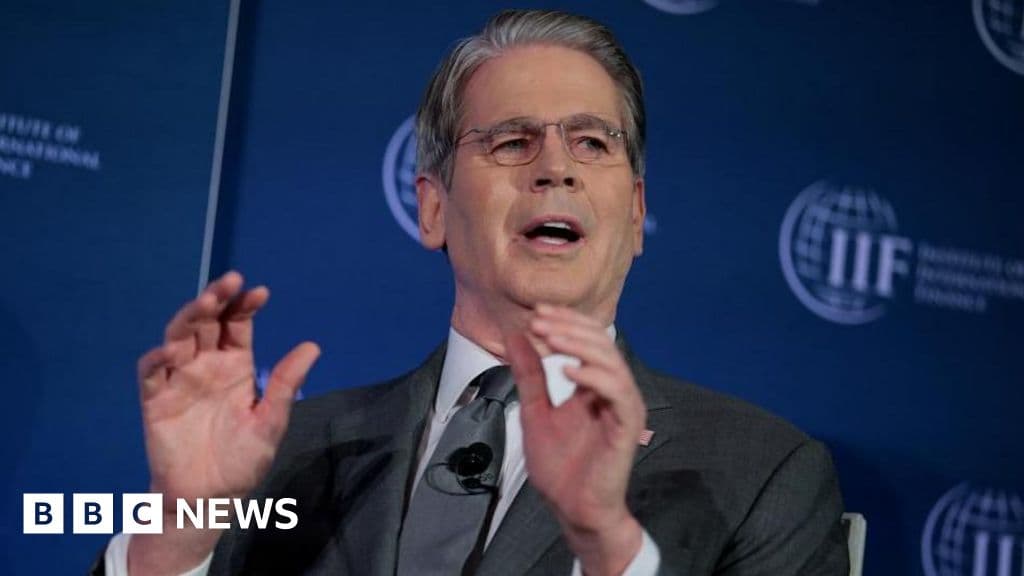
US Treasury Secretary: Short-Term Pain for Long-Term Gain
Treasury Secretary Scott Bessent asserts that short-term economic pain is necessary for long-term security amid rising tensions with Iran. What’s at stake?
Glipzo News Desk|Source: BBC Business
Share
Glipzo
Key Highlights
Bessent: 'A small bit of economic pain' is worth long-term security.
IMF warns conflict could push global growth below 2% by 2026.
Iran enriched uranium to 60%, raising nuclear weapon concerns.
Inflation could reach 6% next year, forcing interest rate hikes.
UK is projected to be hardest hit by the ongoing energy crisis.
Economic Pain for Security: A Necessary Trade-Off
In a bold statement to the BBC, **US Treasury Secretary Scott Bessent** emphasized that a "small bit of economic pain" is an acceptable sacrifice for achieving long-term international security, particularly in light of the ongoing conflict between the **US-Israel coalition and Iran**. As concerns mount over the potential for a global recession due to the war, Bessent's remarks underscore a critical debate about prioritizing national security over immediate economic stability.
Bessent's comments come as the **International Monetary Fund (IMF)** warns that the escalating hostilities could severely disrupt the global economy. Reflecting on the stakes involved, he questioned the potential impact on **global GDP** if a nuclear weapon were to strike a major city like **London**. "I am saying that I am less concerned about short-term forecasts, for long-term security," he stated, highlighting the urgency of addressing the Iranian nuclear threat.
## The Nuclear Threat: A Real Concern
Recent assessments from senior US officials revealed that at the onset of the conflict, Iran had enriched uranium to **60%**, a significant concern given its implications for nuclear weapon development. While Iran does not currently possess nuclear weapons, the risk associated with its ballistic missile capabilities has raised alarms. Bessent referred to the **Iranian military's actions**, such as targeting **Diego Garcia**, underscoring the potential danger to Western capitals.
Despite the **UK government's** position that there is no current assessment of Iran targeting Europe with missiles, Bessent remains steadfast in his belief that the threat cannot be ignored. He remarked, "The biggest risk you can take is one you don't know you were taking," emphasizing the need for vigilance against emerging threats.
## Implications of the Conflict on Global Economy
The IMF has painted a grim picture of the economic fallout from the conflict, noting that if oil, gas, and food prices continue to soar, global growth could plummet to below **2% by 2026**. This scenario would put the world on the brink of recession—a phenomenon that has only occurred four times since **1980**, with the last instance being during the **COVID-19 pandemic**.
Furthermore, since the onset of the war, energy prices have surged, particularly as the **Strait of Hormuz**—a vital shipping route—has been compromised. The IMF cautioned that significant spikes in oil prices, reaching averages of **$110 per barrel in 2026** and **$125 in 2027**, could lead to inflation surging as high as **6%** next year. Central banks might then be forced to raise interest rates to combat rising prices, further complicating the economic landscape.
## Rising Inflation and Unemployment: A Dire Forecast
**Pierre-Olivier Gourinchas**, the IMF's chief economist, warned that the ramifications of a protracted conflict could be dire, leading to rampant inflation, increased unemployment rates, and food insecurity in vulnerable countries. He drew parallels to the **1970s oil crisis**, when Arab oil producers imposed an embargo on countries supporting Israel during the Yom Kippur War, indicating that even a swift resolution of the conflict would have lasting effects on oil supply.
However, Gourinchas also pointed out that the modern world is less reliant on oil and fossil fuels than it was in the past, suggesting that the economic impact on consumers might not be as severe as during previous crises. As the situation evolves, oil prices have fluctuated, reaching close to **$120** during the height of the conflict before settling around **$95** per barrel recently.
## Looking Ahead: Navigating a Complex Landscape
The IMF's projections indicate that the risk of recession will only heighten if adverse conditions persist over a two-year span. Conversely, if diplomatic efforts lead to a swift resolution and allow for the normalization of energy production and exports from the Middle East, global growth could stabilize around **3.1% for 2026**, slightly below previous forecasts. The IMF has maintained its growth prediction for next year at **3.2%**.
As the conflict continues to unfold, all eyes will be on both **Washington and Tehran** for signs of de-escalation. The geopolitical landscape is evolving, and the interplay between military actions and economic repercussions will be crucial in shaping the future. The pressing question remains: How will nations balance their immediate economic interests with the imperative of ensuring long-term security?