
Image: BBC World
US intelligence chief Tulsi Gabbard asserts Iran's regime is intact but degraded amid ongoing military actions. What does this mean for future US-Iran relations?
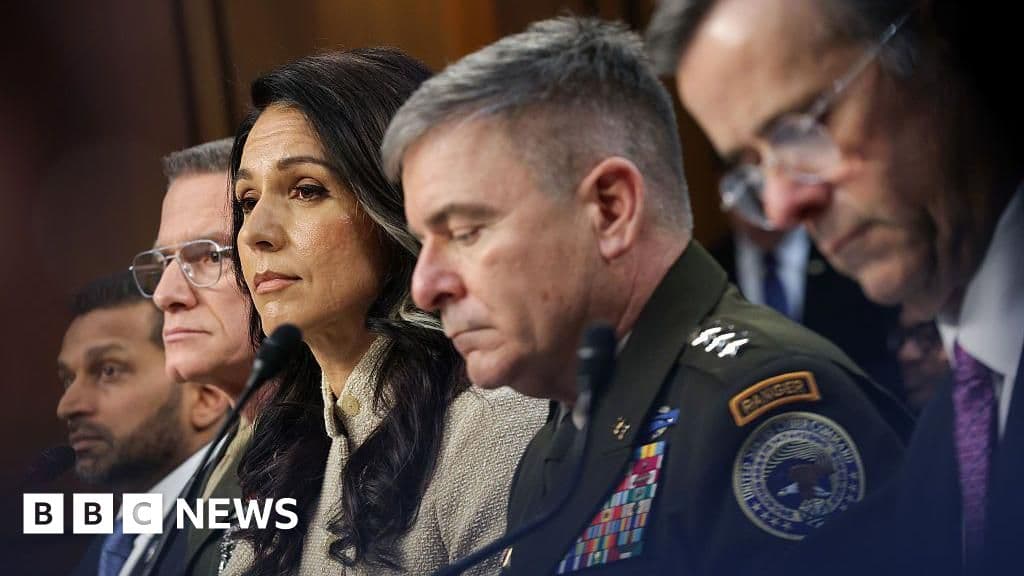
GlipzoIn a pivotal congressional hearing on Wednesday, Tulsi Gabbard, the Director of National Intelligence, emphasized that while the Iranian regime remains intact, it is significantly degraded due to ongoing military actions against its leadership and capabilities. This statement comes at a critical time as tensions between the United States and Iran escalate following the onset of hostilities in late February.
During the two-hour session, Gabbard and other key officials from the Trump administration discussed various global threats, marking the first public briefing since the conflict erupted. The backdrop of this hearing includes a noteworthy resignation from Joe Kent, the former director of the national counterterrorism center, who publicly stated that Iran does not pose an imminent threat to the United States, raising questions about the rationale behind recent military actions.
Gabbard highlighted the intelligence community's assessment that, despite the Iranian regime's structural integrity, it has suffered notable setbacks due to targeted strikes. She noted, "The IC assesses the regime in Iran appears to be intact but largely degraded due to attacks on its leadership and military capabilities."
When pressed by Senator Jon Ossoff about whether Iran should be considered an imminent threat, Gabbard refrained from offering a definitive answer, stating that only the President of the United States can make that determination. This statement underscores the complexity of assessing threats in a geopolitical landscape fraught with conflict.
The debate over the threat posed by Iran has intensified in the wake of military actions. While Gabbard described the regime as degraded, CIA Director John Ratcliffe disagreed, asserting that Iran remains a constant threat to U.S. interests. He emphasized the immediacy of this threat, contrasting Kent's resignation remarks that downplayed the urgency of Iran's capabilities.
In her prepared remarks for the hearing, Gabbard mentioned that previous strikes had obliterated Iran's nuclear enrichment program, suggesting that the country has made no efforts to rebuild its nuclear capabilities. This statement, however, was omitted during her oral presentation, prompting questions from lawmakers about transparency and consistency in messaging.
Lawmakers expressed concern over the extent of intelligence officials' involvement in the decision-making process leading to military actions against Iran. Senator Angus King, an Independent from Maine, probed whether intelligence officials were present during pivotal discussions with President Trump regarding military operations. Ratcliffe acknowledged his frequent interactions with the President but could not confirm whether intelligence was the sole factor in decision-making.
As Iran continues to navigate the fallout from sustained military strikes, it has effectively disrupted operations in the Strait of Hormuz, impacting global oil markets. The Pentagon has taken steps to protect U.S. interests in the region, anticipating potential Iranian retaliation.
The recent military actions against Iran have provoked a spectrum of reactions within Congress, with many questioning the justification for such measures. Gabbard's testimony and the reactions from other intelligence leaders reveal a fragmented understanding of the situation, emphasizing the importance of consistent and transparent communication regarding national security.
As tensions remain high, the focus will likely shift to how the U.S. government plans to navigate its relationship with Iran moving forward. Observers will be watching closely for any changes in U.S. military strategy and diplomatic efforts aimed at de-escalation. Continued assessments of Iran's military capabilities will play a crucial role in shaping future policies and responses.
In the coming weeks, it will be essential to monitor statements from intelligence officials and lawmakers as they grapple with the implications of their actions. The resolution of this situation is critical not only for the U.S. but also for international peace and security in a region marked by volatility.

Tensions soar as the US and Iran engage in air strikes near the Strait of Hormuz, raising concerns over global oil supply and regional stability.
BBC World
Trump's international interventions face serious stalemates. What will this mean for U.S. foreign policy? Explore the critical challenges ahead.
Indian Express
Tehran denies resignation of President Masoud Pezeshkian amid claims of IRGC influence. What does this mean for Iran's political stability? Click to learn more!
Indian Express