
Image: BBC Business
Discover how custard apple farming is revolutionizing agriculture in India, offering sustainable solutions for drought-stricken farmers and international markets.
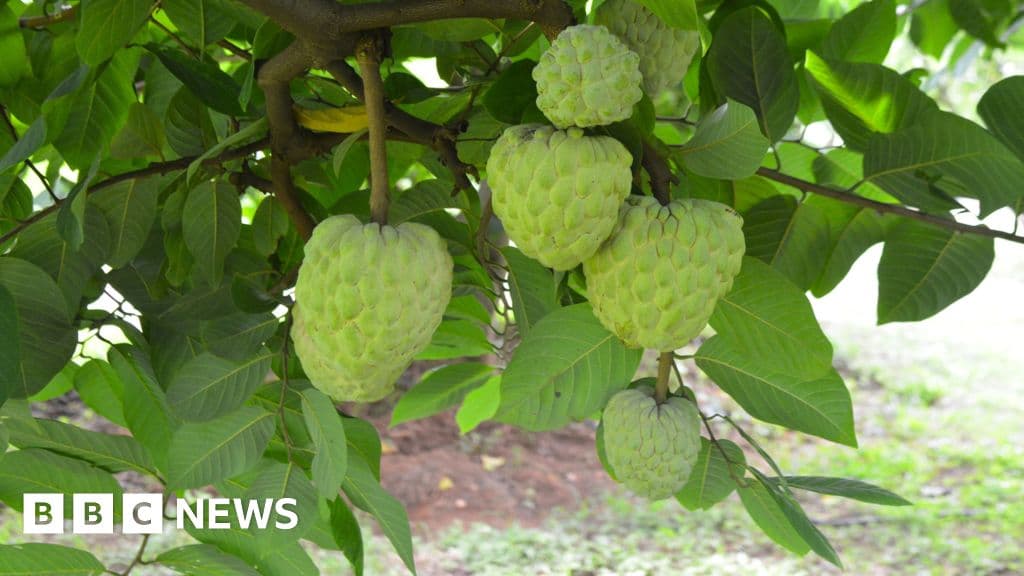
GlipzoThe custard apple, a unique fruit with a creamy texture reminiscent of custard, is emerging as a beacon of hope for farmers in drought-stricken regions of southern India. In Kolar, a district notorious for its challenging agricultural conditions, one farmer's innovative approach is transforming the landscape of fruit farming. Ashoka Shivareddy, who once left farming for a career as an AI software engineer, returned to his roots in 2018 with a mission: to cultivate crops that thrive with minimal water and pesticides.
Shivareddy's journey began when he recognized the custard apple's potential. This knobbly fruit, often compared to an avocado in size, grows prolifically in his local area. According to Shivareddy, "I was looking for a crop that could survive with very little water, grow with rainfall, and not depend heavily on pesticides." By planting the trees closer together and selecting three different varieties of custard apples, he maximized his yield, producing 20 tonnes the first year and 25 tonnes the following year. The demand for this fruit is soaring, both in India and internationally.
Despite the custard apple's resilience, growing it comes with its own set of challenges. Traditional varieties, like Balangar, face significant issues, including a limited shelf life of just three to four days and a high seed count that deters consumers. Dr. Sakthivel T, a principal scientist at the Indian Institute of Horticulture Research (IIHR) in Bangalore, notes, "Traditional varieties have excellent flavour but suffer from low pulp content and a very poor shelf life."
To combat these drawbacks, Dr. Sakthivel's team developed a hybrid known as Arka Sahan, which boasts a longer shelf life of about one week at room temperature, fewer seeds, and a higher pulp content. This hybrid variety has revolutionized custard apple farming, effectively doubling usable harvests without requiring additional land. With a pulp recovery rate jumping from 30% in wild varieties to 70% in hybrids, farmers can now enjoy increased profitability.
As the popularity of custard apples grows, researchers are focusing on enhancing fruit processing to expand its applications in the food industry. Custard apple pulp, when extracted, tends to brown quickly, posing a challenge for its use in products like ice cream and milkshakes. The IIHR is actively exploring new techniques and equipment to preserve the pulp's milky color for an extended period, ensuring its marketability.
The central Indian state of Maharashtra leads the nation in custard apple production, contributing nearly one-third of India's total output. Navnath Malhari Kaspate, a veteran custard apple farmer, has dedicated decades to improving this fruit. Kaspate's passion led him to travel across India, collecting seeds and cross-pollinating them on his farm. "No one had really paid attention to custard apple or done research, so I decided to keep working on it. It takes 12 to 15 years to develop a new variety, which is not quick work—it’s decades of experimentation," he explains.
Kaspate's efforts culminated in the creation of the NMK-01 variety, which hit the market in 2014 and is celebrated for its high yield and resistance to spoilage. Now grown across 50 acres, this improved variety yields about 10 tonnes per acre, providing new export opportunities. Kaspate has begun shipping his custard apples to the Gulf countries and even Europe, which was previously uncharted territory for Indian farmers.
Manoj Kumar Barai, another key player in this industry, exports the NMK-01 variety to markets in the US, UAE, Saudi Arabia, and Europe, emphasizing that quality and appearance are critical for success in these international markets.
The rise of custard apple farming is not just a story of agricultural innovation; it represents a sustainable solution for farmers in regions plagued by drought and economic hardship. As climate change continues to affect agricultural outputs worldwide, the custard apple's ability to thrive in arid conditions offers a glimmer of hope for disadvantaged farming communities.
Shivareddy’s return to farming shows that with creativity and scientific methods, it is possible to overcome traditional agricultural challenges. The focus on developing high-yielding, disease-resistant varieties could pave the way for a new era of farming that prioritizes sustainability and profitability.
Looking ahead, the custard apple industry in India is poised for significant growth. As research continues to improve processing methods and enhance fruit varieties, farmers can expect to see increased demand for their products both domestically and internationally. Innovations in supply chain logistics and marketing strategies will also play a crucial role in reaching untapped markets.
As custard apples gain popularity, it will be interesting to observe how farmers adapt their practices and explore new avenues for export. The future of custard apple farming isn't just about survival—it's about thriving in a changing world.
In summary, the custard apple is not merely a fruit; it symbolizes resilience, innovation, and the potential for a brighter future for farmers in India facing the realities of climate change and economic uncertainty.
Commercial LPG prices have risen again, with increases of ₹42 in Delhi and ₹53.50 in Kolkata impacting businesses and consumers alike. Find out more.
Indian Express
Discover how a tragic coal mine explosion in Shanxi, China, reveals ongoing safety concerns in the industry amidst a push for green energy.
BBC Business
Montek Singh Ahluwalia highlights key economic challenges for India, emphasizing the need for a strategic approach to balance payments and investment.
Indian Express