
Image: Science Daily
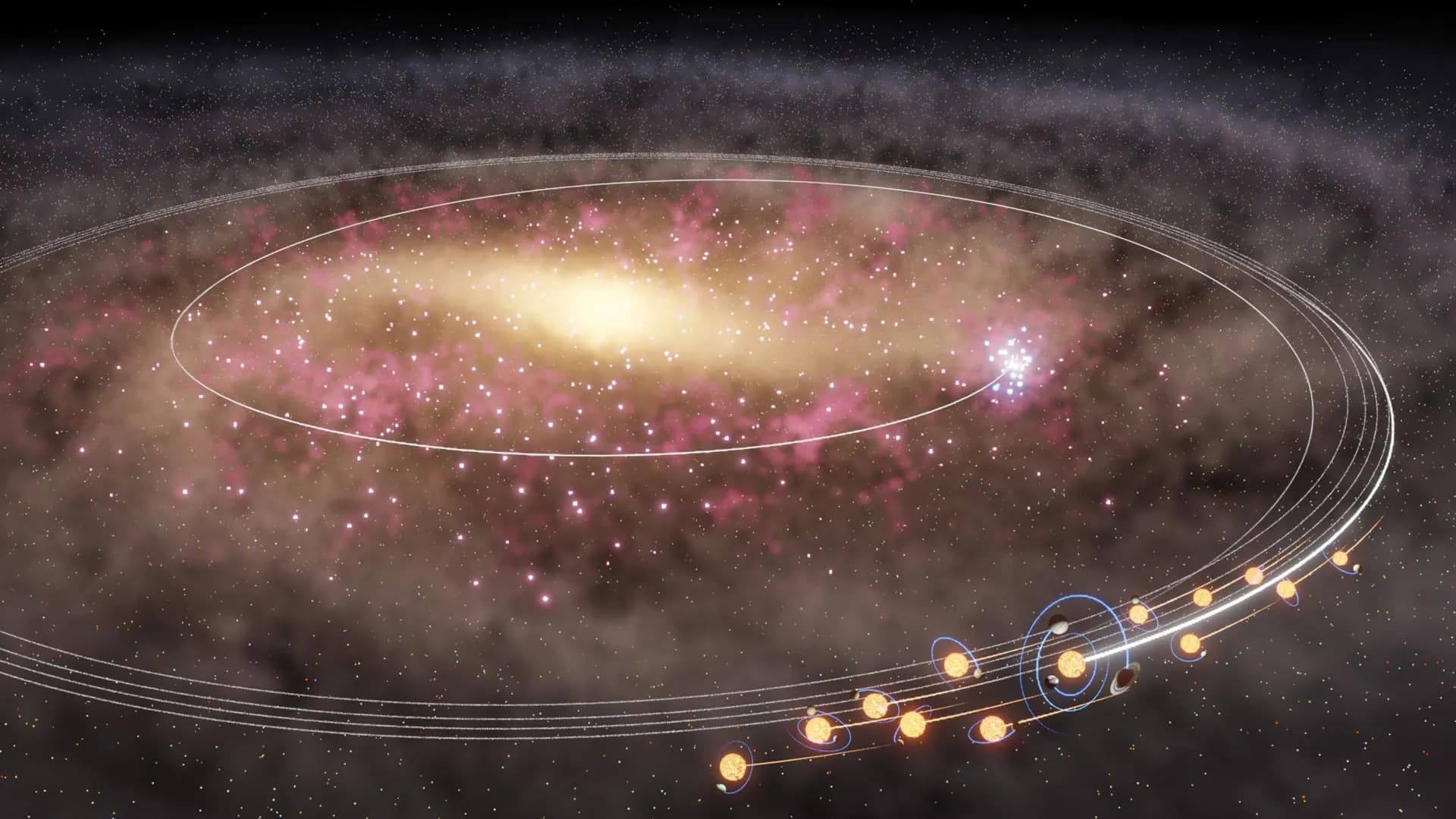
Astronomers have made a groundbreaking discovery suggesting that our Sun may have been part of a significant stellar migration that occurred 4 to 6 billion years ago. This movement involved a group of stars departing from the inner regions of the Milky Way galaxy. The research team, utilizing data from the European Space Agency's Gaia satellite, has shed light on the evolutionary history of our galaxy, particularly regarding the formation of a prominent bar-shaped structure at its center.
Just as archaeologists reconstruct human history by examining artifacts, astronomers employ a technique known as galactic archaeology to piece together the history of stars and galaxies. Scientists believe that the Sun originated approximately 4.6 billion years ago, significantly closer—over 10,000 light-years—to the Milky Way's core than its current position. While stellar chemical compositions have supported this notion, the specifics of this migration have remained elusive.
The Milky Way's central region houses a large bar-like structure that creates what astronomers refer to as a corotation barrier. This gravitational phenomenon complicates the outward movement of stars from the galactic center, making the Sun's migration all the more intriguing.
To delve deeper into how the Sun may have shifted to its current orbit, a team led by Assistant Professors Daisuke Taniguchi from Tokyo Metropolitan University and Takuji Tsujimoto from the National Astronomical Observatory of Japan embarked on a comprehensive study of solar

Survivors of the Laos cave rescue are aiding efforts to find the last two missing men trapped inside, sharing crucial insights for the search operation.
BBC World
A year after the tragic Air India crash, the Ali family reflects on grief, unanswered questions, and the enduring bonds of love in the face of loss.
BBC Business
A devastating explosion in Myanmar's Kaung Tat village has killed at least 55 people, raising serious safety concerns and questions about civilian protection in conflict zones.
BBC World