
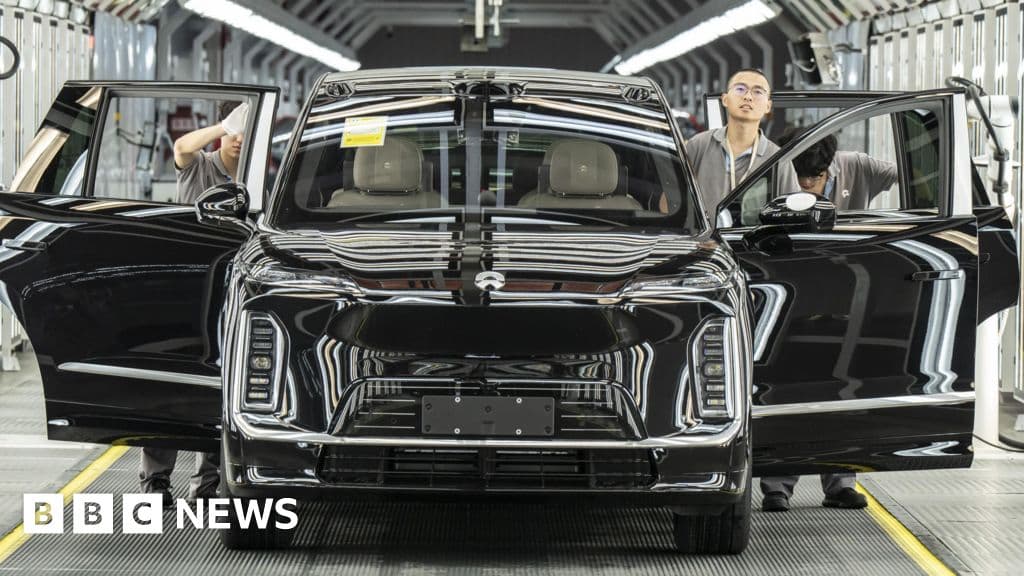
Image: BBC Business
Shocking Decline: Global Carmakers Struggle Against China
Global carmakers are losing ground to Chinese rivals, revealing critical shifts in technology and market dynamics. Discover how this impacts the future of mobility.
GlipzoKey Highlights
- Chinese carmakers are leading the EV race, leaving foreign brands behind.
- Honda and Ford CEOs warn of a survival struggle against Chinese rivals.
- China's dominance in EV supply chains is reshaping global markets.
- Luxury brands are under pressure as local models outsell imports.
A New Era for the Automotive Industry
The global automotive landscape is undergoing a dramatic transformation as traditional powerhouses in the U.S., Europe, and Japan find themselves increasingly overshadowed by Chinese manufacturers. This seismic shift has become evident at Auto China 2026, the world's largest automotive exhibition, where attendees witnessed firsthand the cutting-edge advancements in technology, design, and manufacturing that Chinese companies are rapidly implementing.
Chinese brands are not only leading in the production of electric vehicles (EVs) but are also excelling in the development of batteries and innovative software solutions. This growing dominance has left foreign automakers struggling to catch up. In a candid moment, Honda CEO Toshihiro Mibe expressed his concerns, stating, "We have no chance against this," after touring a highly automated factory in Shanghai. Similarly, Ford CEO Jim Farley characterized the situation as a critical struggle for survival, remarking that Western automakers are now engaged in "a fight for our lives."
The Shift in Partnerships and Strategies
For decades, foreign car manufacturers have invested heavily in joint ventures with Chinese firms, primarily to establish a foothold in this lucrative market. However, as competition intensifies, many of these companies are reevaluating the nature of their partnerships. Bill Russo, an auto analyst based in Shanghai, highlighted a fundamental misunderstanding prevalent in the developed world: "The biggest mistake is believing the transition is solely about electric cars; it’s about who will lead the next generation of mobility technology."
China's automotive ascendancy is not merely confined to vehicles. According to a report from Rhodium Group, China currently leads in exports across more than 315 product categories, a significant increase from 163 in 2016. Many of these categories are integral to the EV supply chain, encompassing batteries, components, and manufacturing machinery.
Competitive Advantages Fueling Growth
The International Energy Agency estimates that it is approximately 30% cheaper to manufacture a small electric SUV in China compared to more advanced economies. This cost efficiency stems largely from lower battery prices and an intricate supply chain that has been meticulously developed over the years. State support has played a crucial role in this progress, with estimates suggesting that China has invested tens of billions of dollars into its EV and battery sectors in recent years.
Critics in the EU and U.S. have raised concerns about these subsidies, arguing they distort market dynamics and give Chinese companies an unfair advantage. As a result, domestic competition has accelerated the pace of innovation within China, with tech giants such as Xiaomi, Huawei, and Alibaba entering the EV market, further blending technology with automotive development.
The Rise of Tech-Driven Automakers
The transition from traditional manufacturing to a technology-driven industry is exemplified by Xiaomi's EV factory near Beijing, where a vehicle is produced approximately every 76 seconds. Despite launching its first electric model in 2024, Xiaomi has quickly ascended to become one of the leading brands in China by integrating its vehicles with smartphones, apps, and other smart-home devices, creating a seamless ecosystem for consumers.
At the Nio plant in Hefei, automation is at the forefront of production, showcasing how advanced technology is reshaping manufacturing processes. BYD, another major player, has developed ultra-fast charging systems capable of adding 400 kilometers (or 249 miles) of range within minutes, rivaling traditional gasoline refueling times.
XPeng's founder, He Xiaopeng, shared an ambitious vision for the future, stating, "In the next decade, any car company will also be a robotics company," indicating the growing convergence of automotive engineering and robotics technology.
Foreign Brands Face Market Challenges
While foreign carmakers have long depended on China for global supply chains, their struggles within the Chinese market have become pronounced. Data from Automobility reveals a stark decline in foreign brands' market share in China, plummeting from 64% in 2020 to a mere 32% in 2023. This downturn has notably impacted profits for industry giants like General Motors and major German manufacturers, which once heavily relied on the Chinese market.
Luxury vehicles have not remained immune to this shift either. The Huawei Maextro S800, a luxury sedan, has emerged as the best-selling car in China priced above $100,000 (£74,145), surpassing iconic imports like the Porsche Panamera and BMW 7 Series, which previously held dominant positions in the market.
Why This Matters: The Future of the Automotive Landscape
The ongoing rivalry between Chinese and foreign automakers is not just a localized issue; it has significant implications for the global automotive market. As China continues to lead in the development of EV technology and manufacturing, it raises critical questions about the future of mobility and competition in the automotive industry.
The rise of Chinese brands could redefine consumer expectations, pushing foreign companies to innovate and adapt or risk obsolescence. The push for advanced technologies, sustainability, and consumer-centric solutions will likely dominate discussions in the years to come.
Looking ahead, the automotive sector must brace for further transformation. Key areas to watch include: - Advancements in battery technology and production efficiency - Integration of AI and robotics in manufacturing and vehicle design - The potential for collaborations or further tensions in global trade involving automotive technologies - The evolving consumer preferences as connectivity and technology become paramount in vehicle choice.
With these factors at play, the battle for dominance in the automotive sector is set to intensify, making it imperative for stakeholders to stay ahead of the curve. As technology and consumer expectations evolve, the future of the automotive industry will depend on who can innovate and adapt the fastest, ensuring that the race is far from over.
Related Articles

Commercial LPG Prices Surge Again: ₹42 in Delhi, ₹53.50 in Kolkata
Commercial LPG prices have risen again, with increases of ₹42 in Delhi and ₹53.50 in Kolkata impacting businesses and consumers alike. Find out more.
Indian Express
Shocking Coal Mine Disaster in China Raises Safety Concerns
Discover how a tragic coal mine explosion in Shanxi, China, reveals ongoing safety concerns in the industry amidst a push for green energy.
BBC Business
Montek Singh Ahluwalia: Critical Economic Insights Unveiled
Montek Singh Ahluwalia highlights key economic challenges for India, emphasizing the need for a strategic approach to balance payments and investment.
Indian Express