
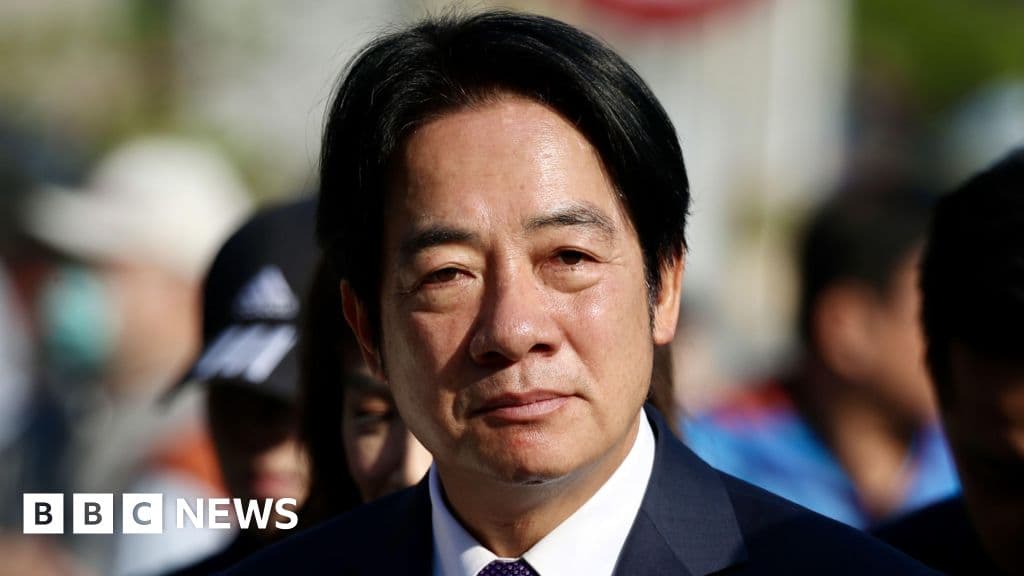
Image: BBC World
Taiwan's President Lai cancels Africa trip due to revoked flight permits amid Chinese pressure. What does this mean for Taiwan's global relations?
GlipzoIn a significant diplomatic blow, Taiwan's President Lai Ching-te has been forced to cancel his planned visit to Eswatini, an ally in southern Africa. The abrupt cancellation stems from the revocation of flight permits by Seychelles, Mauritius, and Madagascar, all of which Taiwan officials claim succumbed to Chinese pressure. This incident marks a notable moment in Taiwan's ongoing struggle for international recognition and illustrates the increasingly aggressive tactics employed by China to isolate Taiwan on the global stage.
President Lai's trip was scheduled for April 22 to 26, during which he was set to attend celebrations for King Mswati III's 40th anniversary on the throne and his birthday. The cancellation not only disrupts Taiwan's diplomatic efforts but also highlights the delicate balance of power and influence in the region, particularly as Taiwan navigates its relationship with its few remaining allies.
According to a Taiwanese official, the decision by Seychelles, Mauritius, and Madagascar to revoke the flight permits was made after what they described as intense economic coercion from China. This situation is particularly alarming as it represents a tactic often used by Beijing to exert control over countries that maintain ties with Taiwan. In a statement, the Taiwanese official lamented that the revocation occurred unexpectedly and without prior notice.
While China has denied these allegations of coercion, its government has consistently advocated for the “one China” principle, asserting its claim over Taiwan and seeking to diminish Taiwan's international presence. The Ministry of Foreign Affairs in Beijing asserted that the so-called “President of the Republic of China”, referring to Lai, no longer holds a valid status in global politics, further emphasizing their stance against Taiwan's sovereignty.
In response to this diplomatic setback, President Lai took to X (formerly Twitter) to express his frustration with China’s actions. He stated that such coercive measures reveal the inherent risks posed by authoritarian regimes to the international order. Lai stressed, “No amount of threats or coercion will shake Taiwan's resolve to engage with the world.” This remark not only reinforces Taiwan's determination to maintain its global relationships but also serves as a rallying cry for other nations to recognize Taiwan's sovereignty.
The government of Eswatini, which remains one of Taiwan’s 12 diplomatic allies, expressed regret over the cancellation of Lai’s visit. They reassured that this unfortunate turn of events would not alter their longstanding bilateral relationship with Taiwan, emphasizing the resilience of their diplomatic ties.
The cancellation of Lai's trip underscores the precarious position Taiwan finds itself in as it confronts challenges posed by China. Beijing's consistent efforts to isolate Taiwan politically and diplomatically have led to a growing concern among Taiwanese officials regarding the future of their international relationships. The incident also highlights the importance of maintaining and strengthening ties with remaining allies in a world where diplomatic recognition is increasingly influenced by Chinese economic power.
As Taiwan grapples with these challenges, it has begun to explore alternative diplomatic strategies. A special envoy will be appointed to attend the Eswatini celebrations on Lai’s behalf, demonstrating Taiwan's commitment to preserving and nurturing its international relationships despite setbacks.
The international community, particularly the United States, has voiced support for Taiwan in light of these recent developments. The House Foreign Affairs Committee Majority publicly criticized the actions of Seychelles, Mauritius, and Madagascar, stating they stand with Taiwan against what they characterize as blatant coercion from China. Additionally, U.S. Senator Ted Cruz expressed concerns over Mauritius’s decision, suggesting that it aligns itself more closely with the Chinese Communist Party than with democratic allies.
This growing alignment between U.S. lawmakers and Taiwan may signify a strengthening of support for Taipei in its ongoing struggle against Chinese encroachment. It also raises questions about how the United States will respond to similar incidents in the future and whether it will take more concrete actions to bolster Taiwan’s international standing.
In light of these developments, Taiwan must navigate a complex diplomatic landscape characterized by external pressures and limited allies. The cancellation of President Lai's trip to Eswatini serves as a stark reminder of the challenges ahead and the necessity for Taiwan to enhance its diplomatic strategies.
As Taiwan continues to assert its sovereignty and engage with the world, observers will be keenly watching how it adapts to these pressures. Future engagements with existing allies, efforts to forge new relationships, and the response from the international community will be crucial in shaping Taiwan's diplomatic future. The resilience shown by President Lai and his administration in the face of adversity will be critical as they work to ensure that Taiwan is not further marginalized in the global arena.
The events surrounding President Lai's canceled trip highlight the ongoing struggle for international recognition faced by Taiwan and the lengths to which China is willing to go to maintain its claims over Taiwan. Understanding these dynamics is crucial for grasping the broader implications for global politics, particularly in the context of authoritarianism versus democracy. As Taiwan continues to fight for its place on the world stage, the support it receives from allies like the U.S. will be pivotal in countering China's influence.

Tensions soar as the US and Iran engage in air strikes near the Strait of Hormuz, raising concerns over global oil supply and regional stability.
BBC World
Trump's international interventions face serious stalemates. What will this mean for U.S. foreign policy? Explore the critical challenges ahead.
Indian Express
Tehran denies resignation of President Masoud Pezeshkian amid claims of IRGC influence. What does this mean for Iran's political stability? Click to learn more!
Indian Express