
Image: Mint (Business)
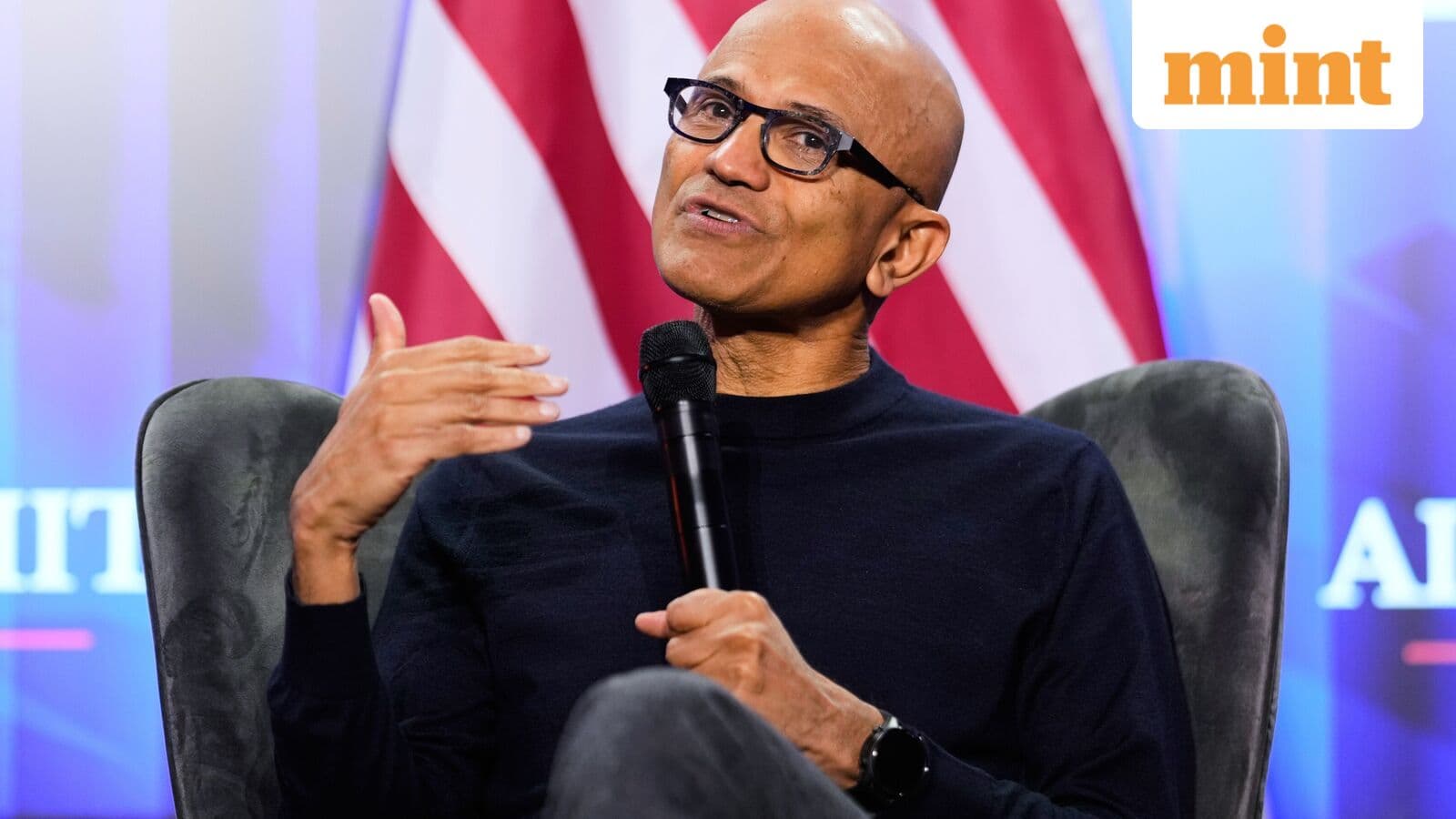
Microsoft CEO Satya Nadella warns AI must prove its worth to society at the World Economic Forum, or face losing public support.
GlipzoAt the World Economic Forum in Davos in January 2026, Satya Nadella, the CEO of Microsoft, delivered a powerful statement regarding the future of artificial intelligence (AI). During a session with BlackRock CEO Laurence Fink, Nadella raised a critical concern about the energy consumption of AI technologies. His warning was not from the perspective of critics or regulators, but rather from an insider who is deeply embedded in the AI landscape.
Nadella emphasized that society's acceptance of AI, particularly its growing energy needs, hinges on the technology's ability to show tangible benefits. He cautioned, "We will quickly lose even the social permission to actually take something like energy, which is a scarce resource, and use it to generate these tokens, if these tokens are not improving health outcomes, education outcomes, public sector efficiency, and private sector competitiveness across all sectors." This assertion underscores the importance of measurable results in justifying AI's environmental impact.
Nadella's comments arrive at a time when public and governmental scrutiny over AI's environmental footprint is intensifying. Data centers that support large-scale AI operations are notorious for their high electricity and water consumption, raising alarms among climate activists, government officials, and the general populace.
The phrase “social permission” used by Nadella is particularly noteworthy. It suggests that the adoption and expansion of AI technologies are not just technical challenges but also deeply intertwined with public sentiment. If the technologies are viewed as extracting more resources than they contribute to societal well-being, public approval could diminish, posing a significant challenge for the industry's future.
This statement by Nadella reflects a larger philosophical dilemma that he has grappled with throughout his career at Microsoft: the balance between technological advancement and societal benefit. It is a call to action for those creating powerful systems to ensure that their innovations align with the needs and welfare of society.
Nadella's perspective casts AI's energy consumption in a new light, urging its developers to consider not only the potential for profit but also the ethical implications of their work. This is an essential conversation as AI technologies continue to permeate various sectors, from healthcare to education and beyond.
Born in Hyderabad on August 19, 1967, Satya Nadella has had a remarkable journey. He studied electrical engineering at the Manipal Institute of Technology before moving to the United States. There, he earned a Master's in Computer Science from the University of Wisconsin–Milwaukee and an MBA from the University of Chicago.
Nadella joined Microsoft in 1992 and climbed the ranks over the years, ultimately becoming the company's third CEO on February 4, 2014, succeeding Steve Ballmer. His leadership marked a pivotal shift for Microsoft as the company embraced cloud computing through Azure and made a strategic investment of $13 billion in OpenAI, positioning itself as a leader in the AI sector.
Under Nadella's stewardship, Microsoft's stock has soared, with shares nearly tenfold since he took the helm, achieving an impressive 27% annual growth rate. This transformation brought an end to 14 years of stagnation in returns, highlighting the effectiveness of his strategic vision.
In early 2025, Nadella further restructured Microsoft's AI operations, integrating its consumer and enterprise Copilot teams. He positioned notable figures, such as Mustafa Suleyman, to focus on developing advanced proprietary models. In an internal memo, he stated, "We are doubling down on our superintelligence mission with the talent and compute to build models that have real product impact."
Satya Nadella's personal life has also been marked by challenges. He married Anupama Priyadarshini in 1992, whom he met while studying at Manipal. The couple has three children, including their son Zain, who faced significant health challenges. Tragically, Zain passed away in February 2022 at the age of 26. Nadella has openly discussed how parenting a child with complex needs has profoundly shaped his perspectives on empathy and technology's role in society.
Nadella's remarks serve as a crucial reminder of the responsibilities that come with technological advancement. As AI continues to evolve, its relationship with society and the environment will be under increasing scrutiny. The challenge for tech leaders will be to demonstrate the positive impact of their innovations clearly.
The conversation about AI's energy consumption and societal benefits is essential as we navigate a future increasingly dominated by technology. Should AI fail to meet societal expectations, it risks not only its own growth but also its legitimacy in the eyes of the public.
As we move forward, it will be critical to watch how AI technologies adapt to these challenges and whether they can genuinely enhance human welfare without excessive resource depletion. The pathway ahead for AI will depend on its ability to earn and retain public trust through responsible practices and demonstrable outcomes.

Commercial LPG prices have risen again, with increases of ₹42 in Delhi and ₹53.50 in Kolkata impacting businesses and consumers alike. Find out more.
Indian Express
Discover how a tragic coal mine explosion in Shanxi, China, reveals ongoing safety concerns in the industry amidst a push for green energy.
BBC Business
Montek Singh Ahluwalia highlights key economic challenges for India, emphasizing the need for a strategic approach to balance payments and investment.
Indian Express