
Image: BBC World
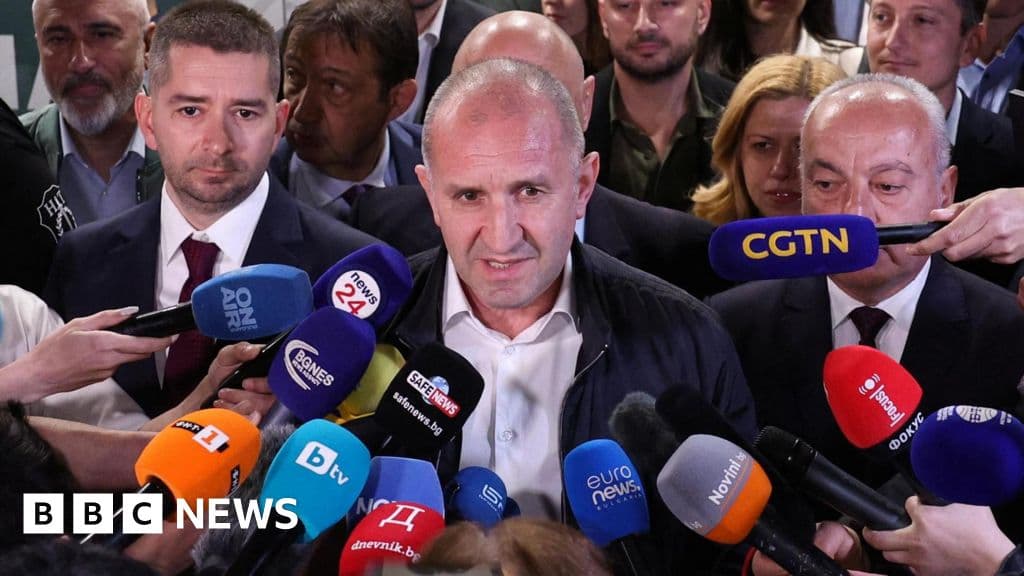
Rumen Radev's Progressive Bulgaria party is set to win the crucial October 2023 parliamentary elections, promising a strong vision for Bulgaria's future.
GlipzoIn a dramatic turn of events, Rumen Radev and his party, Progressive Bulgaria, are on track to win the parliamentary elections held on October 1, 2023. This election marks the eighth general election in just five years for the nation, highlighting the turbulent political landscape of Bulgaria.
According to exit polls, Radev's party has garnered a commanding 37% of the vote, significantly outpacing former Prime Minister Boiko Borisov's GERB, which stands at 16%. This strong performance places Radev in a promising position as he aims to establish a government that aligns with his vision for a more progressive Bulgaria.
The election was triggered by widespread discontent with the previous government, sparked by attempts to pass a controversial budget last December. This led to mass protests, with President Radev openly supporting the demonstrators. Following his anticipated victory, Radev expressed gratitude to the electorate, stating, "People rejected the self-satisfaction and arrogance of old parties and did not fall prey to lies and manipulation. I thank them for their trust."
In his victory speech, Radev emphasized his commitment to building "a strong Bulgaria in a strong Europe." His agenda will focus on fostering critical thinking and pragmatic solutions to current challenges, particularly in the realm of security and industrial competitiveness.
Radev highlighted the importance of Bulgaria's role within the European Union, noting, "What Europe needs right now is critical thinking, pragmatic actions, and good results, especially to build a new security architecture and recover its industrial power and competitiveness." This statement underscores his intentions to position Bulgaria as a key player in European affairs.
Radev, who recently stepped down after nine years as president, is widely viewed as a pragmatic leader with a somewhat pro-Russian stance. He has been critical of EU sanctions on Russia and has called for dialogue with the Kremlin. Notably, he opposes sending military support to Ukraine, reflecting a stance similar to that of Hungary's outgoing Prime Minister Viktor Orban.
Despite Progressive Bulgaria's strong showing, experts suggest that Radev may not have enough support to govern independently. His first challenge post-election will be to seek coalition partners. In his initial address following the election results, he mentioned the need for collaboration, stating he is actively looking for partners to form a stable government.
The political landscape in Bulgaria remains complex, with three or four other parties expected to enter Parliament, having crossed the 4% threshold. This fragmentation may complicate coalition negotiations as Radev works to create a viable governing body.
One of the critical issues facing Radev's administration will be the ongoing conflict in Ukraine and its implications for Bulgaria's defense industry. The country has emerged as a significant supplier of ammunition and explosives, especially through third-party nations like Romania. The war in Ukraine has revitalized an arms industry that has struggled since the Soviet era, providing a crucial economic boost.
The VMZ factory in Sopot, which specializes in producing NATO-grade 155 mm artillery shells, has been at the forefront of this resurgence. In a significant development, the German arms manufacturer Rheinmetall announced a €1 billion joint venture with VMZ aimed at producing up to 100,000 155 mm shells annually. This partnership underscores the growing importance of Bulgaria in the European defense landscape.
While Radev has taken a clear stance against military supplies to Ukraine, he has also recognized the need for Bulgaria to integrate itself into the European defense ecosystem. His administration may mirror that of Slovakia's Prime Minister Robert Fico, who has been critical of EU military support but has not obstructed private arms manufacturing for Ukraine.
Radev's outreach to Rheinmetall, particularly his invitation to CEO Armin Papperger in March 2025, signals a commitment to bolstering Bulgaria's defense capabilities while navigating the complex political landscape surrounding military support for Ukraine. During his visit to Rheinmetall's headquarters in Germany, he remarked, "Bulgaria is becoming part of the European defense ecosystem."
As Rumen Radev prepares to take on a leadership role once again, all eyes will be on how he navigates coalition negotiations and addresses the pressing issues facing Bulgaria. His ability to form a stable government will be crucial, especially in light of the ongoing conflict in Ukraine and its impact on the European security landscape.
In the coming weeks, observers should watch for: - Coalition negotiations and potential alliances with other parties. - Changes in Bulgaria's defense policies, especially regarding military support to Ukraine. - The impact of Radev's policies on the Bulgarian economy and its integration into the European defense market.
Radev's victory marks a significant moment in Bulgaria's political history, and how he chooses to lead in the months ahead will have far-reaching implications for the country and its role in Europe.

Tensions soar as the US and Iran engage in air strikes near the Strait of Hormuz, raising concerns over global oil supply and regional stability.
BBC World
Trump's international interventions face serious stalemates. What will this mean for U.S. foreign policy? Explore the critical challenges ahead.
Indian Express
Tehran denies resignation of President Masoud Pezeshkian amid claims of IRGC influence. What does this mean for Iran's political stability? Click to learn more!
Indian Express