
Image: BBC Technology
Discover how robots like Alpha are stepping in to solve staffing crises in the waste management industry, revolutionizing recycling and efficiency.
GlipzoIn a striking shift towards automation, the waste management and recycling industry is grappling with a significant staffing crisis, particularly evident at a busy facility in Rainham, East London. Owned by the Sharp Group, a family-run firm specializing in skip and waste management, this plant processes a staggering 280,000 tonnes of mixed recycling annually. Yet, the operational demands are taking a toll, as the industry is notorious for its high turnover rates, with annual departures hitting 40%.
The environment at the recycling plant is both noisy and dusty, characterized by the relentless operation of conveyor belts carrying everything from broken electronics to discarded footwear. Health and safety concerns further complicate matters, as work-related injuries in this sector are 45% higher than in others, leading to a challenging atmosphere that makes retaining staff increasingly difficult. Line supervisor Ken Dordoy acknowledges the struggle, stating, "The belt is moving all the time, you’re constantly picking. I go through a lot of pickers because they just aren't up to the job."
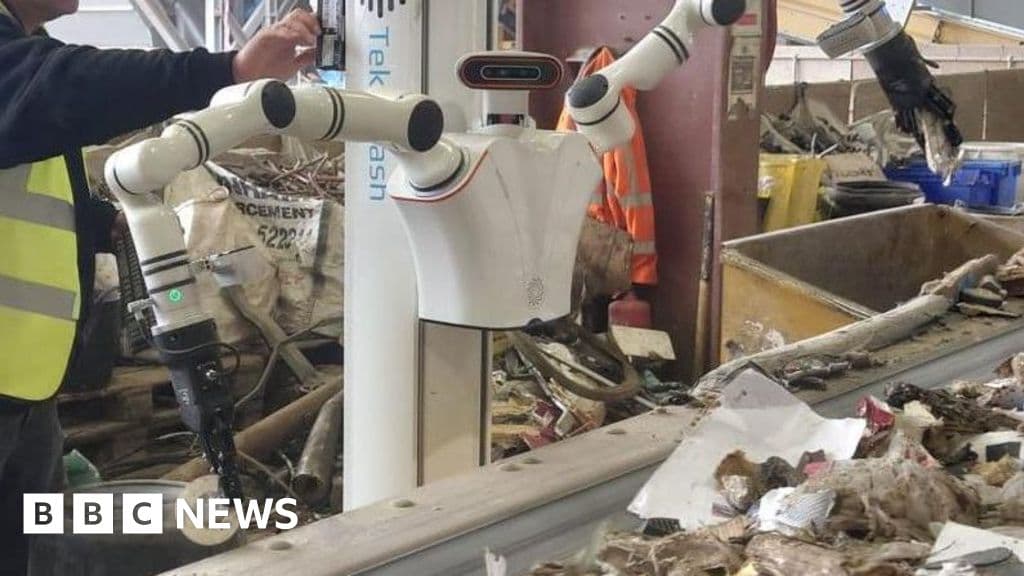
To counteract the staffing shortages, the Sharp Group is exploring an innovative solution: automation. During my visit, I witnessed the training of a humanoid robot named Alpha (Automated Litter Processing Humanoid Assistant), developed by RealMan Robotics in China and adapted for practical recycling tasks by TeknTrash Robotics in the UK. The integration of humanoid robots in recycling is relatively rare, but TeknTrash's founder, Al Costa, believes that mimicking human movements allows these robots to seamlessly fit into existing setups without the need for costly redesigns.
Currently, Alpha is undergoing a rigorous training regimen, learning to identify items on the conveyor belt and execute sorting tasks. Costa emphasizes the complexity of this process, stating, "The market thinks these robots are prêt‑à‑porter, that all you need to do is to plug them to the mains and they will work flawlessly. But they need extensive data in order to be effectively useful." This training involves a feedback loop where a human worker, equipped with a VR headset, demonstrates effective picking techniques, allowing Alpha to learn from real-world scenarios.
The potential benefits of integrating Alpha into the workforce are substantial. Chelsea Sharp, finance director of the plant and granddaughter of the company’s founder, notes, "The attraction of a humanoid is that you can put it here and it stays here. It will pick all day, 24 hours a day, seven days a week. It's not going to apply for a holiday, it's not going to have a sick day." This reliability could alleviate some of the pressure currently faced by the Sharp Group in maintaining an adequate workforce.
While Alpha represents a leap forward, there are other companies also innovating in this space. For instance, AMP Robotics, based in Colorado, employs air jets and AI to enhance sorting efficiency across various facilities worldwide. Tim Stuart, CEO of AMP, highlights the effectiveness of their technology, stating, "Our robots are much more efficient than humans, probably eight or 10 times the pace. The AI technology and jets have really increased the capacity and efficiency and accuracy of what we can do."
Despite the advancements, challenges remain in automating waste sorting. As pointed out by Rebecca Hu-Thrams, co-founder of another automation startup, Glacier, the variability of waste materials complicates operations. Sorting equipment must adapt to an inconsistent flow of items, making it crucial for robotic systems to be versatile and responsive.
The integration of AI in these systems is crucial as it continuously refines the sorting process, enhancing the accuracy and speed of materials identification. While Alpha is still in training, other systems like those employed by Glacier showcase the potential of mounted robotic arms and AI in tackling the chaotic nature of rubbish.
As the waste management industry continues to struggle with staffing shortages, the shift towards automation could redefine operational norms. The rise of humanoid robots and AI-driven systems presents an exciting frontier, promising increased efficiency and reduced reliance on human labor. However, the initial training and integration process remains a significant hurdle that companies must navigate to maximize the potential of these technologies.
Moving forward, it's essential to monitor how these robotic systems perform in real-world applications. As Alpha and its counterparts undergo training and refinement, the industry will be watching closely to see if they can effectively alleviate the staffing crisis while maintaining high safety and operational standards. The evolution of waste management may very well hinge on the successful integration of these advanced technologies, paving the way for a more sustainable and efficient future in recycling.
In conclusion, the balance between human labor and automation will be crucial in shaping the recycling landscape. Companies like Sharp Group and TeknTrash Robotics are at the forefront of this transformation, and their successes or setbacks will likely influence the broader industry trends. As these developments unfold, industry stakeholders must remain adaptable and responsive to the changing dynamics of waste management in the age of automation.

Commercial LPG prices have risen again, with increases of ₹42 in Delhi and ₹53.50 in Kolkata impacting businesses and consumers alike. Find out more.
Indian Express
Discover how a tragic coal mine explosion in Shanxi, China, reveals ongoing safety concerns in the industry amidst a push for green energy.
BBC Business
Montek Singh Ahluwalia highlights key economic challenges for India, emphasizing the need for a strategic approach to balance payments and investment.
Indian Express