

Image: The Hindu
Nvidia's GTC 2026 conference unveils AI innovations amid rising competition. What awaits for the chipmaker's future? Discover the key insights!
GlipzoNvidia is gearing up for its highly anticipated annual developer conference, the GPU Technology Conference (GTC), set to commence on March 20, 2026. CEO Jensen Huang is expected to take center stage in a packed hockey arena, unveiling groundbreaking products and strategic partnerships designed to keep Nvidia at the forefront of the rapidly evolving AI landscape. This year’s event is particularly significant as the tech giant faces increasing competition from other chip manufacturers and even from its own customers venturing into chip development.
The GTC will occupy a pivotal role in Silicon Valley for a week, showcasing Nvidia’s technological advancements in various realms, including AI chips, data centers, the CUDA programming software, and innovative AI agents. Analysts and investors alike are eager for insights into Nvidia’s strategy and whether its substantial investments in the AI ecosystem are translating to tangible growth and innovation. According to Jacob Bourne, an analyst with eMarketer, attendees can expect a comprehensive update on Nvidia’s chip roadmap, emphasizing key areas such as inference, agentic AI, and advanced networking infrastructure.
Nvidia's dominance in the AI chip market has been underpinned by its chips powering hundreds of billions of dollars in global data center investments. However, the competitive landscape is dynamically shifting. While analysts predict the overall AI chip market will continue its upward trajectory, Nvidia’s market share is expected to face challenges as more companies develop their own chips for AI applications. This change signals a significant transition in the industry, particularly as AI agents become more prevalent, executing tasks on behalf of human users. These agents will necessitate an orchestration layer to manage their activities effectively.
Given the rise of in-house chip development by major clients like OpenAI and Meta, who are poised to release new AI chips biannually, Nvidia’s market share, currently exceeding 90% in both training and inference, is at risk. KinNgai Chan, managing director at Summit Insights Group, noted that while Nvidia maintains substantial market dominance today, the company could start to see share loss by 2027 as competitors gain traction with application-specific integrated circuits (ASICs) tailored for specific workloads, which often outperform traditional graphics processing units (GPUs).
In a proactive move to bolster its position, Nvidia recently acquired Groq, a startup specializing in fast and cost-effective inference computing, for $17 billion. This acquisition is expected to play a crucial role in Nvidia’s strategy, with Huang indicating that GTC will highlight how Groq’s cutting-edge AI technology can be integrated into Nvidia’s existing CUDA platform. Such integration promises to enhance Nvidia’s offerings and maintain its competitive edge in the AI landscape.
Furthermore, analysts like William McGonigle from Third Bridge anticipate that Nvidia will introduce a new line of servers that synergize Groq’s chips with Nvidia’s networking technologies. This development could result in a powerful, efficient product lineup that addresses the growing demand for advanced AI solutions.
As Nvidia sets the stage for breakthrough innovations, it must also contend with emerging threats from central processing units (CPUs), long dominated by companies like Intel and Advanced Micro Devices (AMD). As these traditional chip manufacturers adapt their technologies to meet the demands of AI applications, their potential to disrupt the market poses a significant challenge for Nvidia. Analysts are closely monitoring the evolution of CPU capabilities, which could lead to heightened competition in sectors traditionally dominated by GPUs.
The developments at Nvidia’s GTC 2026 are crucial not only for the company but also for the entire tech industry. As AI continues to permeate various sectors—from healthcare to finance—the demand for efficient and powerful computing solutions will only increase. Nvidia’s ability to innovate and adapt amidst fierce competition will determine not just its future but also the trajectory of the AI market as a whole.
In conclusion, as Nvidia prepares to unveil its latest advancements at GTC 2026, stakeholders will be watching closely. The company’s strategies and the competitive dynamics discussed at the conference will shed light on the future landscape of AI technology. Investors and tech enthusiasts alike should keep an eye on Nvidia’s moves, as they will likely set the tone for the industry in the years to come. What remains to be seen is how effectively Nvidia can fend off competition while continuing to innovate and lead in an increasingly crowded market.
As we look forward, the tech community should remain vigilant about Nvidia's strategies and their implications for the future of AI technology.
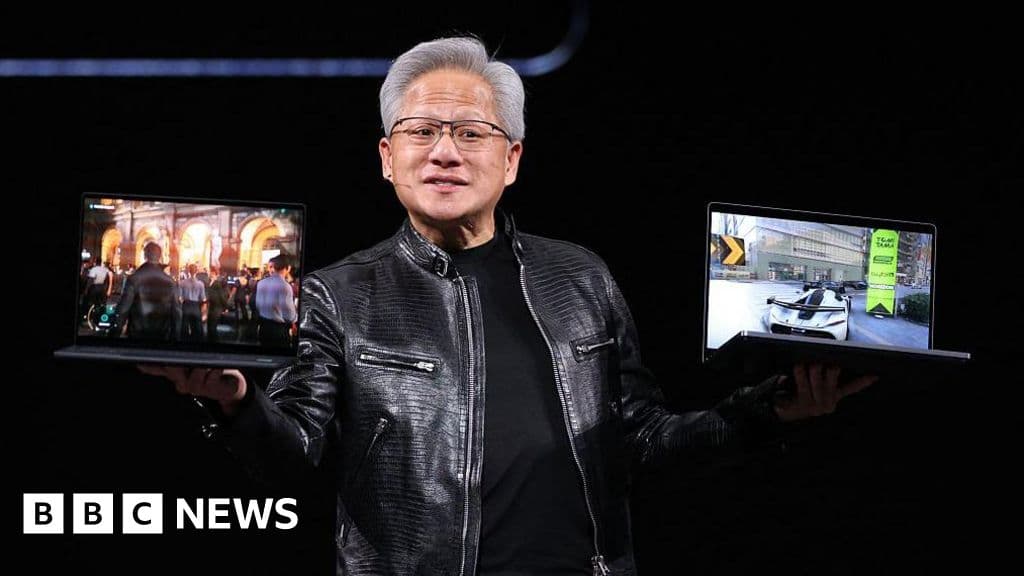
Nvidia's new RTX Spark chip aims to transform personal computing with AI, marking a significant shift in technology. Discover what this means for consumers.
BBC Business
The explosion of Blue Origin's New Glenn rocket raises significant concerns over NASA's lunar ambitions and the future of Amazon's satellite projects. Discover the implications.
BBC Science
Discover how Meta's lack of engagement on user bans raises critical concerns about accountability and transparency in social media governance.
BBC Technology