

Image: The Verge
Nvidia partners with BYD and Geely to advance its robotaxi platform, amid US-China trade tensions. Discover the impact on the autonomous vehicle market.
GlipzoIn a move that highlights Nvidia's commitment to leading the autonomous vehicle sector, the chipmaker has officially welcomed BYD and Geely into its robotaxi initiative. This announcement was made during the GTC conference held today, marking a significant step in Nvidia's strategy to expand its influence in the rapidly evolving self-driving market.
The collaboration with these two leading Chinese automotive manufacturers aims to leverage Nvidia's cutting-edge Drive Hyperion platform. This platform is a comprehensive solution that integrates advanced chips, computers, sensors, and software tailored for developing Level 4 autonomous vehicles. With this partnership, Nvidia is not only solidifying its position in the global market but also addressing the competitive landscape between the United States and China regarding autonomous technologies.
Both BYD and Geely are already familiar with Nvidia's technology. BYD has been utilizing Nvidia chips in its traditional vehicles, while the new agreement will enable the company to enhance its next-generation Level 4 autonomous vehicles using the Drive Hyperion platform. In contrast, Geely is incorporating Nvidia’s Thor chips in its innovative Zeekr models, which are also supplied to Waymo for its US-based robotaxi services. This collaboration underscores the interconnectedness of global automotive innovations.
Ali Kani, Vice President and General Manager of Nvidia’s automotive team, emphasized the significance of these partnerships, stating, “Waymo is using us in the car and the cloud.” This highlights Nvidia's role in supporting not just vehicle operations but also cloud-based processing, which is crucial for autonomous vehicle functionality.
The announcement of Nvidia’s collaborations occurs against the backdrop of ongoing trade tensions between the United States and China. Nvidia’s technologies, particularly those used for training AI models in data centers, have been under intense scrutiny and negotiation between the two nations. Recently, the Trump administration approved the sale of Nvidia’s H200 chips to Chinese firms, indicating a complex landscape where technology, trade, and national interests intersect.
China has emerged as a dominant player in the electric vehicle sector, but the competition in the robotaxi arena remains balanced. For instance, Baidu operates commercial robotaxis in over a dozen cities across China, while Waymo has approximately 3,000 vehicles functioning in 10 U.S. cities. The introduction of Nvidia's technology could significantly boost the robotaxi capabilities of BYD and Geely, potentially shifting the competitive dynamics between the US and China in this high-stakes field.
Nvidia’s strategy to extend its influence in the automotive sector is noteworthy, especially considering that its automotive revenue has historically been a small fraction of its overall earnings. For instance, in the third quarter of 2025, Nvidia reported total revenues of $51.2 billion, with the automotive division contributing only $592 million, representing just 1.2 percent of the total.
In addition to its partnerships with Chinese automakers, Nvidia is also collaborating with Nissan to implement its Hyperion platform, which will be paired with robotaxi software from Wayve. Furthermore, Nvidia is working with Isuzu and Tier IV to create Level 4 buses using its Drive AGX Thor system-on-a-chip, showcasing its diverse applications in the transport sector.
Nvidia's influence extends beyond automakers to include partnerships with ride-hailing companies like Lyft and Uber. Lyft intends to utilize Nvidia’s Hyperion platform for its own robotaxi development, benefitting from various vehicles and software from different suppliers. This relationship will also enhance Lyft’s machine learning capabilities and accelerate its operations in both ridesharing and autonomous vehicle scaling.
Nvidia has already established a significant partnership with Uber, intending to deploy a fleet of 100,000 robotaxis globally by 2027. Recent updates indicate that this initiative will cover 28 markets across four continents by 2028, with major cities like Los Angeles and San Francisco set to see the first rollouts in early 2027. Uber’s collaboration with diverse automakers, including Lucid, Volkswagen, and Stellantis, further consolidates Nvidia’s position as a key player in the autonomous vehicle ecosystem.
The future of autonomous vehicles appears promising, with Nvidia at the forefront of these advancements. The partnerships with BYD, Geely, Lyft, and Uber signify a strategic move toward solidifying its dominance in the industry. As the demand for self-driving technology continues to rise, Nvidia’s comprehensive solutions will likely play a pivotal role in shaping the future of transportation.
The implications of Nvidia’s expansion into the autonomous vehicle sector are far-reaching. Not only does it enhance the technological capabilities of major automakers, but it also signifies a critical juncture in the global race for AI and self-driving technology supremacy. As the competition heats up, all eyes will be on how quickly these partnerships can translate into real-world applications and what this means for the future of mobility.
As Nvidia continues to innovate and expand its partnerships, the industry must watch closely. The developments in autonomous vehicle technology will undoubtedly influence market dynamics and regulatory discussions in the coming years. The potential for growth in this sector is immense, and Nvidia's strategic maneuvers may well define the trajectory of autonomous transportation in both the United States and China.
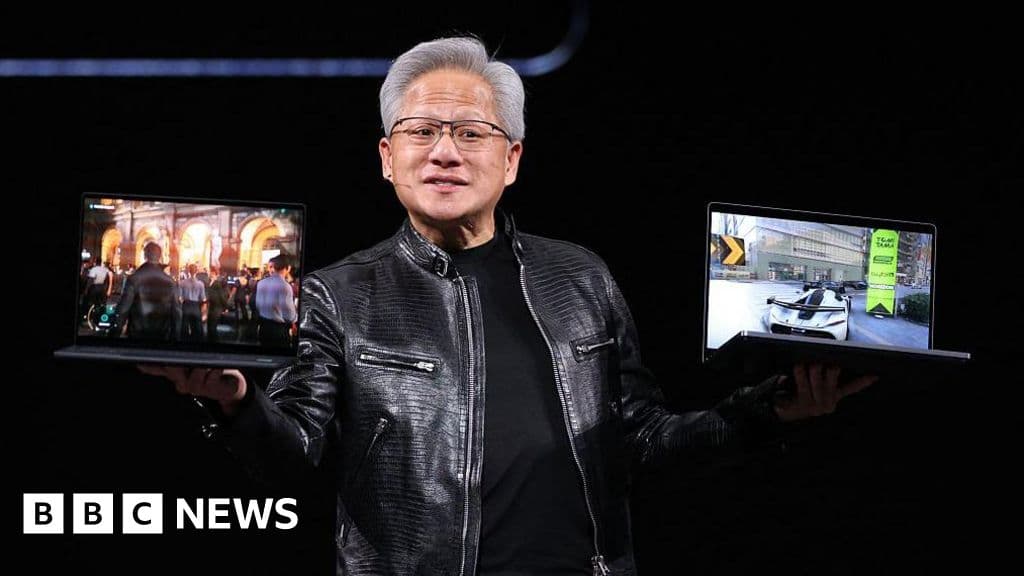
Nvidia's new RTX Spark chip aims to transform personal computing with AI, marking a significant shift in technology. Discover what this means for consumers.
BBC Business
The explosion of Blue Origin's New Glenn rocket raises significant concerns over NASA's lunar ambitions and the future of Amazon's satellite projects. Discover the implications.
BBC Science
Discover how Meta's lack of engagement on user bans raises critical concerns about accountability and transparency in social media governance.
BBC Technology