
Image: BBC Business
A £49 face serum ad banned for misleading 'five years younger' claims raises questions about ethics in beauty advertising. What does this mean for consumers?
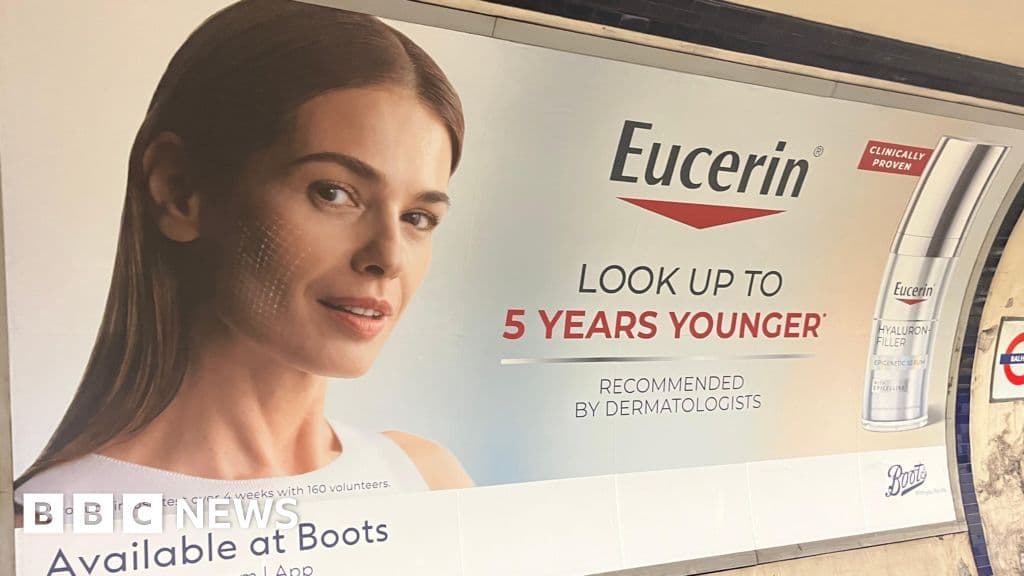
GlipzoA billboard advertisement promoting a £49 face serum has been banned due to deceptive claims suggesting it could make users appear up to five years younger. The controversial advertisement for Eucerin's Hyaluron-Filler Epigenetic Serum claimed to be "clinically proven," relying on a study involving 160 participants who used the product for four weeks. However, the data was called into question by the Advertising Standards Authority (ASA), which raised significant concerns regarding the study's methodology and its reliance on subjective self-reporting.
The ASA's investigation revealed that the study lacked a control group, raising doubts about the validity of the results. Participants were asked to self-assess how much younger they felt they appeared after using the serum, which the ASA highlighted as a problematic method of evaluation. Beiersdorf, the company behind Eucerin, asserted that they presented the claim as "up to" five years younger to reflect a genuine maximum rather than a standard outcome. They emphasized that their products are backed by scientific research, as reported to the BBC.
The Advertising Standards Authority received a complaint regarding the advertisement in November 2025 after it was displayed at the Balham tube station in London. In its report, the ASA expressed doubts about the study’s design, noting that the absence of a control group compromised its conclusions. Additionally, the environmental conditions under which the serum was tested differed from those in the UK, further questioning the relevance of the results.
Beiersdorf provided three other pieces of evidence to support their claims, but the ASA deemed all of them to be unpublished research, which raised further skepticism. Furthermore, the one peer-reviewed study that Beiersdorf submitted did not specifically involve the serum in question. Consequently, the ASA ruled that the advertisement was misleading and instructed that it cannot be displayed in its current form again.
In response to the ruling, Beiersdorf confirmed that the advertisement has been removed from circulation in the UK. The company stated, "All of the studies we cite are carried out in line with industry standards," reinforcing their commitment to ethical advertising practices. However, the incident has ignited a broader conversation about the cosmetics advertising industry, which is often criticized for making exaggerated claims.
Lianne Sykes, an expert in aesthetics marketing, emphasized the need for companies to conduct thorough skin analysis over extended periods to substantiate claims made in advertisements. She suggests that consumers should be skeptical and ask critical questions before believing in the efficacy of beauty products. Her recommendations for consumers include: - Identifying assessment methods: How is skin quality evaluated? - Diversity in testing: Is the product tested across various age groups? - Measuring success: What metrics were used to determine the product's effectiveness?
Sykes argues that individual skin biology varies significantly, and achieving good skin health typically involves a combination of healthy habits rather than reliance on a single product.
The banning of the Eucerin advertisement is a significant reminder of the importance of truth in marketing, especially in the beauty and skincare sectors. Misleading claims not only deceive consumers but also undermine trust in the industry as a whole. As awareness regarding skincare ingredients and efficacy grows among consumers, transparency becomes paramount.
The ASA's decision may set a precedent for stricter oversight of cosmetic advertisements, encouraging companies to prioritize ethical marketing practices. In an era where consumers are more informed than ever, businesses must adapt to maintain credibility and trust.
Moving forward, consumers should remain vigilant about the claims made by skincare brands. The conversation around ethical advertising is likely to intensify, prompting companies to reevaluate their marketing strategies and ensure that they align with scientific evidence.
Furthermore, as regulatory bodies like the ASA continue to scrutinize misleading advertisements, brands may need to invest more in legitimate research and transparent communication. The future of the cosmetics industry may hinge not only on innovative products but also on the authenticity and honesty of their marketing efforts. Consumers deserve clarity and truth about what they are purchasing, and brands that can deliver on these promises will likely thrive in the competitive landscape.
In conclusion, the recent ban serves as a wake-up call for both consumers and companies alike, highlighting the crucial role of ethical standards in advertising. As the conversation continues, it will be essential to watch how brands respond and adapt to the growing demand for transparency in skincare marketing.

Commercial LPG prices have risen again, with increases of ₹42 in Delhi and ₹53.50 in Kolkata impacting businesses and consumers alike. Find out more.
Indian Express
Discover how a tragic coal mine explosion in Shanxi, China, reveals ongoing safety concerns in the industry amidst a push for green energy.
BBC Business
Montek Singh Ahluwalia highlights key economic challenges for India, emphasizing the need for a strategic approach to balance payments and investment.
Indian Express