
Image: BBC Business
Iran's missile strike on Qatar's gas complex has triggered a major economic crisis, threatening Gulf states' stability and energy supply globally.
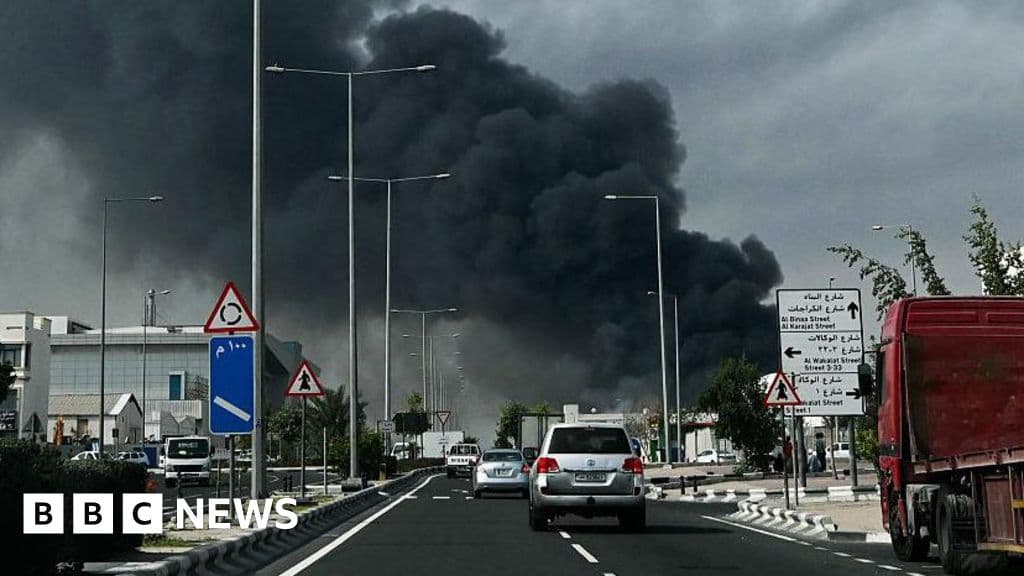
GlipzoIn a shocking escalation of tensions in the Middle East, Iran's ballistic missile strike on March 18 targeted the crucial Ras Laffan gas complex in Qatar, disrupting 17% of global LNG supply. This unprecedented attack has sent ripples through the Gulf economies, raising urgent concerns about long-term economic stability and security in the region.
Historically, Qatar transformed its economy in the early 1990s by betting on its vast natural gas reserves. By investing in the development of liquefied natural gas (LNG) and creating the industrial city of Ras Laffan, Qatar has become a powerhouse in the global energy market. The decision to chill and ship natural gas revolutionized its economy, leading to immense wealth and positioning it among the richest nations worldwide. However, this latest incident has turned a once-promising narrative into a crisis.
The estimated financial impact of the missile strike is staggering, with QatarEnergy projecting a loss of $20 billion (£15 billion) in annual revenues. The repercussions are felt immediately, particularly as key markets in Asia, including China, face significant disruptions in energy supplies. Repairs to the damaged infrastructure could extend from three to five years, which poses a severe threat to Qatar's economic future and that of its neighboring Gulf states.
Senior research scholar Karen Young from the Center on Global Energy Policy at Columbia University emphasizes the profound vulnerability the Gulf states now face. She notes that this attack has sent shockwaves through both global energy markets and the local economies, revealing their precarious position.
The conflict's repercussions extend beyond Qatar. Over 80 energy facilities across the Gulf have been hit since the initiation of strikes by the US and Israel on February 28, resulting in an estimated $58 billion worth of damage. Countries including Bahrain, Kuwait, Saudi Arabia, and the United Arab Emirates are also reeling from the physical and economic fallout.
The World Bank has taken a grim outlook on economic growth in the Middle East, slashing its forecast to 1.8% for 2023, a significant drop from the previously anticipated 4% growth by 2026. The organization cautions that the ongoing conflict could lead to long-term economic 'scarring', with Qatar and Kuwait expected to experience the most severe contractions.
Despite the chaos, Saudi Arabia and the UAE have shown some resilience, bolstered by oil exports that do not pass through the Strait of Hormuz, an essential shipping route that Iran has effectively closed. For Gulf nations, the Strait serves as a vital economic artery, typically managing around 20% of global oil and LNG flows. With its closure, Saudi Arabia has shifted to its East-West pipeline to transport oil to the Red Sea port of Yanbu, while the UAE is making use of its Fujairah pipeline to circumvent the strait. However, these alternative routes can only manage less than half the volume that usually traverses Hormuz, complicating the situation further.
Justin Alexander, a director at consultancy Khalij Economics, highlights the severe impact on Gulf economies while cautioning that the full extent of the damage remains challenging to assess, especially as the conflict endures. He warns that even if hostilities cease today, the economic ramifications will linger long after.
The closure of the Strait of Hormuz and the significant physical damage to energy infrastructure are not the only challenges facing Gulf economies. The crisis has prompted discussions about the necessity for alternative transportation routes for oil and gas exports. Bader Al Saif, a professor at Kuwait University, posits that countries like Qatar, Kuwait, and Bahrain may need to invest in developing pipeline networks to reduce reliance on tanker ships, which are vulnerable to geopolitical conflicts.
As the situation continues to develop, the Gulf states must navigate a complex landscape of economic uncertainty and geopolitical tension. The crisis initiated by the Iranian missile strike has raised questions about energy security and economic resilience in a region heavily dependent on oil and gas exports. The International Energy Agency has described the unfolding crisis as potentially the biggest energy crisis in history, indicating the magnitude of the challenges ahead.
In the coming months and years, stakeholders will be closely monitoring the restoration of infrastructure, the potential for further military actions, and the strategic shifts Gulf nations may undertake to safeguard their economies. The economic landscape of the Middle East may never be the same, and how these countries adapt will be crucial for their long-term stability and prosperity.
In summary, while the immediate impacts are stark, the broader implications of the Iranian conflict on Gulf economies are yet to be fully realized. The region stands at a crossroads, where decisions made today could dictate the trajectory of economic development for decades to come.

Commercial LPG prices have risen again, with increases of ₹42 in Delhi and ₹53.50 in Kolkata impacting businesses and consumers alike. Find out more.
Indian Express
Discover how a tragic coal mine explosion in Shanxi, China, reveals ongoing safety concerns in the industry amidst a push for green energy.
BBC Business
Montek Singh Ahluwalia highlights key economic challenges for India, emphasizing the need for a strategic approach to balance payments and investment.
Indian Express