
Image: BBC Business
Champion hacker Valentina Palmiotti warns AI tools like Claude Mythos may soon threaten her career, reshaping the future of ethical hacking.
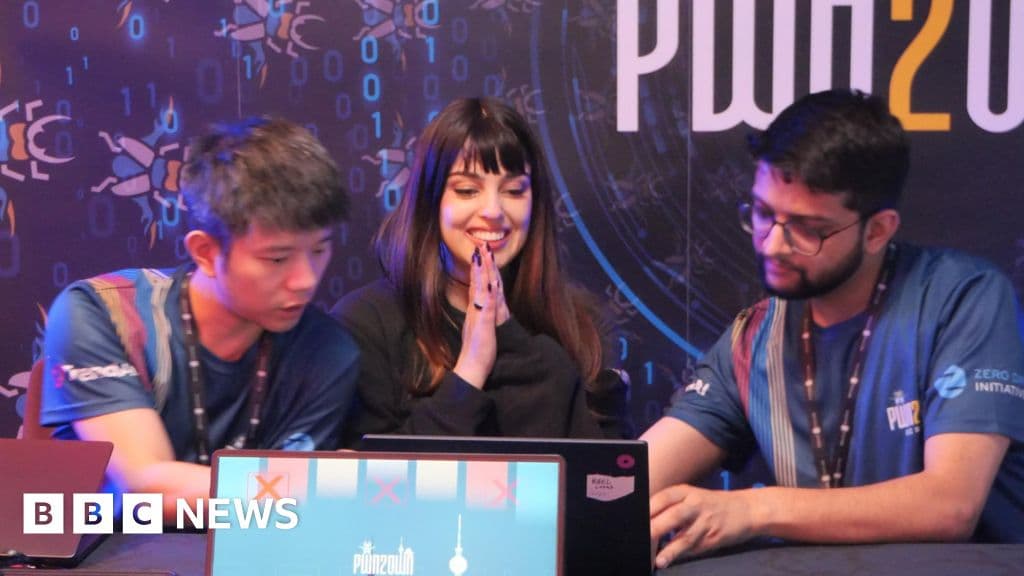
GlipzoIn an era where technology is evolving at breakneck speed, Valentina Palmiotti, popularly known as Chompie, has emerged as a beacon of excellence in the ethical hacking community. Recently, she triumphed at the prestigious Pwn2Own hacking competition held in Berlin, where she showcased her unparalleled skills. However, the rise of advanced AI tools, particularly Claude Mythos, raises questions about the future of ethical hacking and whether even top hackers like Chompie can sustain their careers in this rapidly changing landscape.
Chompie, who has been a standout performer at various hacking contests, revealed that while AI tools have currently aided her in securing lucrative bug bounties—monetary rewards given for identifying vulnerabilities in software—she is concerned that their escalating capabilities could soon outstrip human talent. “AI is becoming so powerful that even champions like me might find it hard to compete,” Chompie stated in an interview with BBC News.
The AI landscape is currently dominated by systems like Claude Mythos, developed by Anthropic. This cutting-edge tool has reportedly identified 1,600 vulnerabilities across numerous software applications, raising alarm bells in the cybersecurity field. The potential threat posed by Mythos is so significant that its access is restricted to select governments and cybersecurity organizations, reflecting its capacity to disrupt the status quo.
The Pwn2Own competition, organized by the ZeroDay Initiative, serves as a platform for ethical hackers worldwide to demonstrate their prowess in uncovering software vulnerabilities. This year, the event awarded nearly $1.3 million (£970,000) to participants who collectively unveiled 47 new hacking methods. These vulnerabilities are crucially reported to software companies, allowing them to patch security flaws before they can be exploited by malicious actors.
Chompie's performance at Pwn2Own showcased her dedication and intense work ethic. On the first day of the competition, she successfully hacked a system linked to Nvidia, earning a remarkable $20,000. Following this victory, she entered what she humorously termed her “zombie hacker mode,” a state of relentless focus fueled by energy drinks and adrenaline. “I worked from 6 PM to 6 AM and didn’t sleep,” she recounted, demonstrating her commitment to excellence.
The culmination of her efforts was another successful hack into a Linux-based system, netting her an additional $50,000. Chompie described this intense concentration, often donned in a black hoodie, as vital to her success, despite acknowledging its toll on her health. “It’s not healthy,” she admitted, yet she emphasized the necessity of such dedication in the high-stakes world of cybersecurity.
Interestingly, many competitors, including Chompie, have begun leveraging AI tools to enhance their performance during competitions. Tools like Claude Code have allowed ethical hackers to accelerate their research processes, enabling them to compete more effectively. Chompie expressed that they currently find themselves in a “sweet spot” where AI acts as a supportive tool rather than a competitor.
However, her outlook is cautious. She anticipates that the balance will soon shift, with emerging models like Claude Mythos and GPT 5.5 Cyber potentially making it harder for ethical hackers to identify vulnerabilities. “I competed in Pwn2Own this year because I thought it might be my last chance,” she shared, indicating a sense of urgency about her career.
Chompie's reflections on the future of ethical hacking suggest a narrowing of opportunities for many hackers. “A lot of the lower-hanging fruit will start to go away,” she predicted, hinting that only the top-tier hackers will continue to find success in identifying new bugs and winning prizes.
In contrast, another prominent hacker, Orange Tsai, who has made a name for himself in the community, expressed a more optimistic view of AI's role in hacking. Tsai led his team to victory, earning $375,000 (£278,000) by uncovering complex hacking pathways. He views AI as a powerful assistant that can enhance the research process. “AI can finally help free my hands,” he stated, emphasizing how it alleviates the burden of exhaustive testing.
Despite the advancements in AI, Tsai remains confident that human creativity and intuition will continue to be indispensable in discovering vulnerabilities that machines may overlook. His perspective underscores the ongoing debate within the hacking community: will AI serve as a collaborative tool or a replacement?
The debate surrounding AI's role in ethical hacking is far from settled. While tools like Mythos pose significant challenges, they also present opportunities for enhancing efficiency and effectiveness in cybersecurity research. As the landscape evolves, ethical hackers must adapt to the changing dynamics brought about by AI.
Looking forward, it will be crucial to monitor how ethical hackers recalibrate their strategies in response to AI advancements. Will they embrace these tools to enhance their capabilities, or will they find themselves overshadowed by the very technologies they once relied upon? The future of ethical hacking hinges on this evolving relationship, and only time will reveal the outcome. Stay tuned for more updates as the cybersecurity field continues to transform.

Nvidia's new RTX Spark chip aims to transform personal computing with AI, marking a significant shift in technology. Discover what this means for consumers.
BBC Business
The explosion of Blue Origin's New Glenn rocket raises significant concerns over NASA's lunar ambitions and the future of Amazon's satellite projects. Discover the implications.
BBC Science
Discover how Meta's lack of engagement on user bans raises critical concerns about accountability and transparency in social media governance.
BBC Technology