
Image: BBC Business
AI Minister Liz Kendall admits she doesn't use AI at work, despite announcing a £500m fund to support UK AI firms. Discover her surprising insights!
GlipzoIn a surprising revelation, Liz Kendall, the UK’s Science, Innovation and Technology Secretary, has stated that she does not utilize Artificial Intelligence (AI) in her professional duties. This revelation comes during a pivotal week where she announced a significant £500 million fund aimed at bolstering British AI companies, which she described as vital for the nation’s security and economic health.
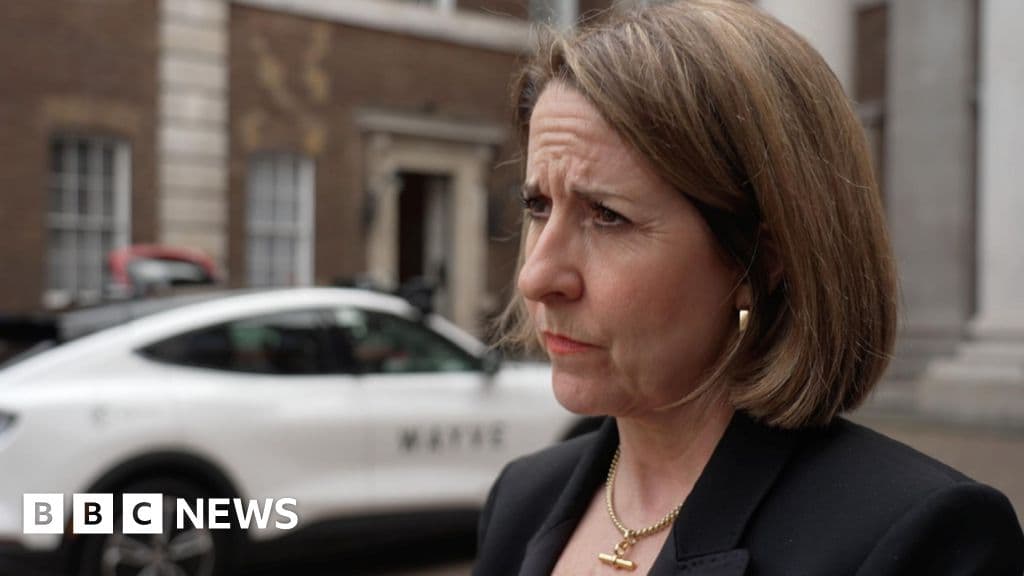
Kendall made this admission while being interviewed in an AI-driven driverless car for BBC Radio 5 Live and Newsnight. Although she acknowledged using AI in her personal life, particularly to assist with an allergic reaction to a skincare product, she maintained that her work does not incorporate AI technologies. This stance contrasts sharply with the expectations set forth by her predecessor, Peter Kyle, who previously introduced AI tools like “Humphrey,” named after a character from the classic sitcom, Yes, Minister. Kyle had emphasized the importance of leveraging AI to enhance efficiency, stating, “No one should be wasting time on something AI can do quicker and better.”
Despite Kendall's personal reluctance to use AI for her work, she did highlight instances where AI is being deployed within the government. For example, while serving in the Department for Work and Pensions, job centre staff utilized AI to assist job seekers by refining their CVs and summarizing feedback from public consultations. The New Statesman recently reported that AI is already playing a role in drafting British laws, although Kendall refuted this claim, insisting, “It’s certainly not written any of my laws that we're doing around social media and online safety.”
Kendall's experiences with AI are personal rather than professional. She recounted how she recently used AI to analyze the ingredients of her skincare products after experiencing an allergic reaction. “I got AI to go through the ingredients of all the products... to identify was there one that was common between the three, and to suggest something I could put on to stop this eczema that had come up,” she explained. After verifying the AI's suggestion with credible sources, she found success with the recommended treatment.
The establishment of the Sovereign AI unit, a venture capital initiative dedicated to investing in British AI startups, underscores the government’s commitment to advancing this technology. However, this advancement raises valid concerns about job displacement, particularly in sectors like transportation. In London alone, there are approximately 123,000 licensed taxi and private hire vehicles, a number that could be jeopardized by the rise of driverless cars.
Kendall acknowledged the potential job market shifts caused by AI, stating, “Jobs will be created, jobs will change, some jobs will go, but new ones will take their place.” To address these concerns, the government aims to provide 10 million workers with free AI skills training, an initiative deemed essential for adapting to the future workforce landscape.
The rapid evolution of AI technology has stirred unease among the British public. A recent YouGov poll revealed that 75% of Britons harbor concerns about AI posing threats to humanity. When questioned about her own anxieties regarding AI, Kendall expressed confidence in the safety of its development, though she recognized the need to consider its implications on employment. “I’m not an engineer or a computer scientist; I am a historian... each time this sort of transition occurs, some jobs are lost while new ones are created,” she noted, emphasizing the role of the government in facilitating this transition.
As the UK government invests heavily in AI, the future landscape of the job market and technology use remains uncertain. With Kendall’s candid admission about her own non-use of AI at work, it raises questions about the practical integration of AI within government operations. The focus now shifts to how effectively the government can implement AI while addressing public concerns and ensuring that workers are equipped with the necessary skills to adapt to new job roles.
In the coming months, it will be crucial to observe how the £500 million fund is allocated and whether it will lead to tangible advancements in AI that benefit both the economy and society. Additionally, the initiative to provide free AI skills training to millions could be a critical step towards easing fears about job displacement. As AI continues to evolve, the balance between innovation and workforce stability will be a key issue for policymakers and the public alike.

Tensions soar as the US and Iran engage in air strikes near the Strait of Hormuz, raising concerns over global oil supply and regional stability.
BBC World
Trump's international interventions face serious stalemates. What will this mean for U.S. foreign policy? Explore the critical challenges ahead.
Indian Express
Tehran denies resignation of President Masoud Pezeshkian amid claims of IRGC influence. What does this mean for Iran's political stability? Click to learn more!
Indian Express