
Image: BBC World
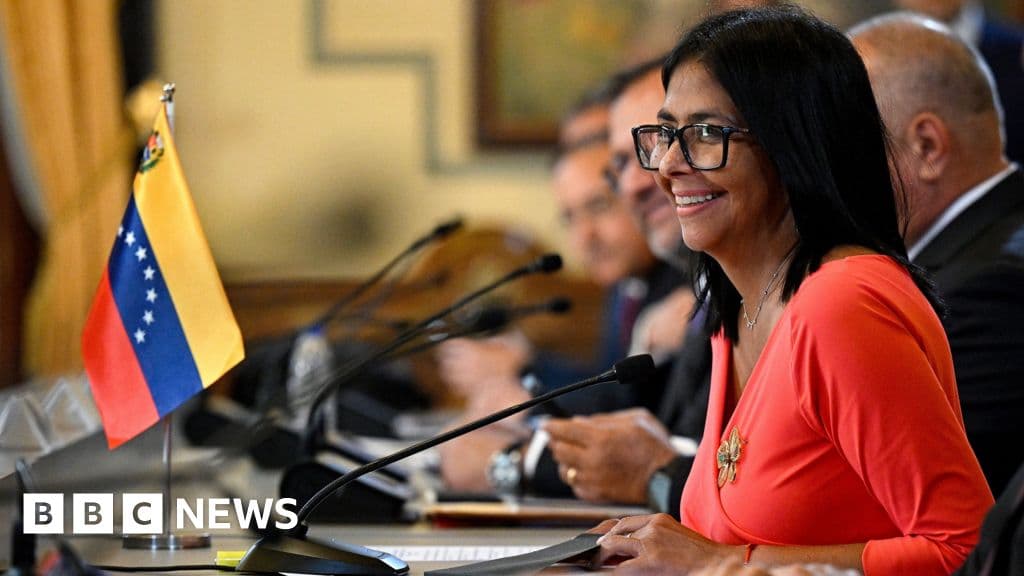
Venezuela's interim President Delcy Rodríguez faces backlash as she claims the political prisoner release scheme is ending, raising concerns over human rights.
GlipzoIn a surprising turn of events, Venezuelan interim President Delcy Rodríguez has declared that the recently initiated scheme aimed at releasing political prisoners is "coming to an end" after just nine weeks in operation. This announcement has sparked outrage among human rights organizations, who have condemned her statement and questioned the legitimacy of her authority to terminate the releases.
Since the introduction of the amnesty law by the National Assembly, nearly 500 political prisoners have been freed according to Foro Penal, a prominent prisoner rights group. Despite this significant figure, many more individuals remain incarcerated, leading to concerns about the ongoing repression in Venezuela.
Human rights advocates have expressed their discontent with Rodríguez's remarks. Foro Penal argues that she lacks the power to unilaterally end the prisoner release initiative, while watchdog group Provea has labeled her comments as "arbitrary and unconstitutional." This sentiment highlights the broader apprehensions about the Venezuelan government’s commitment to human rights and democratic principles.
Rodríguez, who has been a loyal ally of former President Nicolás Maduro, surprisingly gained support from Donald Trump following the U.S. military operation that removed Maduro from power in January. Trump's endorsement has raised eyebrows, especially as he chose to back Rodríguez over opposition leader María Corina Machado. The release of political prisoners, including some of Machado's associates, was seen as a crucial concession by the interim administration to the U.S.
Initially, Jorge Rodríguez, Delcy's brother and President of the National Assembly, announced the amnesty law, stating that 1,557 political prisoners had applied for its provisions. The legislation was intended to cover up to 11,000 individuals, signifying a potential shift in the country’s approach to political dissent.
As of April 20, Foro Penal reported that 473 political prisoners had been released, yet it is believed that over 500 remain behind bars. In a recent meeting in Caracas, Delcy Rodríguez claimed that 8,616 people had been freed under the amnesty law, dubbing it a success in terms of its reach and beneficiaries. However, critics argue that this number is inflated and does not reflect the true nature of the situation.
Following her comments, Gonzalo Himiob, vice-president of Foro Penal, asserted that only a new legislative act or a referendum could repeal the amnesty law, which was designed without an expiration date. He emphasized that the judicial system, part of the oppressive structure that necessitated the amnesty, has shown neither the will nor the capability to apply the law effectively.
Provea echoed this sentiment, stating that halting the release of political prisoners undermines the efforts towards coexistence and peace that the government has purportedly promoted. They view the amnesty law, despite its flaws, as a crucial step toward dismantling the oppressive framework that has dominated Venezuelan society in recent years.
The Justice, Encounter and Pardon group described the announcement regarding the end of prisoner releases as a “grave assault on the rule of law.” They lamented that the amnesty law has devolved into mere political rhetoric rather than a true vehicle for restoring freedom to political prisoners. This criticism underscores the ongoing struggle for justice in Venezuela.
For years, the Maduro administration has utilized the detention of political prisoners as a means to quash dissent and silence critics, creating a climate of fear among opposition voices. Rodríguez, who held the position of vice-president under Maduro, has attempted to portray her interim government as more open to political discourse, particularly in light of U.S. support.
Earlier this month, the U.S. lifted sanctions on Delcy Rodríguez, crediting her administration with progress in promoting stability and economic recovery. This decision has led analysts to speculate whether the U.S. is prioritizing short-term stability over long-term democratic reforms. Secretary of State Marco Rubio characterized the current Venezuelan situation as a

Tensions soar as the US and Iran engage in air strikes near the Strait of Hormuz, raising concerns over global oil supply and regional stability.
BBC World
Trump's international interventions face serious stalemates. What will this mean for U.S. foreign policy? Explore the critical challenges ahead.
Indian Express
Tehran denies resignation of President Masoud Pezeshkian amid claims of IRGC influence. What does this mean for Iran's political stability? Click to learn more!
Indian Express