
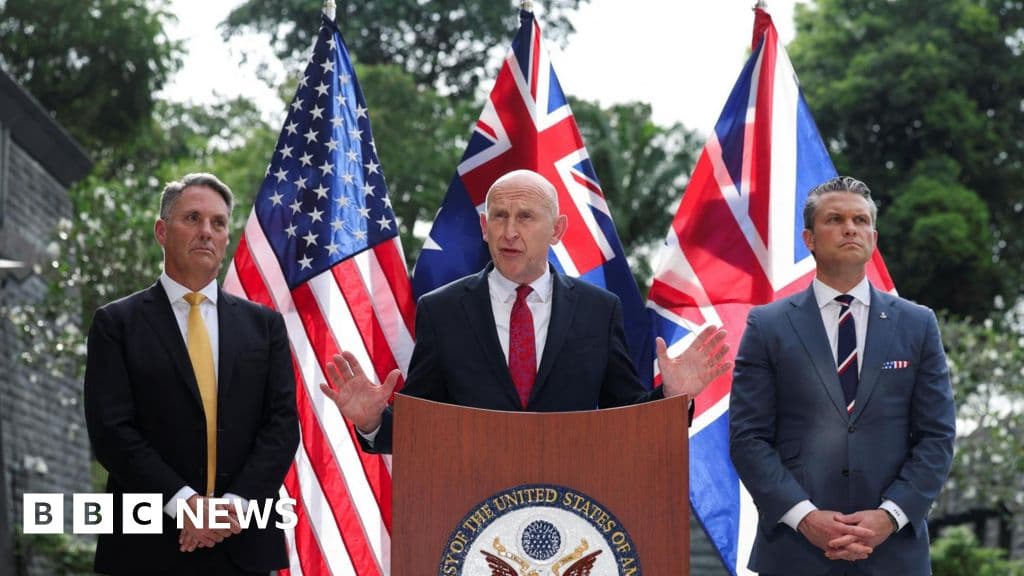
Image: BBC World
Discover how the US, UK, and Australia are developing underwater drone technology to protect critical undersea infrastructure and strengthen defense capabilities.
GlipzoThe UUV project marks a pivotal development under Aukus’s Pillar Two, which focuses on collaboration in advanced military technologies, including long-range hypersonic missiles and artificial intelligence. This initiative is designed not only to enhance defense capabilities but also to protect vital undersea infrastructure critical to everyday life.
Healey emphasized that these vehicles would be equipped with advanced sensors and weapon systems, enabling military forces to rapidly acquire cutting-edge battle technologies. This advancement is significant in light of rising tensions in the Indo-Pacific region, particularly concerning China's assertive maritime activities and Russia’s alleged covert operations targeting undersea infrastructure.
In December, the UK and Norway took proactive steps by signing a pact to jointly monitor Russian submarine activities in the North Atlantic to safeguard undersea cables. These developments underscore the pressing need for a robust defense strategy in face of increasing maritime threats.
Under Pillar One of the Aukus agreement, plans are underway to build nuclear-powered attack submarines in both the UK and Australia, with Australia set to become the second nation to access U.S. nuclear propulsion technology. However, there are growing concerns within Australia regarding whether this monumental defense project can be executed in a timely manner to replace its aging submarine fleet. The first of these submarines is not expected to be operational until the 2040s.
In the interim, the U.S. and UK will rotate their existing nuclear submarines through Australian waters, and Australia plans to purchase second-hand submarines from the U.S. starting in the 2030s. This timeline has prompted criticism, and Australia's Defence Minister Richard Marles has emphasized the necessity of proceeding with the Aukus submarine project, stating, "There is no plan B."
As we look ahead, it will be crucial to monitor the implementation of this UUV technology and the broader Aukus projects. Will these initiatives effectively address the growing security threats in the Indo-Pacific? And how will they reshape the balance of power in maritime defense? The answers to these questions will be pivotal in determining the future stability of the region and the efficacy of international defense collaborations.

Tensions soar as the US and Iran engage in air strikes near the Strait of Hormuz, raising concerns over global oil supply and regional stability.
BBC World
Trump's international interventions face serious stalemates. What will this mean for U.S. foreign policy? Explore the critical challenges ahead.
Indian Express
Tehran denies resignation of President Masoud Pezeshkian amid claims of IRGC influence. What does this mean for Iran's political stability? Click to learn more!
Indian Express