
Image: BBC World
Are the US and Iran nearing peace or slipping back into conflict? Discover the latest developments and what they mean for global security.
GlipzoThe ongoing tension between the United States and Iran has reached a pivotal moment. As of now, the White House indicates that negotiators from both nations might have reached a framework for a 60-day ceasefire extension, aimed at facilitating further discussions. However, this arrangement awaits the approval of President Donald Trump, and as of now, has not been confirmed by Iranian authorities.
This situation arises after a tumultuous week that has put the ceasefire, which was established on April 8, to the test. The ceasefire has notably lasted longer than the preceding active conflict, which had seen intense exchanges of military actions. Recent developments have led many to question whether this is a step toward lasting peace or a precursor to renewed hostilities.
The backdrop of these negotiations is fraught with challenges. Earlier this week, the US Central Command (Centcom) reported conducting strikes against what they labeled a “ground control site” in Bandar Abbas, a southern port city in Iran. In response, Iran’s Islamic Revolutionary Guard Corps (IRGC) issued a stern warning, declaring that any aggression would be met with retaliation. They also claimed responsibility for an attack on a US airbase, though details remained unclear. Centcom later confirmed that a ballistic missile had been intercepted over Kuwait, an area where US military presence is substantial.
This exchange of strikes and warnings has been described as an “egregious ceasefire violation” by Centcom, but it appears that both sides are cautious not to escalate to the full-scale warfare that characterized earlier phases of the conflict. During the initial weeks, the US and its ally Israel conducted extensive airstrikes across Iranian territory, while Iran retaliated with drone and missile attacks targeting US assets and regional allies.
Despite the troubling military encounters, a complicated diplomatic process unfolds behind the scenes. Reports have emerged regarding an unofficial 14-point memorandum that Iran’s state media claims outlines its demands for easing tensions. Key elements of this draft include: - Lifting the US naval blockade of Iranian ports. - Withdrawal of US forces stationed near Iran. - Restoration of non-military shipping traffic through the Strait of Hormuz, with control shared between Iran and Oman.
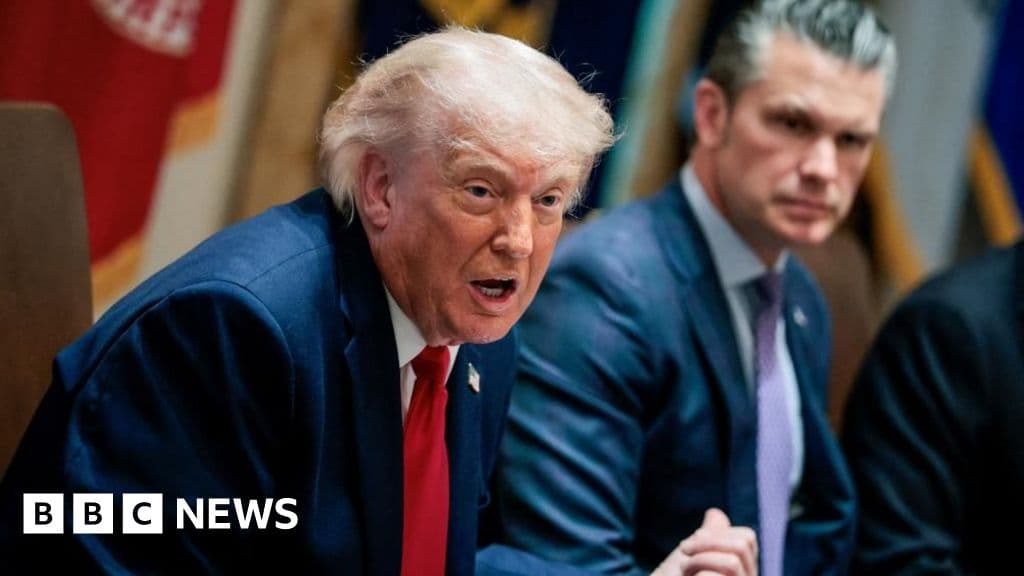
However, the draft notably lacks any provisions regarding Iranian concessions on nuclear issues, a critical aspect of the negotiations. In reaction to the memorandum, the White House dismissed it as a “complete fabrication,” emphasizing that actual negotiations have not reached this stage. During a recent cabinet meeting, President Trump expressed dissatisfaction with the proposals, indicating that while some progress has been made, further concessions from Iran are necessary.
Trump's remarks reflected a sense of urgency and frustration. He noted that Iran is beginning to make the necessary adjustments in negotiations but warned that non-compliance could result in a return to military conflict. He ominously remarked, “If they won’t, then the man on my left is going to finish them off,” referring to Defense Secretary Pete Hegseth. This kind of rhetoric underscores the volatile nature of US-Iran relations, where military threats and diplomatic overtures coexist.
Additionally, the US Treasury Department has imposed sanctions on Iran's newly established Persian Gulf Strait Authority, indicating ongoing concerns about Iran’s attempts to exert control over vital shipping routes. This action reinforces the US narrative of Iran as a state sponsor of terrorism, complicating the diplomatic landscape further.
The implications of US-Iran relations extend beyond the two nations; they are crucial for global security and economic stability. The Strait of Hormuz is a vital passage for around 20% of the world’s oil supply, and any disruption could have significant repercussions on global markets. Furthermore, the ongoing conflict impacts regional allies and could potentially draw in other international players, heightening the risk of a broader conflict.
As tensions simmer, the international community watches closely. Should negotiations fail and military actions escalate, the region could see another round of devastating conflict. Conversely, successful diplomacy could pave the way for a more stable and peaceful Middle East.
As the situation evolves, attention will shift towards several key factors: - Trump’s Decision: Will the president approve the 60-day ceasefire extension, and what conditions will he impose? - Iran’s Response: How will Iran navigate its demands and potential concessions in the face of US sanctions? - International Involvement: Will other nations intervene or facilitate a more robust diplomatic dialogue?
In the coming weeks, the balance between military readiness and diplomatic engagement will determine the trajectory of US-Iran relations. Observers remain cautious but hopeful that the pathway to peace remains viable, even amidst a landscape fraught with uncertainty and risk.

Tensions soar as the US and Iran engage in air strikes near the Strait of Hormuz, raising concerns over global oil supply and regional stability.
BBC World
Trump's international interventions face serious stalemates. What will this mean for U.S. foreign policy? Explore the critical challenges ahead.
Indian Express
Tehran denies resignation of President Masoud Pezeshkian amid claims of IRGC influence. What does this mean for Iran's political stability? Click to learn more!
Indian Express