
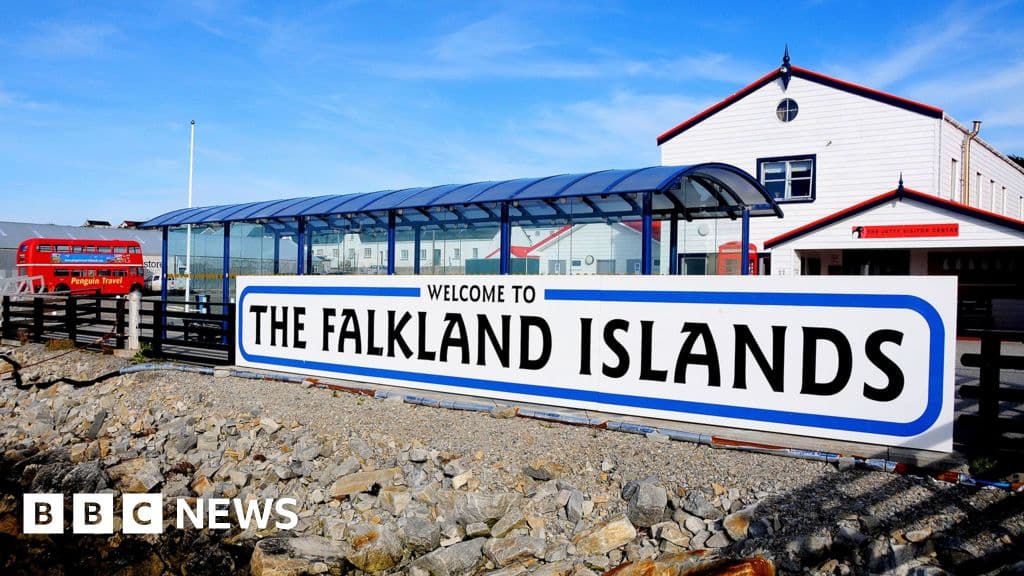
Image: BBC World
UK reaffirms Falkland Islands sovereignty amid US speculation. What does this mean for international relations? Click to learn more.
GlipzoIn a recent statement from Downing Street, the British government has reiterated that sovereignty over the Falkland Islands rests firmly with the United Kingdom. This declaration comes in the wake of a Reuters report suggesting that the U.S. Department of Defense might be contemplating a shift in its stance regarding the territory, which has long been at the center of a sovereignty dispute between the UK and Argentina.
The internal Pentagon email, which was not publicly disclosed but reported by major media outlets, hinted at potential measures designed to penalize NATO allies perceived as lacking support for U.S. military actions in Iran. Among the options floated was the idea of suspending Spain from NATO due to its opposition to U.S. military strategy.
Despite the absence of confirmation on the email from Pentagon officials, a spokesperson emphasized the importance of ensuring that the U.S. allies fulfill their commitments. The spokesperson stated, “Our goal is to make sure that the president has credible options to ensure that our allies are no longer a paper tiger.” This statement echoed sentiments previously expressed by former President Donald Trump, who criticized NATO allies for not sufficiently supporting U.S. initiatives.
The Falkland Islands, located in the southwest Atlantic Ocean, remain a British overseas territory, having been the subject of a heated sovereignty dispute with Argentina since the early 19th century. The islands’ residents overwhelmingly voted in favor of maintaining their status as a UK territory in a 2013 referendum, a point stressed by a spokesperson from No 10.
“The Falkland Islands have consistently expressed their desire to remain a British overseas territory. We have always upheld the islanders' right to self-determination, and sovereignty unequivocally resides with the UK,” the spokesperson declared. This reaffirmation of sovereignty is crucial, especially given the historical tensions surrounding the islands.
In light of the Pentagon leak, Lord West, a former Labour security minister and a veteran of the Falklands War, expressed concern over the apparent misunderstanding of NATO dynamics by U.S. officials. Speaking on BBC Radio 4's The World Tonight, he labeled the situation as “quite extraordinary” and criticized U.S. Defense Secretary Pete Hegseth for his remarks regarding NATO's role in supporting the U.S.
“Hegseth's comments reflect a profound ignorance of NATO's history and function,” Lord West stated. He noted that the only time NATO Article 5, which posits that an attack on one member is an attack on all, was invoked was in response to the September 11 attacks in 2001, emphasizing the alliance's role in defending the United States.
Officials from the Falkland Islands government have expressed confidence in the UK's commitment to defending their rights. They stated, “The Falkland Islands have complete confidence in the UK government's promise to uphold and defend our right to self-determination.” This statement underscores the islands' residents' desire for continued British governance and their right to decide their political future.
Political leaders in the UK have voiced strong opposition to any perceived threat to the Falklands’ sovereignty. Kemi Badenoch, leader of the Conservative Party, dismissed the U.S. report as “absolute nonsense,” while Nigel Farage of Reform UK insisted that Falkland sovereignty is non-negotiable, pledging to raise the matter directly with Argentina’s President Javier Milei later this year.
In a show of solidarity, Sir Ed Davey, leader of the Liberal Democrats, has called for the cancellation of King Charles III’s upcoming visit to the U.S., labeling the current U.S. administration as “unreliable” and “damaging.” His comments underscore the political tension surrounding the rumored U.S. stance on the Falklands, especially as the royal visit approaches.
As the King and Queen Camilla prepare to meet with President Trump at the White House, this situation adds an additional layer of complexity to diplomatic relations between the UK and the U.S.
The ongoing debate over the Falkland Islands is not just a matter of territorial claims; it reflects deeper geopolitical dynamics between major world powers. The UK's steadfast position on the Falklands is crucial not only for maintaining its historical claims but also for reinforcing its relationships within NATO and with its allies.
The U.S.'s potential reassessment of its stance could signal a shift in foreign policy that might affect alliances and global security strategies. As tensions rise, both the UK and the U.S. must navigate these waters carefully to maintain unity among allies, particularly as global conflicts evolve.
As this situation develops, observers should watch for: - Further statements from U.S. officials regarding their stance on the Falklands. - The impact of King Charles III’s visit to the U.S. and its reception. - Potential reactions from Argentina, especially in light of Farage's planned discussions with Milei. - How the UK government will continue to assert its sovereignty claims amid changing international relations.
Ultimately, the sovereignty of the Falkland Islands remains a deeply significant issue, intertwining historical context with contemporary geopolitical realities. The next steps taken by both the UK and the U.S. could define future diplomatic relations in a rapidly changing world.

Tensions soar as the US and Iran engage in air strikes near the Strait of Hormuz, raising concerns over global oil supply and regional stability.
BBC World
Trump's international interventions face serious stalemates. What will this mean for U.S. foreign policy? Explore the critical challenges ahead.
Indian Express
Tehran denies resignation of President Masoud Pezeshkian amid claims of IRGC influence. What does this mean for Iran's political stability? Click to learn more!
Indian Express