
Image: BBC World
Trump warns Iran of imminent military action if a deal is not reached by his deadline. What does this mean for global stability and energy markets?
GlipzoIn a significant escalation of tensions between the United States and Iran, President Donald Trump threatened to take military action that could obliterate the country in a single night if an agreement is not reached by his imposed deadline. This ultimatum centers around the reopening of the Strait of Hormuz, a vital passage for global oil shipments, and is set for 8:00 PM EDT on Tuesday.
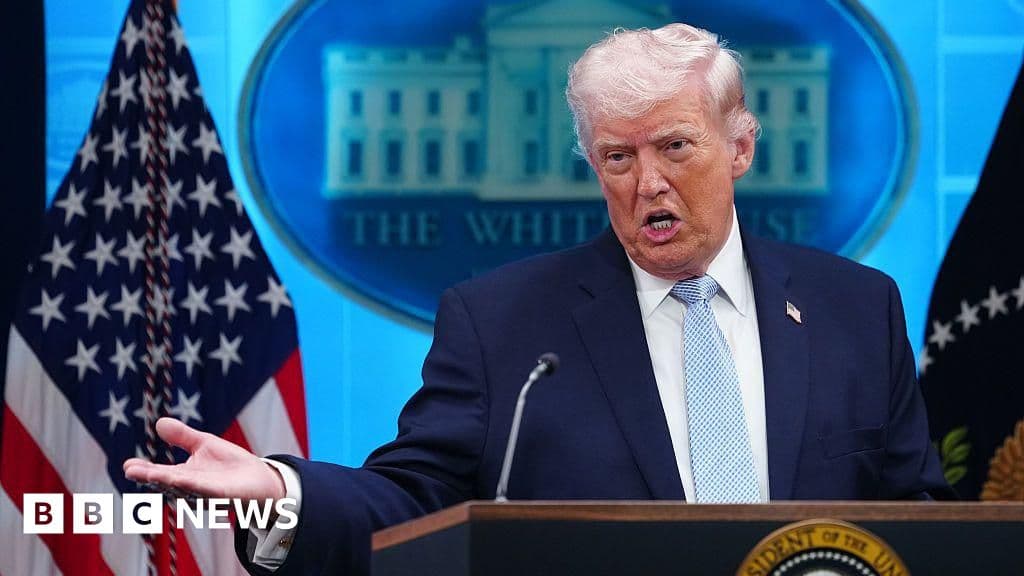
During a press conference at the White House on Monday, Trump expressed confidence that some Iranian leaders were negotiating in good faith, yet he acknowledged that the situation remains precarious. With the clock ticking, the stakes are high as he reiterated the potential consequences of inaction.
Iran has so far dismissed proposals from the US, instead demanding an end to hostilities and the lifting of sanctions. The Iranian government has made it clear that they are not inclined to accept the US's terms for a ceasefire.
As negotiations stall, Trump stated, "The entire country can be taken out in one night – and that night might be tomorrow night." He emphasized that should Iran fail to comply with his demands, the nation would be thrust back into the Stone Ages, devoid of essential infrastructure. “They're going to have no bridges,” he warned. “They're going to have no power plants.”
This dramatic warning comes on the heels of a military operation where US forces successfully rescued two crew members from a downed F-15 fighter jet in southern Iran. Trump took the opportunity to commend the operation's success while simultaneously reinforcing his stance against Iran.
Legal experts have raised alarms regarding the implications of Trump's threats, suggesting that such a strategy could be classified as a war crime. According to a former legal advisor from the Obama administration, actions aimed at crippling Iran's infrastructure could violate international law.
Efforts from Pakistan, Turkey, and Egypt to mediate between the two nations have been complicated by communication challenges. An anonymous official familiar with the situation noted, "The average time of response has been a day or so," highlighting the difficulties in orchestrating effective dialogue.
Despite these setbacks, Trump remained optimistic about the potential for negotiations, revealing little about his administration's strategies but asserting that he has “the best plan.”
Amidst the growing conflict, Trump criticized key allies, including the UK, NATO, and South Korea, for their perceived lack of support during the ongoing crisis. He remarked, "That's a mark on NATO that will never disappear," asserting that the US does not necessarily require the UK’s assistance.
The US military has conducted over 13,000 strikes in Iran since hostilities began, underscoring the extensive military presence and active engagement in the region.
The situation is critical not only for US-Iran relations but also for global energy markets. The Strait of Hormuz is a key route for oil transport, and any military action could disrupt supplies, leading to significant economic repercussions worldwide. Trump’s comments have raised concerns about escalating military involvement and the potential for widespread civilian suffering in Iran.
As the deadline looms, all eyes are on Iran's response to Trump's ultimatum. Will Iran capitulate to the demands, or will tensions escalate further? The coming days will be crucial in determining the direction of this geopolitical standoff. Observers are urged to monitor not only Iran's diplomatic responses but also the movements and strategies of US military forces in the region.
In conclusion, the interplay between military threats and diplomatic efforts illuminates the delicate balance of power in this high-stakes situation. As negotiations falter, the potential for conflict remains alarmingly high, making it imperative for all parties involved to seek a resolution that avoids catastrophic outcomes.

Tensions soar as the US and Iran engage in air strikes near the Strait of Hormuz, raising concerns over global oil supply and regional stability.
BBC World
Trump's international interventions face serious stalemates. What will this mean for U.S. foreign policy? Explore the critical challenges ahead.
Indian Express
Tehran denies resignation of President Masoud Pezeshkian amid claims of IRGC influence. What does this mean for Iran's political stability? Click to learn more!
Indian Express