
Image: BBC World
Trump's critical visit to China focuses on trade, technology, and Taiwan. Discover the stakes as he meets Xi Jinping amid global tensions.
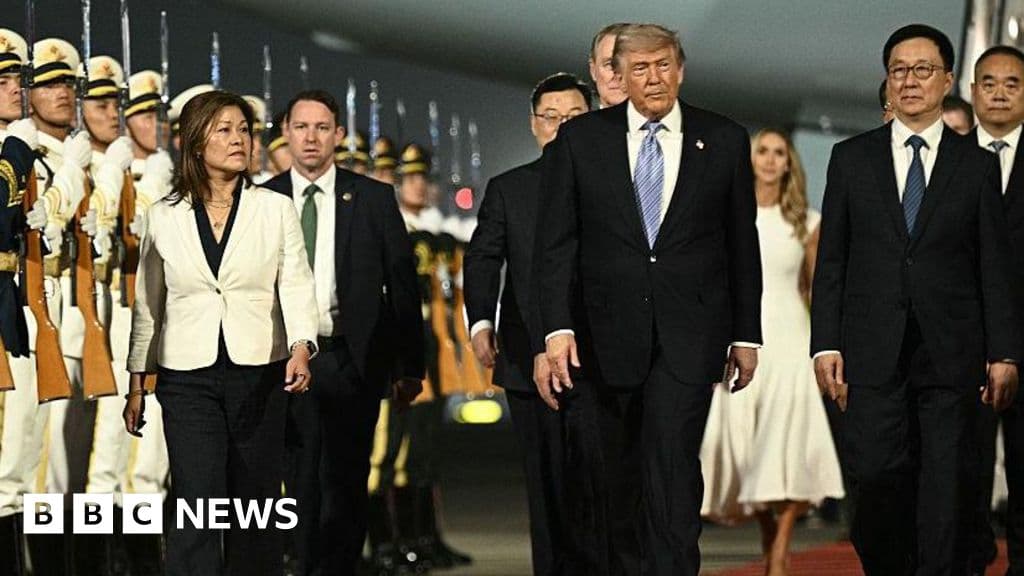
GlipzoUS President Donald Trump landed in Beijing on Wednesday evening, where he was welcomed with a grand ceremony as he prepares for pivotal discussions with Chinese President Xi Jinping. This visit, spanning two days, comes at a critical juncture for both nations, with key topics including tariffs, technology competition, the ongoing war in Iran, and the complex relationship with Taiwan.
During his arrival, Trump was greeted by Chinese Vice-President Han Zheng, marking a significant diplomatic gesture, especially in contrast to his previous visit where a lower-ranking official welcomed him. Accompanied by influential figures from the US tech industry, including Elon Musk of Tesla and Jensen Huang of Nvidia, Trump aims to promote deeper economic ties between the two countries.
As Trump embarks on this visit, he faces a more assertive China compared to his last trip in 2017. The backdrop of increasing scrutiny regarding his military actions in the Middle East adds another layer of complexity to the talks. The trip was initially slated for March but was postponed due to the US and Israel's ongoing conflict in Iran, which continues to create ripples in the global economy.
Trade relations between the US and China have significantly deteriorated in recent years, largely due to an escalating tariff war. The bilateral trade figures reveal a stark contrast, with $414.7 billion in trade recorded last year, a sharp decline from the $690.4 billion in 2022. Trump is expected to press for increased Chinese purchases of US agricultural products while also seeking to reduce the trade deficit, which saw the US importing over $200 billion more from China than it exported.
China's ambitions in the global AI arms race further complicate the relationship. The country has ramped up its demand for US-made computing chips, but US officials remain cautious, worried about potential technology theft by Chinese firms. This has resulted in stricter export controls, allowing China to leverage its dominance in rare earth metals—crucial for high-tech industries—potentially using it as a bargaining chip in trade discussions.
Another significant topic on the agenda is the ongoing conflict in Iran. China’s reliance on Iranian oil exports has been challenged, particularly as these exports face severe restrictions navigating the Strait of Hormuz. Trump has indicated a desire for a lengthy discussion about Iran with Xi, yet he maintains that the US does not require any assistance in addressing the conflict.
As the war continues, rising oil prices are exerting pressure on China's economy, making the resolution of this conflict a priority for Beijing as well. The historical alliance between China and Iran adds further intricacies to these discussions.
Tensions surrounding Taiwan are also poised to be a critical element of the summit. The Trump administration has adopted a dual approach towards Taiwan, demonstrating support through a major arms deal while simultaneously managing the delicate relationship with China. Recently, a bipartisan group of US senators urged Trump to reaffirm US support for Taiwan, emphasizing the importance of reminding Xi about the $14 billion arms sale to Taiwan approved by Congress in the previous year.
Trump's handling of Taiwan could play a significant role in the dynamics of the summit. Taiwan’s security remains a sensitive issue, and any missteps could escalate tensions further.
As Trump and Xi prepare for these crucial discussions, the outcomes could have lasting implications for US-China relations. Both countries are at a crossroads, with economic interdependence clashing against rising nationalism and competitive posturing.
This summit is not just about immediate trade issues; it also sets the stage for future diplomatic and economic interactions between the two superpowers. How Trump navigates these discussions could reshape the landscape of international relations, particularly concerning technology, trade, and geopolitical stability in the Asia-Pacific region.
As the summit progresses, observers should pay attention to: - Trade Agreements: Will new deals be struck to ease tariffs and enhance agricultural trade? - Technology Cooperation: How will both nations address concerns over technology transfer and competition? - Iran's Impact: What stance will China take regarding its oil imports from Iran amidst US pressures? - Taiwan's Security: Will Trump reinforce US support for Taiwan, or will he maintain a more cautious approach?
The outcomes of these discussions will not only influence the bilateral relationship but will also have ripple effects across global markets and geopolitical alliances. As the summit unfolds, the world will be watching closely.

Tensions soar as the US and Iran engage in air strikes near the Strait of Hormuz, raising concerns over global oil supply and regional stability.
BBC World
Trump's international interventions face serious stalemates. What will this mean for U.S. foreign policy? Explore the critical challenges ahead.
Indian Express
Tehran denies resignation of President Masoud Pezeshkian amid claims of IRGC influence. What does this mean for Iran's political stability? Click to learn more!
Indian Express